

How Mercedes Turned Its Massive S-Class Into The Fastest Production Car Of 1975
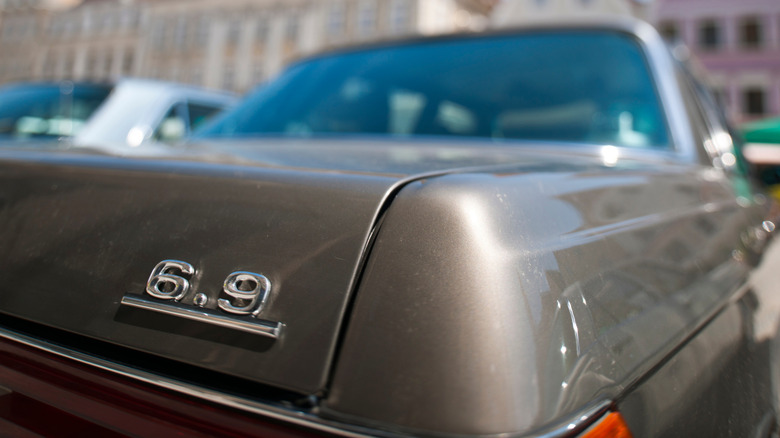
Before AMG started hybridizing the S-Class to push out mountains of torque, the first "Sonderklasse" to take performance to unprecedented heights was the 450 SEL 6.9. While the W116-generation S-Class debuted in 1972, it took three more years for the 6.9 to enter the market and an additional two years for it to reach U.S. shores. Such was the reception that Car and Driver's July 1977 issue called the 450 SEL 6.9 the best automobile Mercedes-Benz has ever sold to the public. As a replacement to its much-loved predecessor, the 300 SEL 6.3, the spiciest of the 450 SEL lineup (marketed in the States as simply the 6.9), used an upsized version of the hulking 6.3 M100 V8, first seen in the mighty 600 Grosser.
Although the 600 Grosser weighed about as much as a medium-sized mountain, at 2.5 metric tonnes (or 5,500 pounds), the 300 SEL was lighter, tipping the scales at around 4,000 pounds. And having the 247-horsepower Grosser-derived V8 meant it could clock a 0-60 mph time of 6.5 seconds and a top speed of 137 mph. Naturally, its 6.9 successor, with its larger engine and 286 horsepower (in European spec), pushed the top speed to 140 mph, although some sources claim it would go even faster than that). That made it the fastest production four-door sedan of its time, according to Hagerty, challenging the 1972 Jaguar XJ12 – a Series I super sedan capable of 140 mph. For context, Car and Driver recorded a 425-horsepower 1971 LS6 Corvette topping out at just over 150 mph.
Smooth and sophisticated
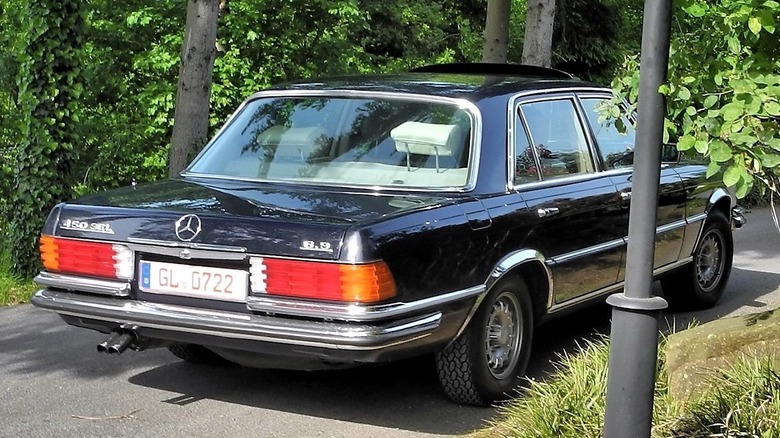
While you could argue that the updated Series II, which replaced the previous title holder, and the 6.9 were on par in terms of horsepower, the torque figures tell a different story — 294 pound-feet in the V12 Jag versus 406 pound-feet in the banker's hotrod. Series II XJ12s weighed around 4,300 pounds, while the 6.9 was closer to 4,400 pounds.
American emissions regulations at the time weren't kind to many cars, including the 6.9, so when it reached stateside, output dropped to 250 horsepower and 360 lb-ft compared — still robust numbers nonetheless. Since the car was porkier than its predecessor, the 6.9 wasn't as quick to hit 60 mph, evidenced by Car and Driver's test result of 7.1 seconds. But the publication seemed impressed by how silkier and more sophisticated it felt over the SEL 6.3.
Speaking of sophistication, the hand-built 6.9-liter V8 (or 6,384 cc, to be precise) was the largest European production car engine after World War II, using dry-sump lubrication, Bosch K-Jetronic electromechanical fuel injection, and forged internals, including crankshaft, connecting rods, and pistons. All that power was sent to the rear wheels via a unique three-speed automatic and a limited-slip differential. Suspension duties were handled by a trick Citroen-like hydropneumatic system, but with an improved design. Although it wasn't entirely immune to failures, much like the 6.3's air suspension. One of the testers at British magazine CAR went as far as to call the 450 SEL 6.9 a "genuine four-door four-seater hard-topped air-conditioned racing car," when it was pitted against the Rolls-Royce Silver Shadow, Jaguar XJ12, and Cadillac Seville.