

What Are The Differences Between Locking And Limited-Slip Differentials?
Broadly speaking, differentials can be categorized into open, locking, and limited-slip, and each of those types of differentials can be mechanical or electronic. In its most basic format, an open differential allows the inner and outer wheels to spin at different speeds when the car is taking a corner. This vintage film does a great job of explaining how differentials work. It's worth noting that open differentials struggle in low-traction situations because the torque on the wheel with better traction is limited by the wheel that's slipping, sabotaging acceleration. The engineering limits of open-diff vehicles are tested when they are introduced to a more performance/enthusiast setting, such as rock crawling or the race track, which often warrant an upgrade to either a locked or a limited-slip differential (LSD).
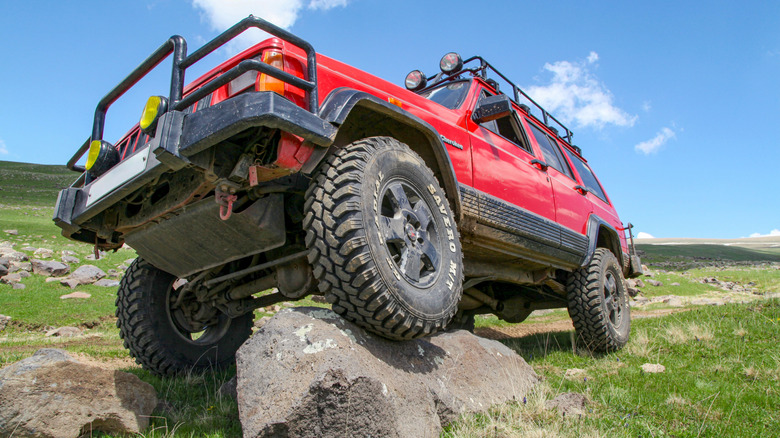
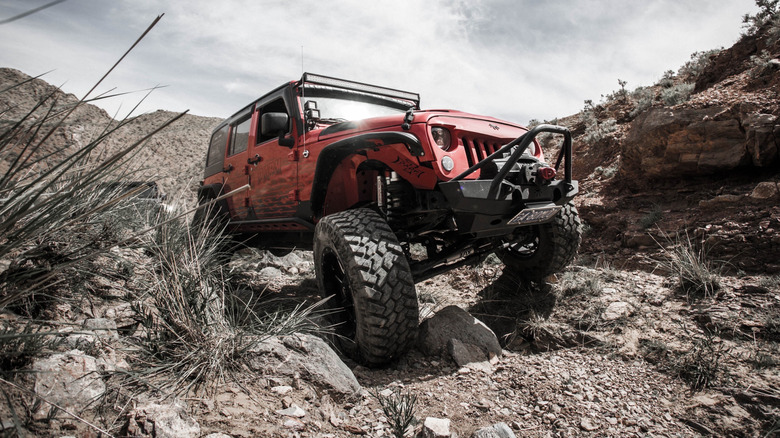
Off-road enthusiasts typically prefer locking differentials (or "lockers"), which are usually open but, as the name suggests, lock the axle shafts together under torque to allow power to be delivered to both driven wheels regardless of traction differences. However, the setup negatively affects the vehicle's turning ability as both wheels are now rotating at the same speed regardless of the differences in traction.
In contrast, limited-slip differentials can be considered a hybrid between an open and locking setup. They work like an open diff in most situations — allowing the vehicle to turn smoothly — but when there is wheel slip, a limited-slip differential sends more torque to the wheel with better traction. And although it allows both wheels to rotate at the same speed in certain scenarios, it doesn't fully lock the axles together like a locking differential does.
Types of locking differentials
There are various types of locking differentials, with the most basic distinction being automatic or manual/selectable. Depending on the system, some automatic lockers remain locked by default and unlock when necessary, while others do the opposite, remaining unlocked for the most part and locking the axles when there is traction loss. Although the convenience is an advantage, the system isn't perhaps the most refined or intuitive, as the engaging and disengaging sequence can be abrupt and may require a bit of getting used to.
Among the manual/selectable lockers are your cable-operated lockers, air lockers, and electronic or e-lockers. They are all typically more expensive than automatic lockers but offer greater control over the differential's operation. While cable-operated lockers often feature a lever next to the shifter to engage or disengage the locking mechanism, air lockers and e-lockers typically use buttons to get the differentials locked. Depending on the design, an e-locker may be clutch-based or use a locking collar, pins, or a set of dog teeth to mechanically lock the side gears together within the differential assembly. Air lockers, on the other hand, use compressed air to engage and disengage the locking mechanism.
Types of limited-slip differentials
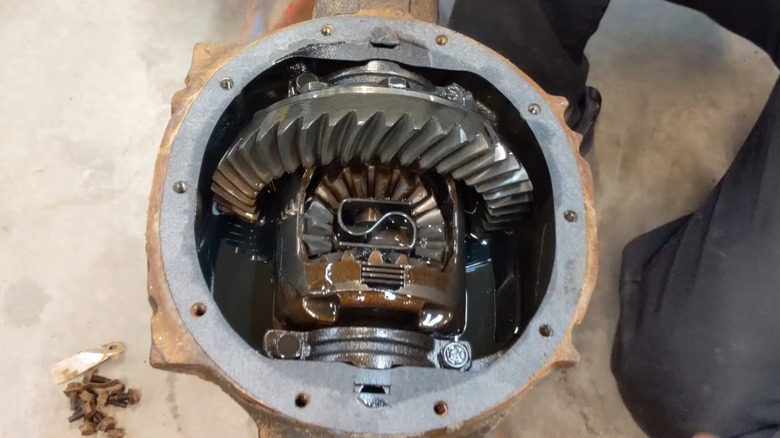
Limited-slip differentials are broadly classified into helical-type, clutch/plate-type, viscous couplings, and electronic or e-LSDs. Helical-type LSDs, which include Torsen and Eaton's Truetrac, use worm gears instead of clutches to allow the LSD to do its thing, while viscous coupling uses thick silicone fluid that heats up and thickens to locks the differential, and e-LSDs employ sophisticated computer algorithms and actuators to control clutch engagement and torque distribution.
Clutch-based LSDs can be further classified as one-way, two-way, or 1.5-way systems, with different power and coast characteristics. For instance, a one-way LSD locks up under acceleration, while a two-way setup locks up under both acceleration and deceleration, with the 1.5 being not as aggressive as the two-way at lockup under deceleration.
Although ideal for most daily drivers, many LSD systems are reactive in nature, meaning they don't lock up unless slip has already occurred. However, according to Eaton, e-LSDs can be programmed to anticipate slip through advanced algorithms. Something else worth mentioning is brake-based torque vectoring, where the system mimics an LSD by applying brakes to the slipping wheel, allowing more torque to be directed to the wheel with better traction. McLaren is an example, using an open-diff-brake combo in its supercars instead of an LSD.