

Do All 4 Of Your Tire Tread Patterns Have To Match?
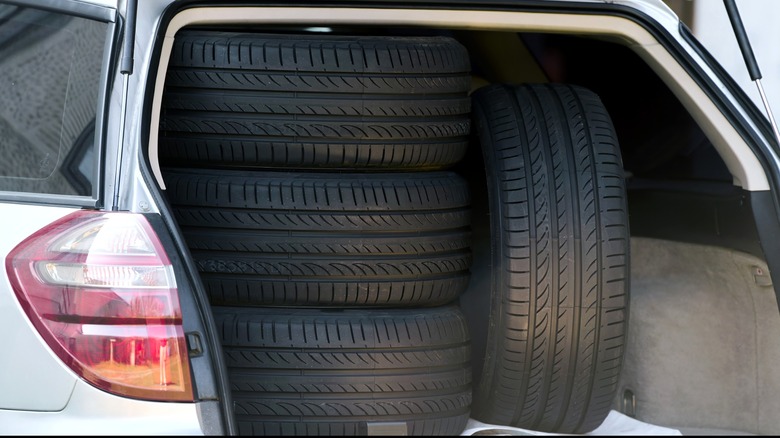
Mixing tires is usually a touchy subject due to budget issues and availability, and it comes with a diverse set of risks and potential issues. For example, installing tires with different speed ratings might give your vehicle an inconsistent ride quality, and it's often not safe and economical to use tires from different brands, either. In fact, Michelin insists that every tire on any vehicle should be of the same size, type, construction, load capacity, and speed rating. Continental adds that their "guidance is to fit the same tires on all wheel positions."
Industry experts generally recommend not mixing tires on any vehicle unless the manufacturer says so, including mixing tires with different tread patterns. That said, all four of your vehicle's tires must be the same size, kind, and type to meet the factory specifications regarding speed, braking, handling, stability, and load requirements. This includes matching tread patterns.
Tires come with symmetrical, asymmetrical, or directional tread patterns, and each performs differently. Symmetrical tread patterns are the most common. They are easy to rotate since they can be mounted in any direction, but they generally don't offer the best traction. Asymmetrical tread patterns are designed to perform well in both wet and dry weather. Meanwhile, directional tires deliver relentless traction on wet or snowy roads, but they're more expensive. Based on this, it's not hard to see why mixing tires with different tread patterns could pose handling, performance, or safety issues.
What if I have to mix my tire tread patterns?

Let's say the front all-season tires of your car have worn out faster than those in the rear. It so happens that you have a pair of used, all-season tires in the garage from a different brand that have no signs of visible aging or dry rot, are less than 6 to 10 years old, and have at least 2/32 inches of tread depth. However, they happen to be of a different brand and make than the rear tires in your car. Is it okay to mix the spares with the existing rear tires?
Assuming both spares are of the same brand and have the same tread pattern, then yes, Continental says it's okay to mix brands and tread patterns, but only if you pair tires of the same tread pattern and brand to the same axle. In short, the left and right tires in the front axle should be identical, and the same applies to the rear.
Things to know before mixing tires

Even if the tires are of the same brand, you should never mix tires of a different size on the same axle unless you're looking to make your vehicle act haphazardly or out of sync when steering, cornering, or braking, especially on wet roads. Another thing to consider is whether the vehicle has traction control, anti-lock brakes (ABS), or an all-wheel drive (AWD) or four-wheel drivetrain (4WD). Those systems require feeding of consistent rolling parameters to function optimally. Therefore, even if you use the same tires per axle, mixing tires with different tread patterns or sizes could interfere with safety settings and put unnecessary stress on the drivetrain.
For instance, Subaru recommends replacing all four tires at the same time, since the brand's symmetrical all-wheel drivetrain needs tires of the same size, type, and tread pattern to deliver optimum traction, grip, and control. Finally, the tread depth matters, too. If you insist on mixing tires, the pair with the deeper treads should be installed in the rear, and this rule applies regardless of whether the vehicle is front-wheel drive (FWD) or rear-wheel drive (RWD).