

Do Turbos Use Air-To-Water Or Water-To-Air Intercoolers?
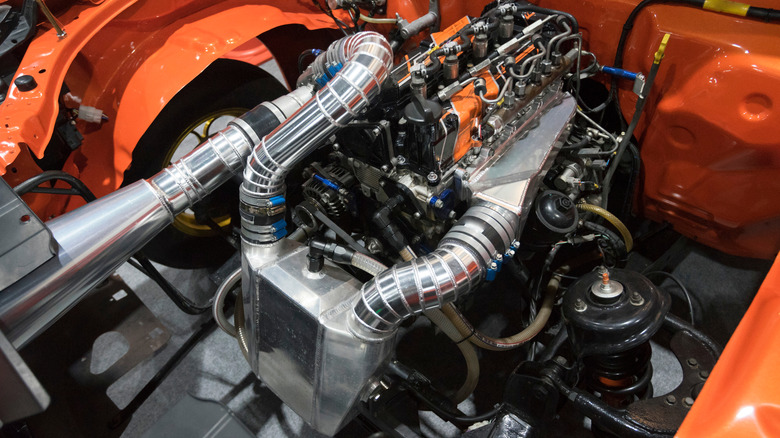
Saab opened the floodgates for reliable turbo performance back in the '80s, and automakers haven't stopped innovating since. BMW used single and dual turbochargers to make the most of its engines' displacements, and some brands have even put little electric motors in turbochargers to minimize lag, such as Porsche in the new 911 Carrera GTS T-Hybrid. One of the most commonplace aspects of turbocharging that ensures maximum power and efficiency is the use of an intercooler, of which there are two types: air-to-air and air-to-water.
The basic concept of an intercooler is that it cools the intake air after it has been compressed and heated up by the turbocharger. Like an engine's radiator, it's a form of heat exchanger. This is important, as hot air is less dense and therefore less oxygen-rich than cooler air, which means the engine won't produce as much power. It also means the engine control unit (ECU) must pull ignition timing to accommodate, which reduces power even more. However, when H2O is involved to help cool the air, is this an air-to-water or water-to-air intercooler? Let's survey what the professionals say and discuss what the correct nomenclature is.
How an intercooler works hints at the proper phrasing
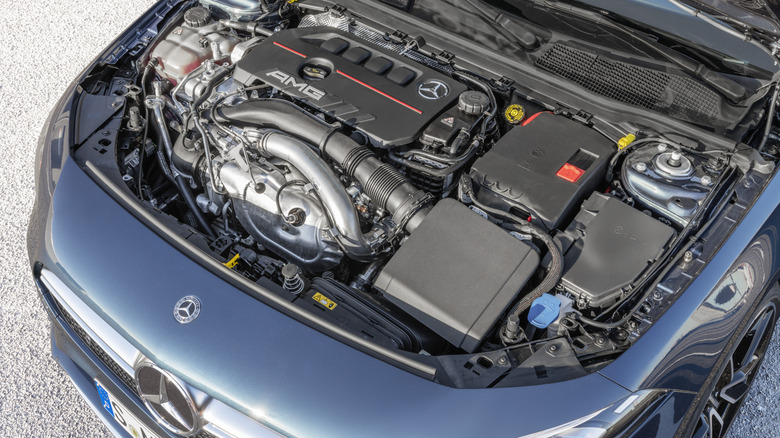
An air-to-air intercooler uses ambient air passing through its fins to cool the charge down. When water is involved, it passes through and pulls the heat out of the air, which is then pumped to its own heat exchanger to be cooled down on a loop. For example, the Mercedes-AMG A35 in the above photo utilizes an air-to-water setup from the factory. Based on this, one would assume it should be called an air-to-water intercooler since the heat transfers from the air to the water. However, the Society of Automotive Engineers (SAE) doesn't denote which is the proper nomenclature, but you'll find a myriad of sources, including Mishimoto and Engine Labs, using the term "air-to-water intercooler." Others, however, say "water-to-air," such as High Performance Academy on YouTube.
Based on what we found, it's most likely a simple dialectal difference, considering the former is based in Australia, and since a forum post on the Australians 300ZX Owners' Association forum uses this term, too. But as near as we can tell, both terms are simply interchangeable. Fight each other if you'd like, but both are commonplace — whether turbos use air-to-water or water-to-air intercoolers is just one of those things. Then again, the heat is going from the charge to the water, and turbos don't run on water, if you catch our drift.