

How Saab's APC Opened The Floodgates For Stupendous Turbo Power

Because turbocharging has become such a household method of increasing power in many cars' engines for a while now, it's hard to imagine a world without precision boost control. Modern sensors usually have no issue determining how far the wastegate should be opened, which controls the amount of exhaust spinning the turbine wheel and thus producing boost pressure. But hop in a time machine and travel back to the early '80s, and boost control was a bit more basic — especially when the Saab 900 Turbo was first catching the eyes of enthusiasts.
Back in the day, it was tough for automakers to squeeze more power out of engines via turbocharging without encountering dreaded knock or detonation, which could destroy an engine if left unchecked. But once Saab introduced Automatic Power Control (APC), it completely changed the game. Let's dive into why it was genuinely simple and such a neat and innovative technology for its era.
APC waves goodbye to turbo knock
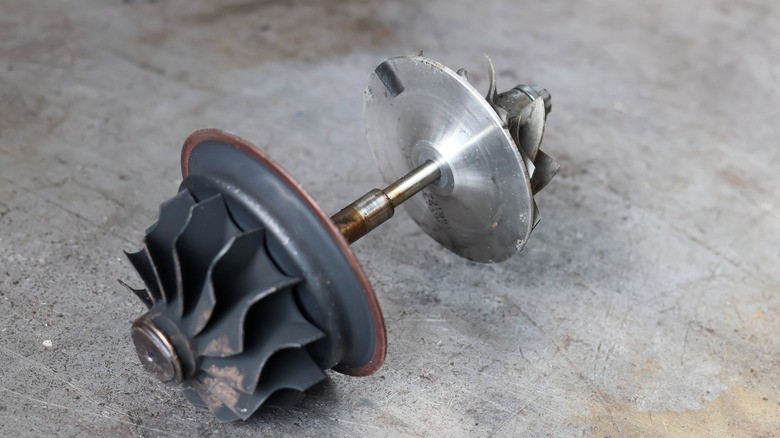
If you're a little unsure of how turbocharging works, it's simple: the engine's exhaust gas spins a turbine, which is connected via a shaft to the compressor wheel, which sucks in additional, pressurized air and sends it to the intake manifold. That air is cooled along the way by an intercooler, and when mixed with the appropriate amount of fuel, it creates more power than the engine would have without it.
Developed in 1980, APC centers around controlling exhaust gas flow with the help of the wastegate, which, by default, works by opening a door to let the exhaust gas bypass the turbine when boost exceeds a certain threshold, thus controlling the speed at which it spins. Lower turbine speed means less boost and less power. Higher turbine speed means more boost and more power.
In Saabs with APC, a sensor keeps an eye out for knock as boost pressure is being fed into the engine. Once knock occurs, instead of telling the ignition system to advance or slow down timing, APC triggers the wastegate to open, cutting boost pressure. "The small, accelerometer-like sensor is one element of a feedback loop, which also contains a compact electronic brain and a solenoid valve," Don Sherman wrote for Car And Driver back in 1980. "This valve is in turn plumbed into the boost-pressure line to the waste gate."
If there's no knock, the solenoid valve is modulated to control boost pressure up to the factory-limited 7.25 PS. When detonation is detected, the sensor tells the brain to move the solenoid and thus open the wastegate. This reduces boost pressure and prevents detonation before it can wreak havoc inside the engine.
Why APC makes turbo engines more powerful and efficient
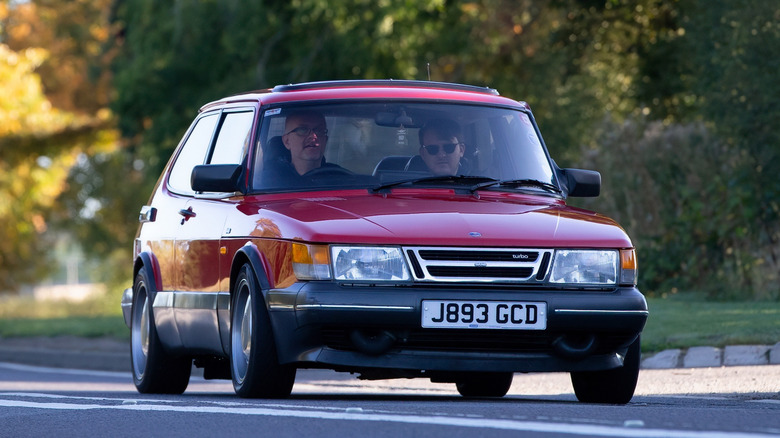
The effectiveness of a turbocharged system is heavily dependent on the octane rating of the gasoline that it's working with. The higher the octane rating, the more resistant it is to knock. The APC is always receiving data from a pressure sensor in the intake manifold, determining how much boost is entering the engine at any given time, and balancing it to feel as natural as possible. It responds in fractions of a second to avoid it, all of which allows it to make the most of whatever octane is being sprayed.
In fact, it's so effective that Saab was able to raise the 900 Turbo's compression ratio from 7.2:1 to 8.5:1, which improves throttle response when boost isn't in the picture and aids fuel economy. It also gave the Saab 900 better acceleration by giving it a nice, thick torque curve. For example, the pre-APC 1978 Saab 99 Turbo's 2.0-liter inline-four made 143 horsepower and 174 pound-feet of torque and hit the 60 mph mark in 9 seconds. Fast-forward to the APC-equipped 1980 900 Turbo, and output was essentially the same, but the 0-60 mph dropped to roughly 8.2 seconds.
This is all commonplace technology today, but it was ahead of its time back then. Plenty of other manufacturers worked to refine turbocharging before and during Saab's use of APC, but the quirky Swedes' efforts opened the floodgates for stupendous turbo power. We tip our caps to them for laying the groundwork for reliable turbocharged fun and helping pave the way for finely tuned boost control that we take for granted today.