

What Does It Take To Repair A Rusty Car Frame?
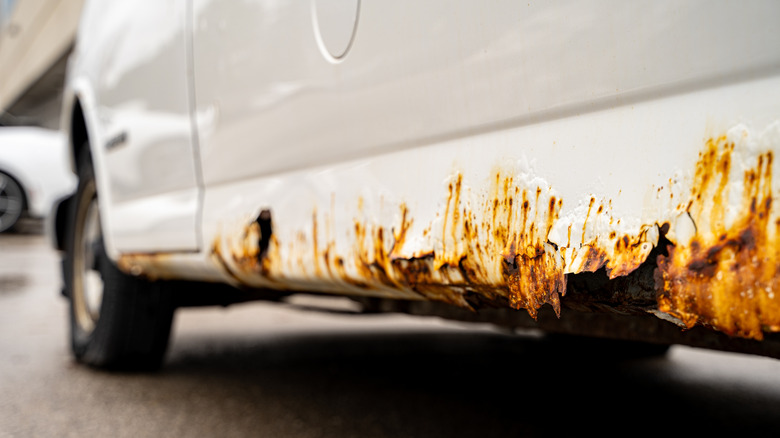
The short answer is, paying someone else to repair your rusty car frame takes an awful lot of money. Tackling it as a DIY project, though, will require some basic tools coupled with a lot of time and patience – and potentially hours of cutting and welding, depending on how bad the rust is. There isn't a great deal of good news when it comes to repairing a rusty old wreck, but the one glimmering light of hope for budding restorers is that the task at hand is entirely possible. Countless restorations completed in the past prove it is totally feasible, no matter how poor the starting point is.
How bad that starting point is will dictate how the rust is best tackled. If the frame has some light surface corrosion, the best approach will usually be quite simple and will require no cutting or welding. If, however, the frame is badly rotted with holes and cracks, the process is a lot more involved. Essentially, the steps include cleaning the area so the state of the frame can properly be assessed, cutting out the offending rusted parts, and following up by welding in fresh metal. We've shown how huge rust holes in the frame can be fixed by following this basic method in the past, but the reality of it is almost always far more challenging than theory.
How to tackle lighter surface corrosion on a car frame

In this instance, when the metal hasn't been fully penetrated by rust, it's entirely possible to make a repair without having to delve into the world of cutting and welding. The first step is always to prepare the car and the area. Ensure you have appropriate protective equipment on for the job, such as safety glasses, gloves, and a breathing mask, and also have the car somewhere accessible, be that on a ramp or up on axle stands.
Next, prep the area. Remove any loose rust (wire wool is a valuable tool here), and be sure to do a thorough job. Follow this up with a chemical rust treatment to ensure no rust spots are missed. Once this has cured according to the product's specific timeframe, scrub, clean, and dry the area in preparation for sanding. Sandpaper is great for tighter spots, while using sanding discs on an angle grinder will make light work of larger surfaces. Start with coarser grits first, such as 40 to 60 grit, and then work your way up the grit ladder, finishing with a fine disc grade — 180 to 200 grit will be fine for frame repairs. Make sure to let it dry thoroughly overnight or use heat lamps.
By this point, the frame should now be rust-free and ready for long-term protection. Considering the pros, cons, and risks of underbody coatings, an appropriate rust-inhibiting primer, filler (for any dents), and paint or sealant is a solid choice to keep your chassis protected.
A closer look at repairing major rust problems

You've told us before about the rustiest cars you've ever tried to save, so we know some Jalopnik readers will be all too familiar with this process. For a car frame that's so rusted it's become structurally weakened, the only real solution is to cut that rust out and replace it with fresh metal. But while cosmetic repairs such as fenders can be handled by most people, it's crucial to consult an authorized auto body shop for more structural frame repairs first.
As before, the first step is to prep the car and yourself, and then begin cleaning the area. Brush off loose rust, and then use something abrasive to clean it up further, so the condition can be properly assessed. You can then use an angle grinder to remove any compromised surfaces until you reach clean metal. At this point, the frame is ready for new parts to be welded in. If you have a repair panel ready, trim the frame to suit with the angle grinder. If you need to fabricate a repair piece instead, use cardboard to create a template for the hole. This will eliminate guesswork when it comes to cutting out a repair piece from fresh sheet metal.
All that's standing between you and a solid frame now is to weld that piece in. Tack-weld the piece first, and then stitch-weld around the perimeter to finish, alternating sides to avoid heating up one area too much. Now just clean up the welds with the angle grinder, dress them with seam sealer to prevent further corrosion, and complete the job with a rust protectant of your choice, be that primer and paint, or an alternative underbody coating.