

Chevrolet Considered Turbo-V6 Corvettes During The Late '70s Gas Crisis
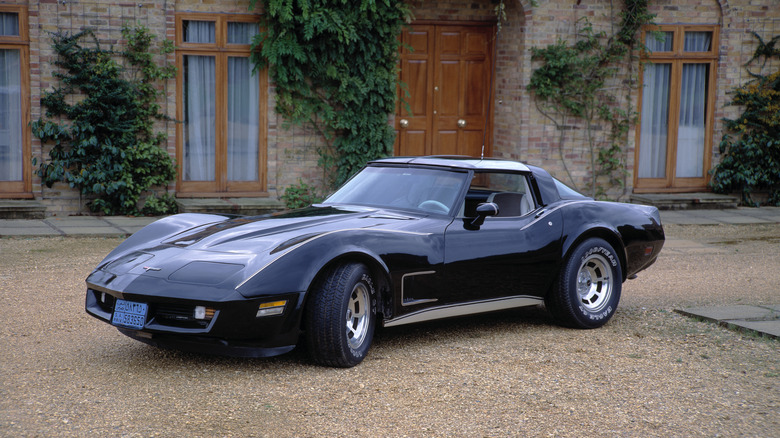
The new Corvette ZR1, along with its Nurburgring record-breaking hybridized ZR1X twin, is understandably a hot car at the moment. It's 1,064 horsepower and 828 lb-ft of tire-shredding torque shocked the car world when it first debuted, but all of that violent performance is thanks to its two turbochargers. While the ZR1 is the first-ever officially turbocharged Corvette, GM previously flirted with the idea long before. In fact, GM built a twin-turbocharged Corvette back in 1981 and get this — those turbos were strapped to a V6.
Diehard Corvette fans would be forgiven for the audible gasp they may have just let out. However, GM experimented with several different turbocharged engines in the late '70s and early '80s, including a couple of V8s. The fuel crisis of the 1970s wasn't kind to performance cars, and American automakers were looking for ways to improve fuel economy while maintaining power and performance. Turbocharging and downsizing are great ways to do that, if you can convince customers to give up their beloved V8s. Unfortunately, the idea of a V6 Corvette wasn't particularly well received by customers and fans. What did GM really expect, though? Either way, the Corvette wouldn't officially gain engine snails until this current-generation ZR1, which makes the C3-generation twin-turbo V6 'Vette a very unique part of the model's history.
The surprisingly high-tech V6 could have changed the Corvette's history
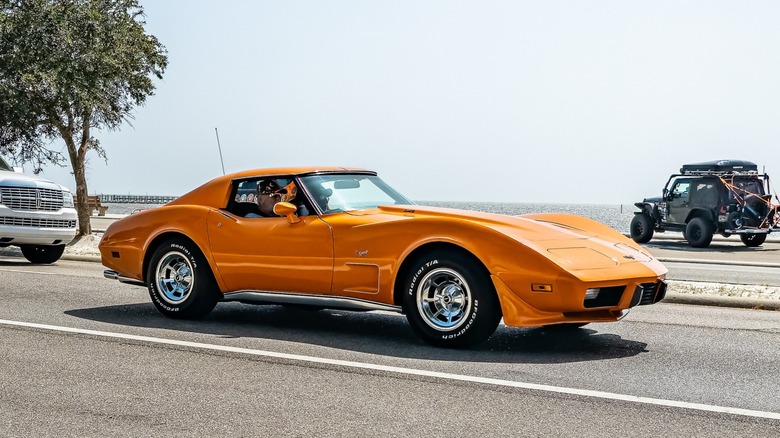
There's only ever been one six-cylinder Corvette, as the original C1 car offered a "Blue Flame" straight-six in its early days. Since then, no Corvette has had fewer (or more) than eight cylinders. However, that doesn't mean GM wasn't any good at making six-pots, even back then. In fact, the blown-six in the Corvette prototype was said to be pretty dang good.
According to Hot Rod magazine back in 1982, the team that tested Chevy's "Proto-Vette" was incredibly impressed. It wasn't just some standard V6 from any other Chevy with a couple of turbos bolted on; the Corvette deserved much more than that. So what it got was a heavily modified 229-cubic-inch (3.7-liter) 90-degree V6 that was bumped to an enormous 262 cubic inches (4.2 liters). It then got pistons from the Corvette's L-82 V8, the camshaft from a heavy-duty Chevy marine V6, and, of course, the turbochargers. The Warner-Ishi RHB-6 turbochargers had their own wastegates and produced a maximum of 9 pounds of boost.
All in, the Corvette's twin-turbo V6 made 270 horsepower with a lower state of tune and seven pounds of boost. But with the full-fat 9 pounds of boost, the V6 made 300 horsepower. For reference, the 350 cubic-inch V8-powered Corvette made 200 horsepower in 1982. Hot Rod claimed that the V6's throttle response was "instant without any lag," and it reached peak boost by just 2,400 rpm. At the time, the magazine declared that the V6 'Vette "runs like a rocket, is quiet, smooth, and very responsive." Sounds great, right? So why didn't GM build it?
If the twin-turbo V6 Corvette was so popular, why did the idea die with the prototype?
Timing has a lot to do with why the turbo Corvette didn't happen until 2025. When Chevy originally slapped in the twin-turbo V6, the Corvette was still in just its third generation, and while turbochargers had existed for a while, they were still pretty new to the automotive scene. Chevy dabbled with adding turbos to a V8 to keep traditional customers happy, but getting the turbocharger system to function better, while reducing weight, was proving expensive. The improvements in naturally aspirated engine technology didn't help the turbos cause, either.
So, for the C4-generation Corvette, which debuted just two years later in 1984, GM went to plain old V8s. Ironically, tuning company Callaway ended up making a twin-turbo package for the C4 in 1987 that GM was so impressed with, you could order it from GM and have it installed at the dealer. It was called the "RPO B2K" option, and it bumped power to 345 horsepower and 465 lb-ft of torque, astonishing for 1987. In fact, in one-off Callaway Sledgehammer form, it was even faster than a Bugatti Veyron. Despite the impressive performance of the Callaway B2K Corvette, Chevy wasn't convinced enough to make a turbo 'Vette until almost 40 years later.
It could be that customer demand wasn't there or that customers feared potential reliability concerns from the added engine complication. This caution certainly wasn't helped by Callaway's test car having a catastrophic failure while Car and Driver was testing its top speed. Either way, whatever the reason, customers spoke with their wallets and continued to buy Corvettes powered by old-school American iron, and the twin-turbo V6 Corvette ended up as the least significant of footnotes in the model's long, impressive history.