

Does A Muscle Car Necessarily Have To Be American?
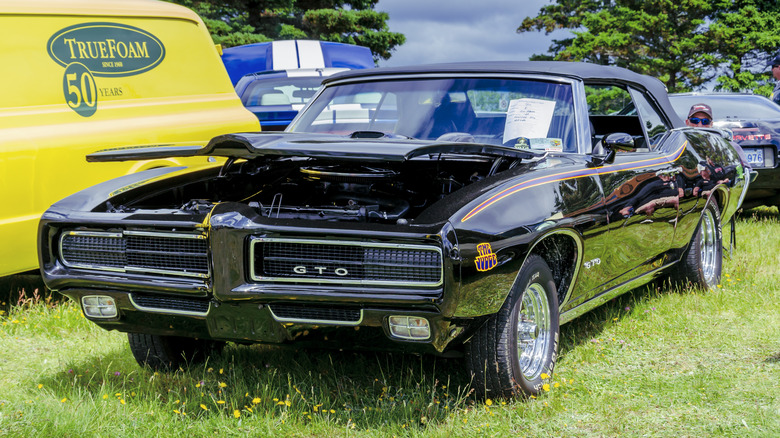
The Merriam-Webster dictionary defines a muscle car as "any of a group of American-made two-door sports coupes with powerful engines designed for high-performance driving." Clean, simple — and for a lot of enthusiasts, final. However, that tidy dictionary entry glosses over decades of genuine disagreement. The term "muscle car" simply is not clearly defined, and which models actually qualify is often disputed.
Even pinning down where it all started is difficult. Some trace the muscle car's origins all the way back to the 1949 Oldsmobile Rocket 88 — a full 15 years before the car most history books credit as the first. The car in question came into being when John DeLorean's team dropped a 389 cubic-inch V8 from the full-size Pontiac lineup into the mid-size Tempest, and found a clever loophole past GM management that prohibited mid-size family cars from using engines larger than 330 cubic inches. That car, of course, is the 1964 Pontiac GTO.
Detroit ran with it, but the idea didn't stay within the U.S. The recipe traveled to (besides other places) Australia, Germany, the U.K. — and when you look at what came out of those places, you start to wonder whether nationality was ever really the point, or just where it first got a name. So, does a "muscle car" necessarily have to be American? Here are the cars that make the argument interesting — and the cases for both sides.
The cars that suggest muscle cars need not be American
A large-displacement V8, a mid-size body, rear-wheel drive, and a relatively attainable price. If you run that checklist against what Australia was building in the late 1960s, the results are hard to argue with. The Holden Monaro debuted in 1968 with big V8 power, two-door coupe proportions, and a relatively attainable price. Funny enough, the Monaro remains one of the coolest classics almost nobody in America bothers to import — perhaps because admitting it belongs in the conversation would mean admitting muscle cars were never exclusively American.
However, America did eventually acknowledge the connection: GM later rebadged a modernized Monaro and sold it to the U.S. market as the 2004 Pontiac GTO. The brand that many believe invented the culture, imported a car made in Australia as its own "muscle car." Then there's the Australia-only Ford Falcon GT-HO Phase III — a 351 Cleveland V8 Ford, the proportions, and the title of fastest four-door production car in the world at the time.
Europe made its own case in 1968. A Mercedes engineer named Erich Waxenberger — without his bosses' knowledge — pulled the 6.3-liter V8 from the flagship 600 limousine and shoehorned it into a standard 300 SEL. The result was, by many accounts, a German muscle car that hit 0-62 mph in 6.5 seconds with a top speed of 137 mph.
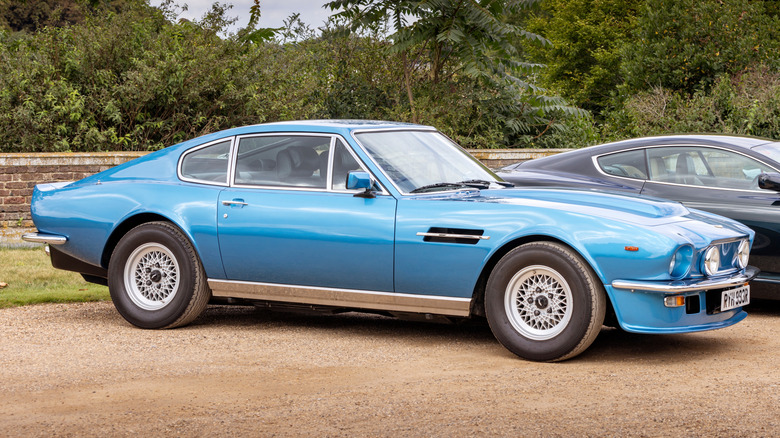
Similarly, the 1977 Aston Martin V8 Vantage packed a hand-built 5.3-liter V8 into a two-door body, hit 60 mph in 5.3 seconds, and topped out at 170 mph — fast enough to edge out the Ferrari Daytona. AutoEvolution notes that its proportions earned it a nickname of a British muscle car. Detroit would certainly recognize the recipe, but whether that's enough to earn the title is another question entirely.
The reasons why muscle cars should be American
Looking like one, driving like one, even being built like one — none of that necessarily makes it one. The muscle car isn't just a formula; it's as American as baseball and apple pie. The classic muscle car era was a distinctly American cultural phenomenon — cheap gas, drag strips, and the Big Three locked in an all-out horsepower war that was as much about brand identity as performance. You can't separate the car from the context it was born in, no matter the engineering.
The Aston Martin V8 Vantage never called itself a muscle car, but rather a supercar. The muscle car label got applied retroactively — by journalists, by enthusiasts, by anyone trying to stretch a definition that was never envisioned for it by the automaker. At its core, even the difference between a muscle car and a pony car starts with one word — American. Everything else is a conversation about inspiration, not identity. In the same way Champagne is defined by where it comes from.
Everything else — no matter how many bubbles, no matter how well-made — is just sparkling wine. The Merriam-Webster definition doesn't say muscle cars need a big V8 and rear-wheel drive. It says American-made, and that word isn't an oversight.
But just because the dictionary says something, it doesn't make it true. Whether you're team U.S.-only or you think muscle cars can come from anywhere, cast your vote and join the never-ending argument.