

What Does Porting An Intake Manifold Do For Engine Performance?
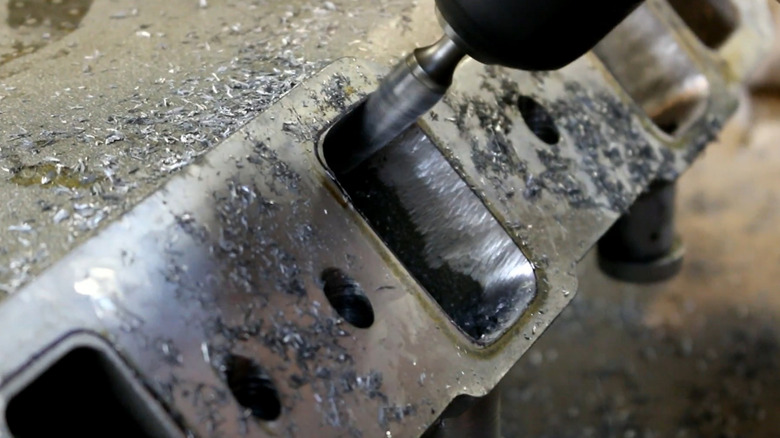
Porting an intake manifold essentially helps increase airflow into the engine. Improved airflow equates to more horsepower and helps the engine feel more responsive at the throttle. A standard intake manifold — particularly on an engine that isn't performance-oriented – has rough surfaces and sharp edges within it that all reduce airflow. Porting is the art of smoothing out these surfaces and rounding off those sharp turns to improve airflow. Fewer restrictions mean a higher volume of air can pass through the intake — measured in cubic feet per minute (CFM) – resulting in more power.
Porting an intake manifold won't turn a four-cylinder EcoBoost into a Shelby-slayer, but it can net solid returns, with some industry experts putting the power gains between 10 and 20% on some applications, when done correctly. Although it's worth mentioning that gains can be minimal or even negative when done incorrectly, too. To really maximize the effects of a ported intake manifold, supporting performance modifications are generally required.
Porting is especially welcome for high-revving and naturally aspirated engines that don't have a turbo to help force more air into the engine, which is another reason why we all should have purchased Honda S2000s while they were cheap. For even more power gains, though, it's also well worth porting the cylinder head, exhaust manifold, and turbocharger (if one is there).
How to port an intake manifold yourself
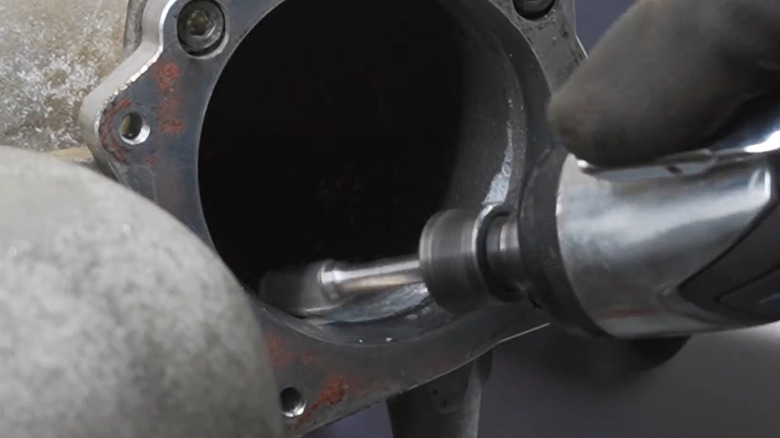
Having a professional engineering shop port the intake manifold usually costs upward of $200, with more advanced jobs being closer to $1,000 or more. However, with some basic tools and a can-do attitude, port-matching could be one of those cheap spring tune-up jobs you tackle yourself, saving a considerable sum of money. Port-matching is a type of porting that looks to match up the diameters of two openings, such as the ends of the runners on your intake manifold to the port openings on the cylinder head. The tools required are fairly basic and accessible. A DIYer will need a die grinder (air or electric), carbide bits, extended shanks, sanding rolls, abrasives, and flap wheels, along with safety equipment to keep metal shavings out of their eyes and face.
First, the intake manifold should be removed, allowing the use of the gasket as a template for showing how much material to remove when port-matching. Simply use the gasket as a guide to mark the material that needs to be removed. Carefully measure the ports with calipers to avoid over-porting. Now, simply begin grinding away with the die grinder. Be mindful not to remove too much from below the gasket line, and avoid creating a balloon-like shape, as this could hinder airflow. Following on, use the sanding rolls to gradually smooth the surface to a fine finish before using the flap wheels to round off the edges within the manifold itself.
The pros and cons of intake manifold porting
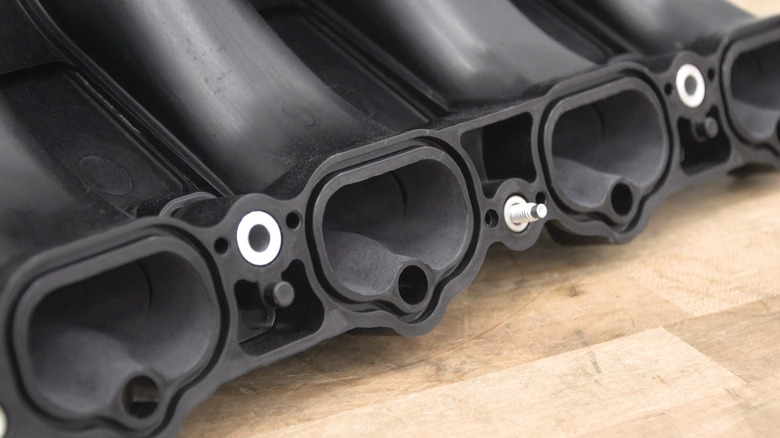
Some of the initial cons of intake manifold porting are quite obvious. First of all, if this isn't a job you feel comfortable tackling yourself, it can get quite expensive and might not be the best bang-for-buck car mod to start off with. For example, a simple engine control unit (ECU) tune could cost roughly the same, and net more notable power gains if your car is turbocharged.
Secondly, you might mess it up. As mentioned, incorrectly port-matching can actually harm the airflow within your intake system, netting you the opposite result. Furthermore, the pursuit of top-end power from porting could come at the expense of low-end torque as the larger openings mean the same volume of air can move more slowly through the manifold. Depending on your personal drivability goals, it may be preferable to keep the factory torque level, rather than pursuing top-end power figures. However, while intake manifold porting will never net huge results on its own, it's a great and effective modification that works especially well in conjunction with other supporting tweaks, so it's well worth considering as an aspect of a larger build or as a standalone modification.