

This 7-Series Flagship From The '80s Was The Second Turbo Road Car BMW Ever Produced
The 1973 BMW 2002 turbo was the first turbocharged production road car from Europe, and it landed right smack in the middle of an oil crisis. Then, as now, the efficiency of turbochargers helps turn exhaust into oomph, extracting more power from an engine without making it larger. BMW proved that a compact, 2.0-liter four-cylinder car with two doors — hence 2002 — could upend performance expectations. Sure, its primitive boost lag could be timed with a sundial before arriving with ferocity. So when it came time for their next trick, what did those Ultimate Driving Machine engineers do? They stuck a turbo in a 7-series. Because nothing says luxury flagship like a sudden shove in the seat at 4,500 rpm.
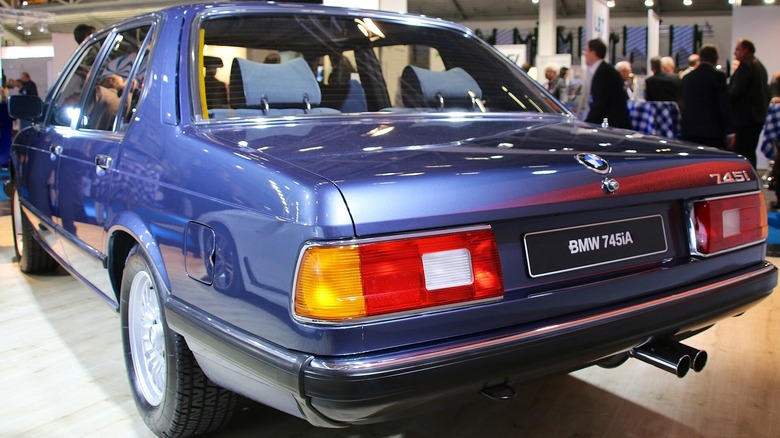
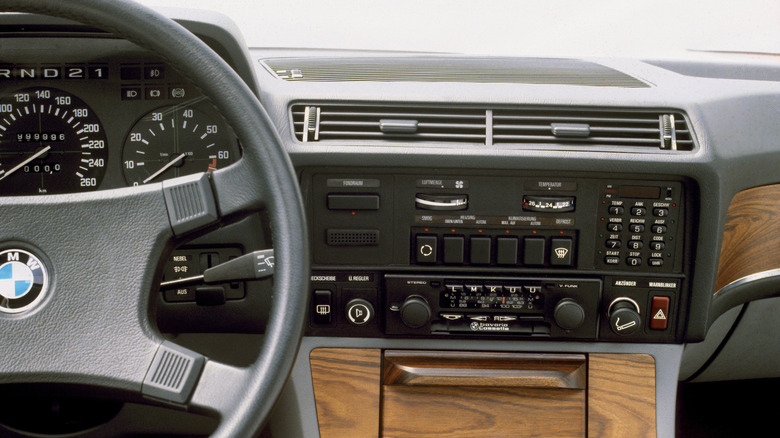
The European 1980-1986 BMW 745i was the second turbo road car BMW ever produced, and it lives in the Venn diagram center where lunacy, sensibility, and urgency overlap. It was big. It was quick. It could ferry five people in style, and was equipped with a ZF three-speed automatic transmission, which was later updated to a four-speed. And it featured a standard electronic anti-lock braking system to bring its heft to a halt — a pricey option on its Mercedes competition.
But, in spite of its badge, and unlike that luxury rival from Stuttgart, it didn't have a 4.5-liter engine. Before the 745i, and throughout its history, BMW badges generally telegraphed engine displacement. There's a charming, boastful math behind the name of the car that broke the mold, and helped pave the way for modern BMWs.
When names were engines, and engines were names
The 1977 BMW 320i featured a 2.0-liter four-cylinder (before pulling a switcheroo for a 1.8-liter in 1980). The (relatively) recent 2006 330i had a 3.0-liter inline-six. Simple. Memorable. Elegant. Now? BMW vehicles that contain "40i" — such as the 440i, or 740i — have 3.0-liter engines. Names like "X5 xDrive40i" don't exactly roll off the tongue. When you lead the way in road test scores as BMW does, changing naming schemes is certainly not a deal-breaker. It's just a bit arbitrary. However, the name "745i" was not arbitrary.
Blessed with a 3.2-liter inline six, the 745i should have been the 732i turbo, or 732it. It was called the 745 because, with turbocharging, the BMW 3.2 was capable of matching the output of a 4.5-liter engine. Which 4.5-liter engine? BMW wanted to put a 4.5-liter V12 into production, but it was too thirsty. The real bogey was the 4.5-liter V8 of the Mercedes 450SEL, which had about 220 horsepower. The 745i brought 252 hp to the club.
BMW urgently needed a flagship to run with that S-Class, and stuffing a turbo in a gasoline-powered executive car in 1980 was a bold move — not unheard of, but turbos were still more common to diesels, sports cars, and quirky-cool Swedes. BMW's problem was that the 450SEL also came in a that's-not-my-name version: the vaunted 450SEL 6.9, with 250 hp and 360 foot-pounds of torque at 2500 rpm in U.S. guise, wrapped in a Mercedes tuxedo that was built like a vault.
A different take on luxury and performance
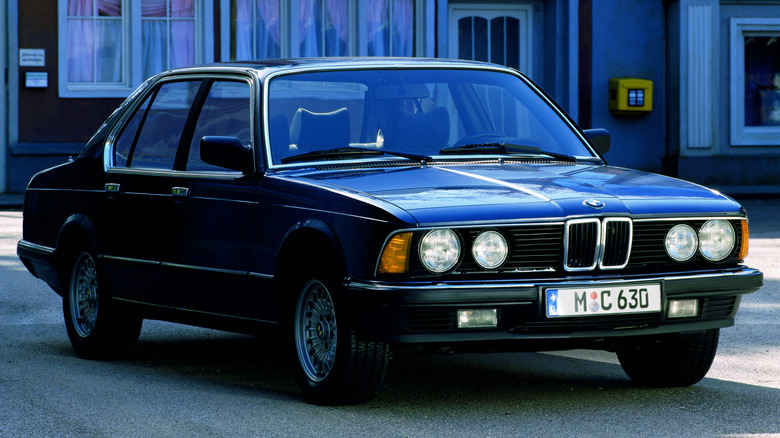
The on/off nature of the 745i turbo's engine didn't exude smooth luxury, despite a return valve that kept the exhaust turbine spinning when drivers slightly eased off the gas. Its character was most available on full boil, and it had lower gearing than a comparable Mercedes, which didn't help fuel economy. Perhaps the V12 would have been a better bet? There was a sport package available, with Michelin TRX tires and a self-leveling hydro-pneumatic suspension, to help keep things planted. The compromise was a stiffer ride that — coupled with BMW's tight steering — made for a decidedly performance-oriented, Ultimate Driving Machine skew on luxury.
The 745i didn't have a catalytic converter and was never officially sold in the U.S., but gray market imports can be found on U.S. roads. There was also another BMW 745i in production between 1984 and 1986 — and it didn't have a 4.5-liter engine, either. It was a special model built for the South African market. Engine and turbo packaging in the Euro 745i were incompatible with right-hand drive. So BMW dropped the 3.5-liter straight-6 M88 from the legendary M1 supercar into the 745i SA.
The 745i would be the last turbocharged gasoline engine in a production BMW until the 2007 E90 335i sedan and coupe arrived, but its legacy lives on. Every series in the current lineup features turbocharging, from 2 to Z. If you want a new, non-turbo BMW in the U.S., you're buying electric.