

The Corvette ZR-2 'Big Doggie' Almost Brought Big Block V8 Power To The 1980s Sports Car Fight
It's always fascinating learning about a concept car's backstory. Some entered production looking pretty darn close to their original design, like the Audi TT, whereas others were case studies used to satisfy engineers' eternal "what-if?" curiosities — especially when it comes to powertrain possibilities.
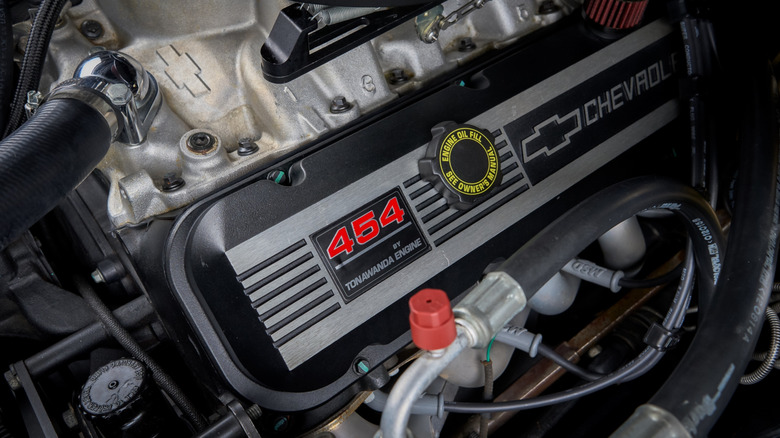
One of those possibilities was conjured up by GM's nerds working at its proving ground in Arizona in 1989, and focused on the Chevrolet Corvette. The standard, single-cam L98 V8 during that era of the C4-generation Vette was a good time, and the (soon-to-debut) dual-overhead-camshaft LT5 V8 had a lot of fascinating engineering behind it, thanks to Lotus. But what about the good ol' 454-cubic-inch V8?
With some minor modifications, they made it work and, by gum, GM's engineers had a good thing going. They even dubbed it the Corvette ZR-2 "Big Doggie." But there were various reasons why it ultimately wasn't tossed into the production Corvette lineup. Here's why the Corvette ZR-2 "Big Doggie" almost brought big-block V8 power to the 1980s sports car fight.
Big doggie vs. little doggie
The Big Doggie – captured in the video above around the 0:25 mark — started out as a "what-if" at the hands of GM engineer Scott Leon and his colleagues one night after work. Could a 454 fit between the Vette's frame rails? As told by K. Scott Teeters for MotorTrend, "Using an old '84 mule car, the crew was surprised to find that the big Rat [meaning, the 454] fit into the frame with only a few minor chassis modifications."
They then whipped up a system of tuned-port fuel injection, plus a modified tunnel-ram intake manifold. Toss in a little welding and some fuel injectors from the Buick Grand National, and voilà: it made around the same power as the then-in-production LT5-powered ZR-1 (not the latest ZR-1 that stole five track records) and undoubtedly more torque. We say "around" and "undoubtedly" because it was never thrown on a dyno — these are the engineers' estimates.
For comparison, when the ZR-1 went on sale a year after the Big Doggie was cobbled together, its LT5 made 375 horsepower and 370 pound-feet of torque. Despite coming in at 5.7 liters of displacement — compared to the 454's 7.4 — it was sadly never dubbed "Little Doggie."
The Big Doggie concept was somewhat reserved. The only discernible change in aesthetics was a slightly higher hood to accommodate the 454's girth — the rest was more of an "if you know, you know" scenario. The three finished prototypes sported the Chevy catalog's Z51 performance suspension, a six-speed manual transmission, an orange paint job, and not much else. Okay, the bright orange would certainly convey that this was indeed something special, but it's not like it had widened bodywork, excessive badging, and other "look at me" accessories.
Who killed the eclectic car?
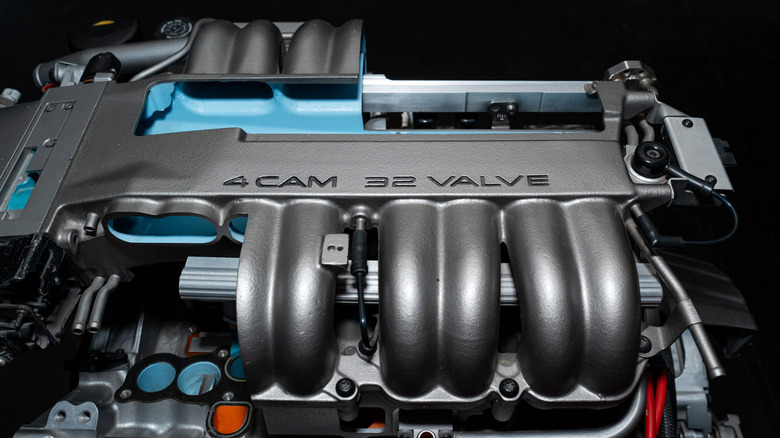
The ZR-2 Big Doggie never went into production. GM had bought Lotus and sunk so much into the ZR-1's development that it wasn't willing to scrap it all just to throw in the trusty ol' 454, which had been kicking around GM since 1970. Having two engines that made around the same power — albeit allegedly far more torque in the 454 — doesn't make a whole lot of sense. Additionally, it would've been tough to meet the era's emissions and fuel economy standards.
There was discussion around making the ZR-2 into a swap kit in GM's performance parts catalog, but that never came to be, either. A cursory search of Barrett-Jackson auction history reveals that one of the Big Doggies was sold at Scottsdale in 2009 with a bill of sale, as it was never titled. This helped GM raise some funds in the wake of the 2008 financial crisis and all the harm that it had endured during the era.
Between its healthy-for-the-era power output, Z51 suspension, and simply fascinating backstory, the Corvette ZR-2 Big Doggie almost brought big-block V8 power to the 1980s sports car fight.