

Here's How To Find A Hidden Tracking Device On Your Car
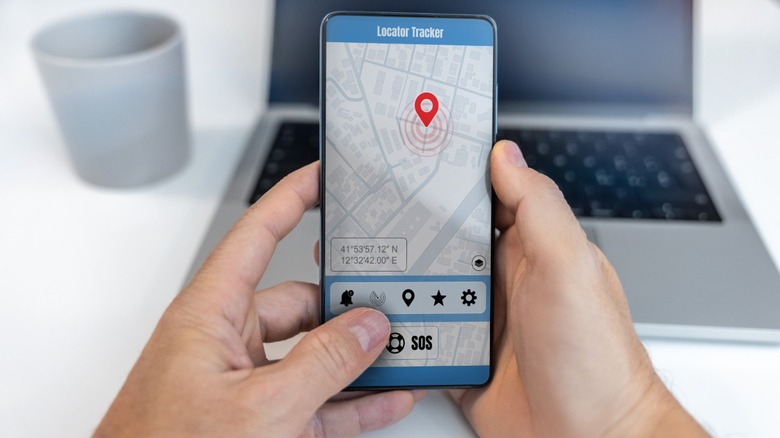
Stalking has been a widespread problem for some time. As technology progresses, stalkers are becoming more sophisticated and using tools such as tracking devices. For example, a 2024 study carried out in the Australian state of New South Wales found that one in four people who buy tracking devices have a history of domestic violence. Make no mistake, this is a form of abuse. If you find yourself in this kind of situation and suspect this person is monitoring your whereabouts, don't dismiss your worries as being "in your head."
How do you know if your car has a tracking device? There may be signs, such as your car's electronics acting in odd ways or your car battery not holding a charge as well as it used to. On the other hand, there may not be obvious signs, which means you'll need to look for the tracker. The good news is that there are devices and smartphone apps that can detect trackers. There are also places where these trackers are commonly found, like the undercarriage or inside the wheel well.
Of course, these devices can be used legitimately, such as when one man used an AirTag to find his stolen BMW. And it's important to note that there are reasons outside of stalking and domestic abuse why a tracking device might be placed on your car. Some of these reasons are even legal. That's why it's important to know your rights and seek help when needed.
Signs you might have a tracking device on your car

Some trackers have their own batteries, while others are hardwired to your car's battery. If it's the hardwired type, your battery may start draining faster than normal. Dash lights and other displays in the car may begin to flicker. You could hear static whenever you turn on the radio. You may notice an unrecognized device in your phone's Bluetooth settings. In one case, a man used the Tesla app to stalk his estranged wife through a co-owned Model X.
There could be physical signs, too. Maybe you've noticed wiring that seems out of place. Sudden rattling could be a sign that your car was tampered with in order to install a tracking device. The same could be said of loose screws or panels that appear to have been tampered with. Of course, none of these things in and of themselves mean that a tracking device was definitely placed in your car, but they're important to keep in mind.
In addition to being observant of the condition of your car, take note of the behavior of the people around you, especially the person you suspect of tracking you. Common sense would suggest that if they seem to know where you've been, even though you've never told them, that could be a sign. Another common sense indication is noticing cars following you.
Where to look for a tracking device
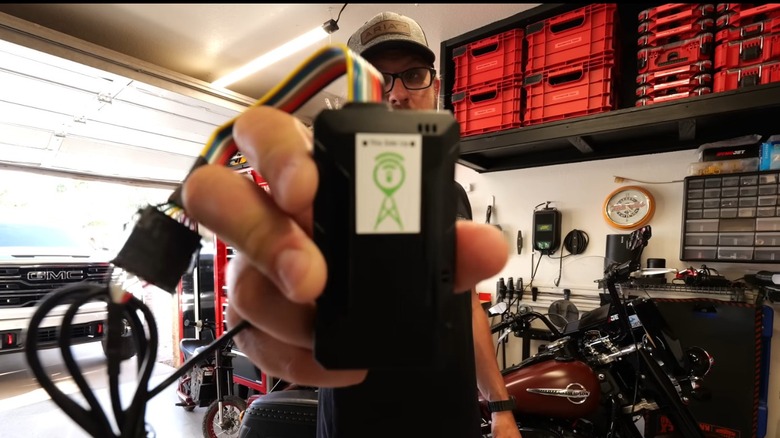
What are you looking for, exactly? Sometimes a tracking device could be as simple as an Apple AirTag or a phone that was somehow left in your car. Other kinds of trackers include devices attached via a magnet to the exterior of your car. These are often self-contained and powered by their own batteries. The kind that are hardwired to your car's battery are often installed in the interior. One type that should be easy to spot is plugged into your OBD-II port — much like an OBD-II scanner.
But there are other places to look inside your car. For example, under the dashboard is a popular place, and inside the glove box is another. Look beneath your seats and behind them, as well as under your steering wheel. Of course, the easiest place for someone to stick a tracking device on your car is on the exterior. So, look inside your bumper, license plate area, front grille, and wheel wells, as well as the undercarriage.
There are apps and devices you can use, too. AirGuard, for example, is an app you can download to your phone to detect AirTags and other smart tags, and it's available on both the App Store and Google Play. You can also use devices like bug detectors and RF detectors. Plus, you can check your phone for unfamiliar Bluetooth devices.
Is tracking legal?

Tracking is illegal in most cases, as it's a serious violation of privacy. Illinois makes it illegal in two statutes, one of which is its anti-stalking law. Minnesota makes it illegal to attach a mobile tracking device to someone else's property unless under court order or if the owner of the property has given consent. New York's anti-stalking statute makes it illegal to follow someone for purposes related to stalking, and defines "following" to include using a GPS or other device. Oklahoma gives this its own statute, prohibiting putting a GPS device on another vehicle without the consent of that vehicle's owner. And federal law makes it illegal if state lines are crossed.
You may have noticed that a couple of those laws specified that this is a crime when done without the consent of the vehicle owner. You may have unwittingly given your consent in paperwork you signed if you bought your car at one of those "buy here, pay here" dealerships. So if you do find a tracker, double-check that paperwork you signed with the dealership.
Another legal way a tracker can be put on your vehicle is if law enforcement does it, but only in some cases. The Fourth Amendment of the U.S. Constitution prohibits unlawful search and seizure, and that applies to sticking a tracker on your car. The police generally need a warrant to do this.
What to do if you find a tracking device
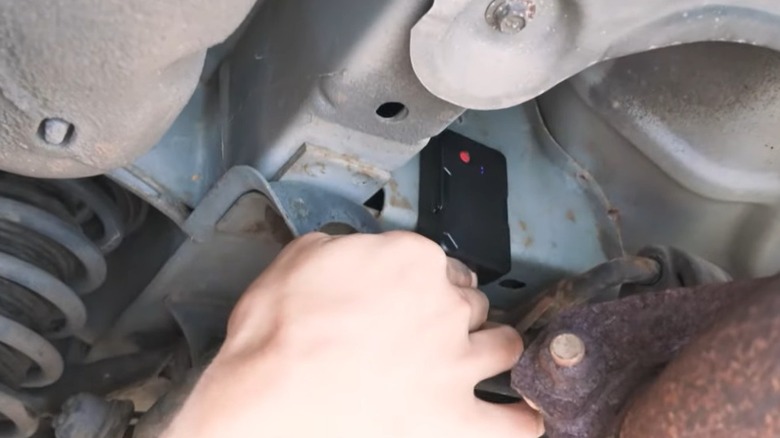
What should you do if you find a tracking device? Your first impulse will likely be to rip the thing off. Resist that impulse, especially if you're in a situation involving stalking or domestic violence. Removing the device will tip off the stalker that you found it, and may antagonize them. It's best to call law enforcement and reach out to an agency that can help. The folks at the National Domestic Violence Hotline at 1-800-799-7233 can help walk you through what your first steps should be and create a safety plan for you. You should also avoid using any device that you share with the abuser to make calls to the hotline, contact law enforcement, or search for information about tracking devices. Use a friend's phone instead.
Even if you are not in a domestic violence situation, you should still not remove the right away if you believe someone placed it your vehicle illegally. The tracker is evidence, and calling the police first is still your best option. If you must touch it, wear gloves so you don't leave fingerprints or interfere with the offender's fingerprints. Instead, take photos of the device and its surrounding area. Make note of the date and time you found it, as well as any serial numbers you can see.
What if law enforcement put a tracking device on your car?

It's a whole different thing if law enforcement placed the tracker on your car. To put the tracker there legally, law enforcement would need a court order — this was decided by the U.S. Supreme Court in 2012 in United States v. Jones. That means that removing it without authorization is a legal grey area.
In 2018, as Vice reported at the time, an Indiana man removed such a tracker from his car and stored it in his garage. The police used that as probable cause to search his home, arguing that the man's actions were theft of police property. The Indiana Supreme Court ruled that the man's actions weren't theft, and the search warrant for his home was invalid.
As we indicated before, the tracker could also be there legally if you're financing your car through the dealership or leasing it. Dealerships don't want you to pay that car loan off right away, but they do want to be able to find a vehicle that's in default so that it's easier to repossess.
What if you think the police or the finance company put the tracker there illegally? Contact an attorney who can advise you on the best course of action. This would be a good time to point out that nothing you've read in this article constitutes legal advice. We're not lawyers here, so it's best to get advice from the experts.