

What's The Difference Between Anti-Seize Lubricant And Threadlocking Adhesives?
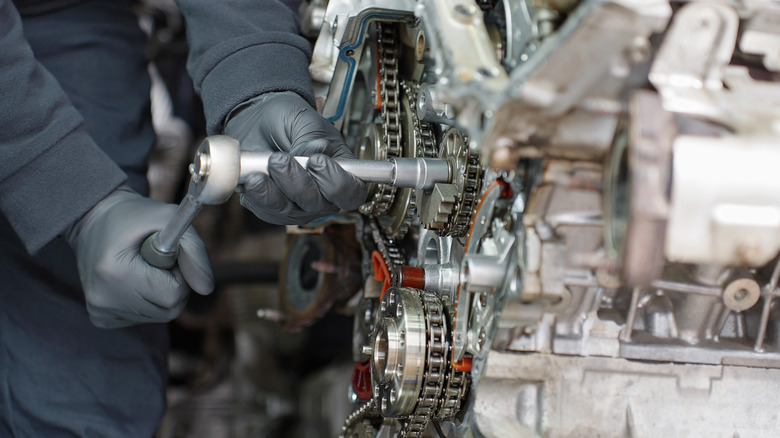
Although both anti-seize lubricant and threadlocking adhesive are often used on the same kind of parts, their main functions really couldn't be more different. You probably don't need us to tell you that, essentially, a lubricant is slippery stuff engineered so that parts slide against each other with added ease, while the primary use of adhesive is to make sure parts stick together.
To be more exact, we're talking about threaded parts today — usually fasteners, like bolts — which have machined threads cut into them so they can be screwed into place. (Note, however, that spark plugs don't need anti-seize lubricant despite the fact they have threads.) The lubricant does indeed prevent parts from sticking together, making life easier for mechanics. Yet that's only one benefit of the stuff. Anti-seize lubricants have additives included, too. As a result, the same layer of lubrication that forms between the parts to prevent friction prevents other types of damage as well. Typically, that barrier helps parts resist the high pressures and high temperatures found in the engine bay, for instance, plus it can help prevent corrosion.
Anti-seize lubricant comes in three basic flavors, depending on just what the lubricant's base is. That, in turn, is tied into temperatures. Aluminum-based anti-seize, for example, is effective at up to 850 degrees centigrade, which is considered moderately warm in the auto world. Copper-based anti-seize products can withstand up to 1000 degrees centigrade, with nickel used as the base in anti-seize lubricants exposed to extreme temps of up to 1300 degrees centigrade – and is usually reserved for marine applications like cruise ships' multiple diesel engines.
Unlocking the secrets of threadlocking adhesives
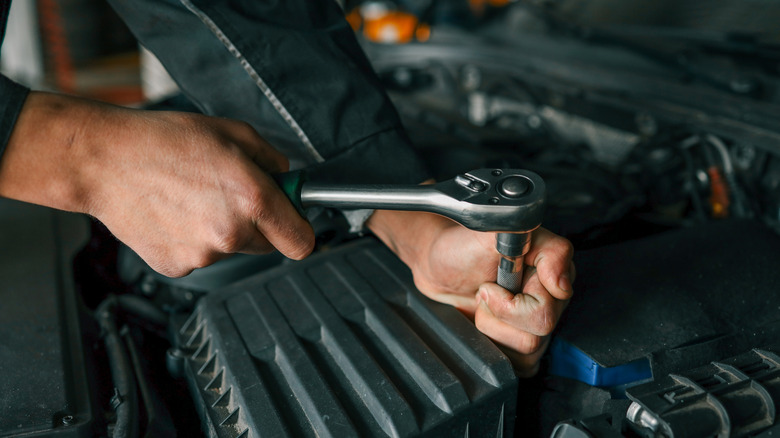
As mentioned, threadlocking adhesive represents sort of the flipside of anti-seize lubricants. Their goal isn't literally to cause the parts to seize up, but it is meant to keep them from unintentionally loosening as a result of the physical operation of the car. Now, you may think a properly torqued fastener on its own should be enough, but you'd be wrong. Even then, there can be tiny spaces left between the threads of the bolt and the part.
So there's still room for movement when the engine starts vibrating or if the metal expands and contracts due to temperature changes. The problem is that those little motions add up over time, and eventually, a bolt can loosen up enough to drop right out. Threadlocker creates an anaerobic chemical bond between the threads to prevent the loosening in the first place.
Okay, and there is another similarity between threadlocker and anti-seize lubricant: There are different types for different applications. Threadlockers are sorted by color, with the most popular typically being dyed purple, blue, and red for low-, medium-, and high-strength formulations, respectively. Green, with extra penetrating power, is also common.
Just be aware that there are reports that the occasional unscrupulous mechanic may use threadlocker in a particularly dangerous situation: Automakers will sometimes use torque-to-yield bolts engineered as sort of a set-it-and-forget-it solution. Tightening these bolts changes their shape to better lock them into place, so they are meant for a single use. Naturally, some might try recycling them with the help of a threadlocker, but the bolts won't be as strong as before, so it's strongly discouraged.