

2026 Toyota Camry Nightshade Edition Adds A Dash Of Visual Excitement To An Otherwise Utilitarian Car
The Toyota Camry is the best-selling car in the country, and has been for over 20 years. There are lots of upsides to being the most popular car in the U.S., but the big downside of achieving such broad appeal is the loss of excitement that comes with seeing Camrys everywhere you look. When was the last time you were excited to see a Camry? My point exactly.
Toyota recognized this concern a while back, and every subsequent generation has gradually become less boring. The latest ninth-generation Camry debuted in 2025 with a hybrid-only engine lineup, bolder styling, and a more engaging driving experience. Even with a little added spice, the Camry still proved to have the winning formula, posting best-ever sales figures again in 2025. As a car nerd, I was excited to get behind the wheel of a 2026 Toyota Camry and see what all the fuss is about.
 Logan K. Carter/ Jalopnik
Full disclosure: Toyota was kind enough to loan me this 2026 Camry Nightshade Edition for a whole week to use as my daily driver. I did lots of different kinds of driving over that week, and I feel like I got a pretty good feel for the car.
Nightshade edition is new for 2026, but not much else is
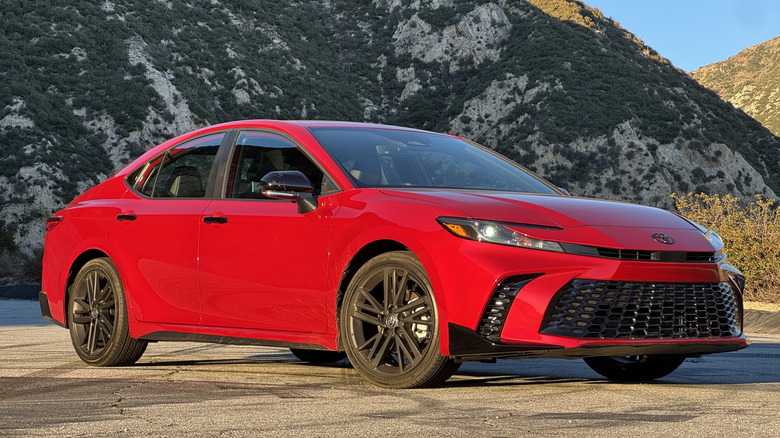
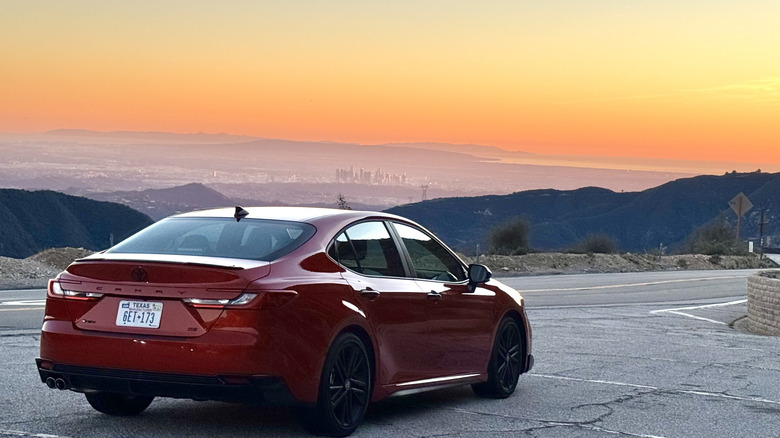
My test car was the new Nightshade Edition, which the press release says gives the Camry a "blacked-out sporty appearance [that] enhances the undeniable Camry vibe." It elbows its way into the middle of Camry lineup, just below the XLE trim at a base price of $33,795 including a $1,195 destination charge; this one also had the $600 Convenience Package, beautiful red paint for $475, a larger 12.3-inch screen for $735, and a couple other extras that ran the price up to a still-reasonable $35,878.
None of the options on my press car felt like must-haves, so if you're a cost-conscious buyer considering a Camry, the base LE has everything you really need for $3,500 less than the Nightshade. If you wouldn't be caught dead behind the wheel of a base model, the sportier-looking Camry SE is $1,000 cheaper than the Nightshade, and only misses out on its blacked-out details.
 Logan K. Carter/ Jalopnik
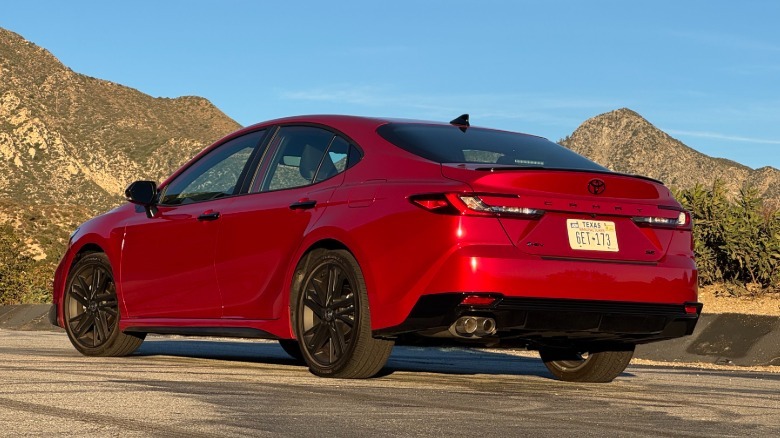
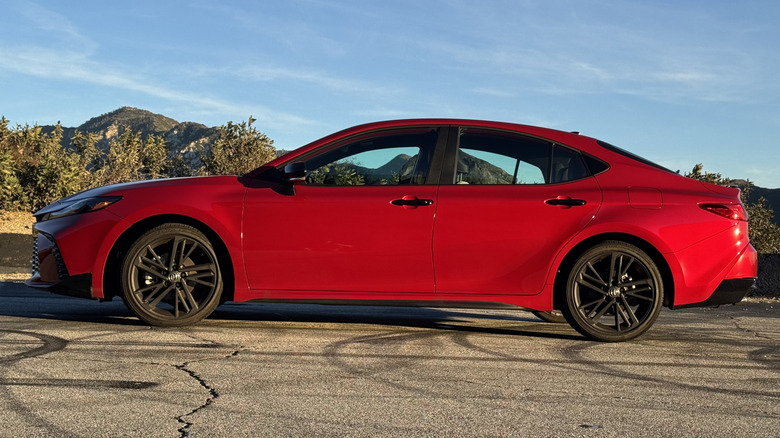
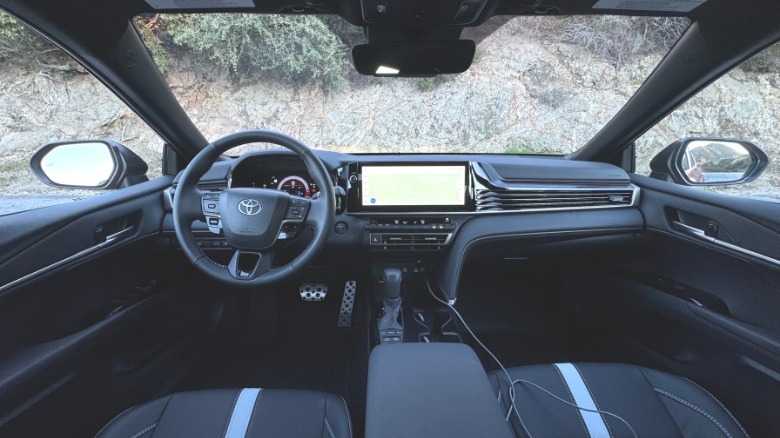
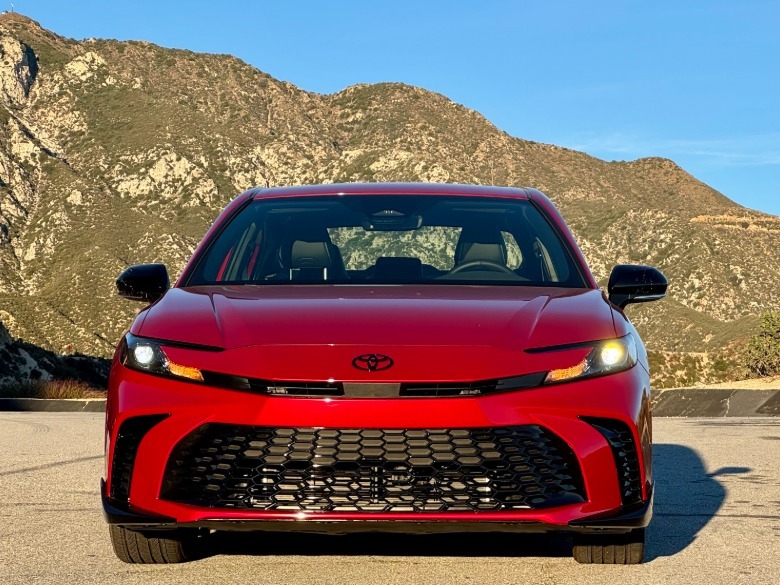
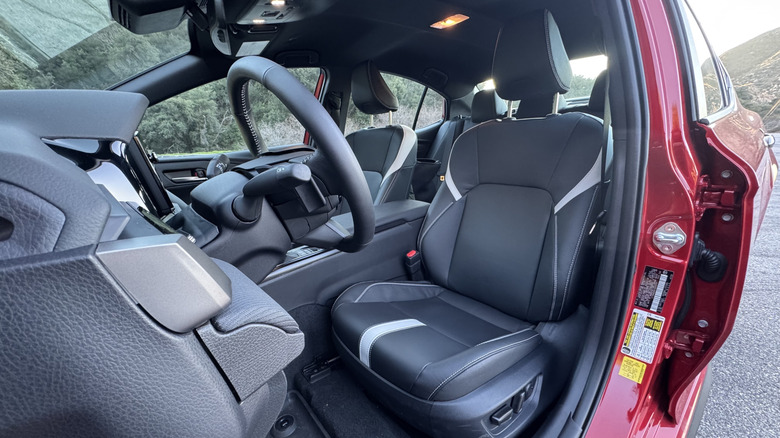
On the face of it, my press car certainly looked more exciting than any earlier Camry designs, with its Supersonic Red paint contrasting nicely with the Nightshade's Midnight Black Metallic grille, canards, door handles, mirror caps, antenna, rear diffuser and spoiler. The interior is typical Camry, with black fake leather and fabric seats, a standard 7-inch digital gauge cluster, and lots of hard plastics. Nothing objectively bad, but nothing particularly thrilling either.
Hybrid or bust
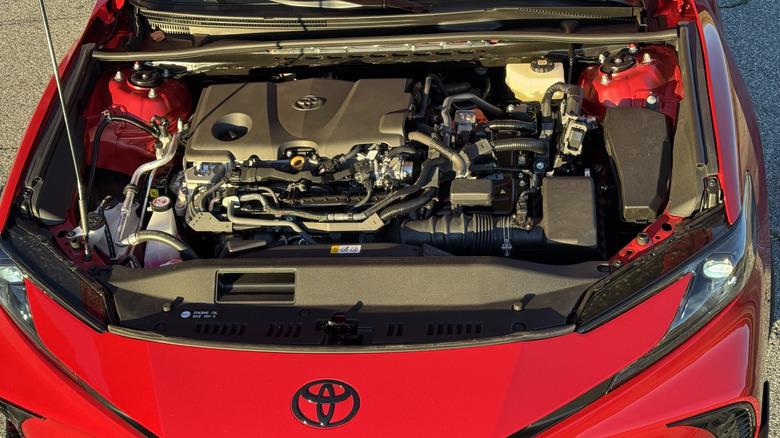
One of the biggest pieces of news that came along with the 2025 Camry was the announcement that all Camrys are now hybrids. You can no longer get a gasoline-only Camry, and though some people think that's a mistake, I think it's a great move. The Camry is not known to be an enthusiast pick, and with more than 300,000 sold every year it's a perfect way to minimize fuel consumption on American roads. It also allows Toyota to produce more enthusiast-focused cars that might not be quite as environmentally conscious. This isn't a Miata, it's a Camry, so chuck in a hybrid powertrain with a CVT and let the masses flock.
Toyota is synonymous with hybrids anyway, and the new Camry proves why — the powertrain is supremely smooth, efficient, and actually quite powerful. The naturally aspirated 2.5-liter inline-4 engine is paired with a 134-horsepower front-mounted electric motor and a 0.6-kWh lithium-ion battery pack that together produce 225 horsepower in front-wheel-drive models like my press car. All-wheel drive is available on all trims, adding a small 40-hp electric motor to the rear axle for a total of 232 horsepower.
 Logan K. Carter/ Jalopnik
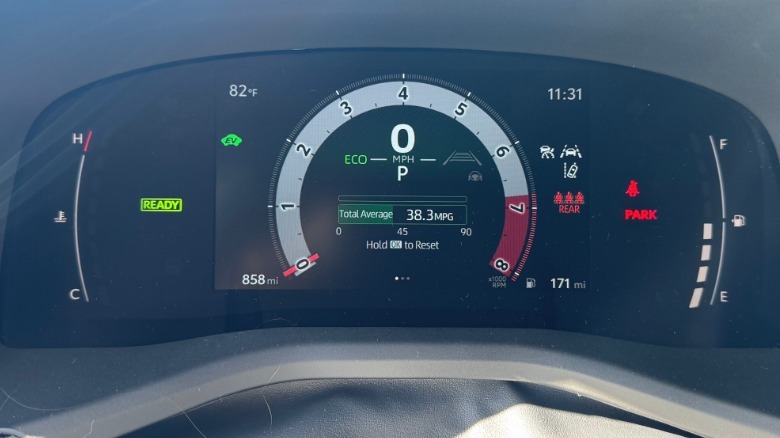
It can return as much as 53 mpg city, 50 mpg highway, and 51 mpg combined in base LE front-wheel-drive configuration, or as little as 44 mpg city, 43 mpg highway, and 44 mpg combined in top XSE AWD form. You can't be mad at a car that goes from 0-to-60 mph in around 7 seconds and still returns as much as 53 mpg.
It's competent, but I wouldn't describe the driving experience as particularly fun
Given how much I'd heard about the redesigned Camry's fun nature, I was expecting to be completely won over by it on the mountain roads I'm lucky enough to live by. While it impressed me, for a Camry, I would be lying if I said I found it truly enjoyable to drive. The most fun part about driving the Camry comes from the surprisingly punchy drivetrain, which feels quite quick thanks to its electric assistance.
Chucking it down a twisty road revealed a relatively quick turn-in response, followed by a bit more grip than I expected, but it never felt good to push harder. The car seemed to reluctantly accept the fact that I was pushing it down a winding road, but not happy to do so or especially eager to go faster. It's certainly competent, but I didn't walk away from the experience thinking, "wow, that was fun."
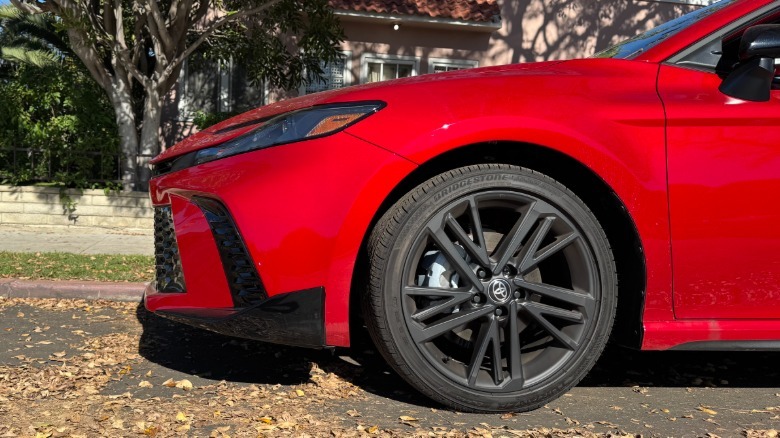
If you lift off the throttle in a turn to fight understeer and encourage rotation, the Camry barely budges; if you want any rotation, you have to tap the brakes to get the weight to transfer to the front of the car and then the nose tucks in. At least it tucks in, but it's by no means playful or eager. This may have something to do with the 235/40 Bridgestone Turanza tires that encircle the Nightshade Edition's standard 19-inch satin black alloy wheels, but hey that's what I had to play with.
Nobody buys a Camry for its driving excitement, though
"Disappointed but not surprised" was a phrase that I used to utter frequently before I realized that we create our own worldview, but I'll bring it out of retirement to describe the Camry's so-called sporty driving dynamics. I was disappointed that it wasn't actually fun, but I wasn't surprised, given its utilitarian purpose.
When used for its intended objective of being an efficient and affordable source of transportation, though, the Camry began to impress. The hybrid powertrain felt torquey around town, and it can be driven pretty aggressively while still returning great gas mileage. I averaged 38 mpg over the course of my week-long test, which involved more than a little hard driving.
 Logan K. Carter/ Jalopnik
The driving experience was totally smooth and seamless, from acceleration to braking to the lack of shifts from the ECVT, which can no doubt be attributed to Toyota's extensive experience building hybrid powertrains. Smoothness is the overarching theme with the new Camry. I had a few passengers during my week with it, and when I asked them their thoughts on the experience, they all said it was really smooth. The interior wasn't as quiet as I wanted at highway speeds, especially on concrete or broken roads, but it's not a dealbreaker.
All Camrys come standard with Toyota's suite of active driver-assistance features, which includes full-speed adaptive cruise control, lane departure assist, lane tracing, blind-spot monitoring, and automated emergency braking. I found the Camry's cruise control and lane tracing to work flawlessly, and take some of the fatigue out of LA's hectic freeways.
 Logan K. Carter/ Jalopnik
Unfortunately, the 2026 Camry Nightshade continues with a fault that has plagued other Camry generations: a long, low front overhang. If you're going through a dip, you'd better slow way down, otherwise the nose will scrape. If you're pulling into a parking spot, do not pull up until your tires hit the curb or parking bumper, or you're liable to rip the entire bumper off when you try to back out. If you're trying to make a U-turn on a tight road, don't let the front of the car get too close to any curbs, or you'll scrape that low-hanging bumper. A front camera or surround-view camera system would help this, but it's only available as an option on top XLE and XSE trims.
The interior is simple and effective
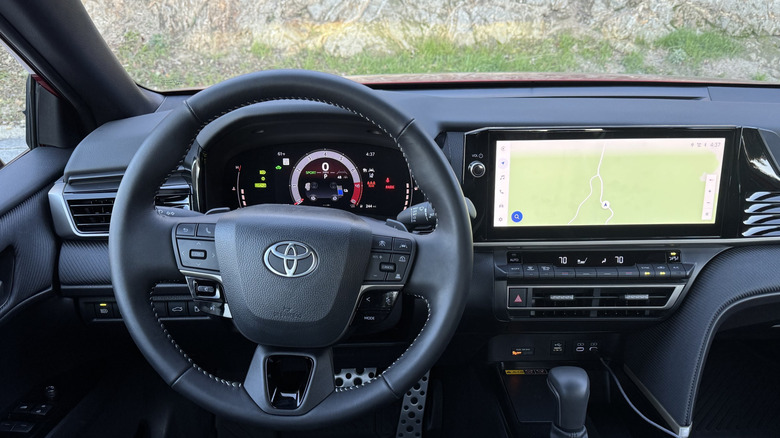
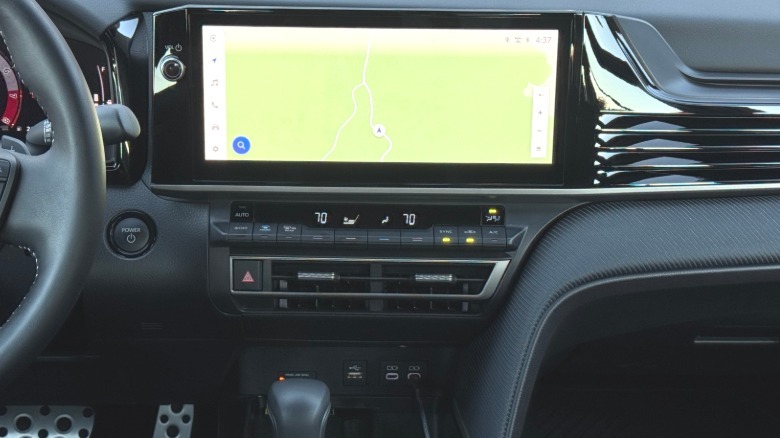
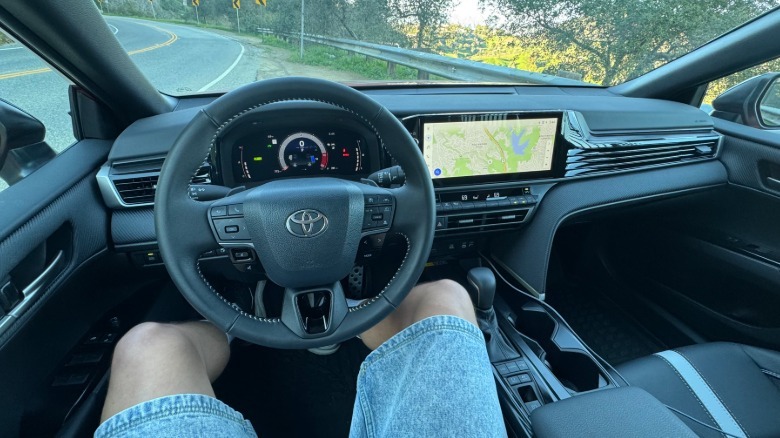
The Camry's interior strikes a great balance between technological integration and physical buttons for important and frequently used controls. My Nightshade Edition tester was a rarity among press cars, in that it wasn't a top spec model fitted with all the features and gadgets. Instead, it was pretty representative of what the average Camry you'd see on the road, which was a nice change as a reviewer. That means there's not much reason to dive into the 12.3-inch touchscreen's menus with any sort of frequency, so I found myself hopping in, putting my phone on the wireless charger, and hitting the road.
There are dead-simple physical controls for climate settings, so they're easy to adjust while driving, and wireless CarPlay worked great. The vast array of steering wheel–mounted buttons are another thing that makes the Camry easy to live with. They're all large and clearly marked, and like a good fidget toy, operations were palpably discernable without looking away from the road.
 Logan K. Carter/ Jalopnik
The 6-speaker sound system in my test car was the same one that's standard across all Camrys, and I can't believe I'm saying this, but it sounded great. I love listening to music when I drive, and I can be quite picky about my sound systems, so considering that this is the standard system that comes on even the cheapest Camry LE, I was thoroughly impressed.
As far as interior room goes, the Camry is short on headroom. Yes, I'm a bit taller than the average person at 6-foot-8, but I have very long legs and a more average-size torso, so I was surprised by how little headroom I found in the Camry's driver's seat. My tester didn't even have a moonroof, which usually eats into headroom; even as a slicktop, the Camry doesn't have great headroom up front, or in the back seats, for that matter. The sloping roofline can likely be blamed for the lack of rear seat headroom. If your family is known for its long torsos, the Camry won't be a great choice for you. Legroom was fine in both rows, not outstanding in any way, but elbow room was great in both rows. Overall, the interior felt wide and roomy, but not tall.
 Logan K. Carter/ Jalopnik
One feeling I couldn't shake was that everything about the Camry seemed hollow. When I'd shut the door, it sounded like the sheetmetal popped in for a split second before returning to its convex shape. Combined with the fact that the interior sounded boomy when going over big bumps, I was left feeling like the Camry was well screwed together, but not the most solid or vault-like product.
The 2026 Camry Nightshade is a lot of car for $36,000
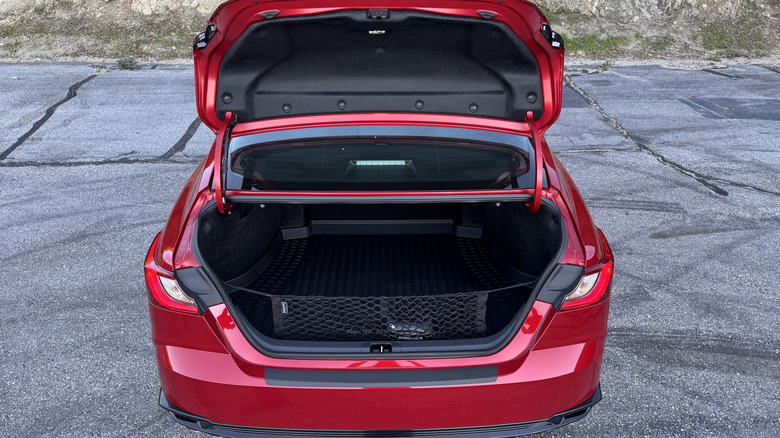
Sadly, we live in a time where the cheapest new car on sale is just over $22,000, and the average new car costs around $50,000. All things considered, the 2026 Toyota Camry Nightshade Edition is a lot of car for $36,000. It gets great gas mileage, which saves money in the long-run, and it's a Toyota, so it ought to be ultra-reliable and hold its resale value exceptionally well. It gives you everything you need, from the active-safety systems to wireless Apple CarPlay and Android Auto, and it has real room for a family of four.
I found the claims of the new Camry's "fun-to-drive" nature to be exaggerated, but depending on your persuasion and your priorities, that likely won't matter too much. As it turns out, the 2026 Toyota Camry is still a smart, affordable, and sensible choice after all these years on top, and there are no signs of that changing any time soon.