

The Smallest Production Cars Ever Built Make Modern Compacts Look Huge
The U.S. market is flooded with massive cars. From sedans and minivans to trucks and SUVs, everything is large, and this includes subcompact cars. At 143 inches long and 66.3 inches wide, the Fiat 500e is indeed small and a great EV for the city, but that's pretty much it. The Mini is also smaller than most new cars in America, but at 152.6 inches long and 68.7 inches wide, it's in a whole different category.
Even in Europe, a market that loves its small city cars, you can't go much smaller than the Fiat 500e. The Kia Picanto, for instance, measures 141.9 inches long and 62.8 inches wide. That seems tiny from today's perspective, yes, but it's nothing compared to the smallest production cars ever built. Heck, some of the cars we listed here can fit inside the cabin of most modern subcompact cars, or your bathroom. Put them next to a modern compact car, and they will look like toys.
Rest assured, though — these are real cars. They're not quadricycles like the amiable Citroën Ami, or NEVs (neighborhood electric vehicles) like the Gem e2. Remarkably, many of them were even designed to swallow four human beings at once! Buckle up (if you can fit), and let's dive into the adorable world of microcars.
2008 to 2014 Toyota iQ/Scion iQ
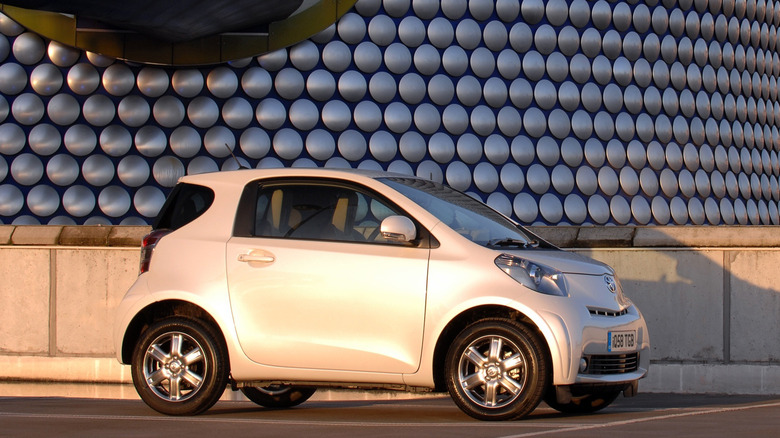
We won't blame you for missing one of Toyota's most genius cars in the last 2 decades. It was under the Scion brand in the U.S. and marketed as the Toyota iQ in other markets, but it couldn't attract the customers. However, the fact remains that it was an excellent small car that could've greatly improved urban mobility.
How? Well, the Scion was just 120.1 inches long (the Toyota iQ was even shorter at just 117.52 inches), yet it could seat four people and keep them safe with 11 standard airbags. Okay, it had enough space for three adults and a kid and was relatively wide at 66.1 inches without mirrors. Still, to design such a space-efficient modern car that passed IIHS crash tests with flying colors is nothing short of astonishing.
The real kicker — the European Toyota iQ is one of the best cars I've ever driven. It has a 12.8-foot turning radius, which means you'll make even the tightest U-turns on the first try. Parking in tight spaces? Easy-peasy! Heck, the iQ even feels grown up and stable on the highway and has a premium-looking interior. It's just a joyous car to drive, full stop.
The question remains — how can you squeeze four passengers in the cabin? Well, Toyota developed an ultra-compact air conditioning unit specifically for the iQ and mounted the differential in front of the engine. The dashboard was also asymmetrical, so the passenger could move the seat forward to free up space behind. Yes, it wasn't wildly comfortable, but it was still enough to accommodate my buddies on short-to-medium trips.
1957 to 1975 Fiat Nuova 500
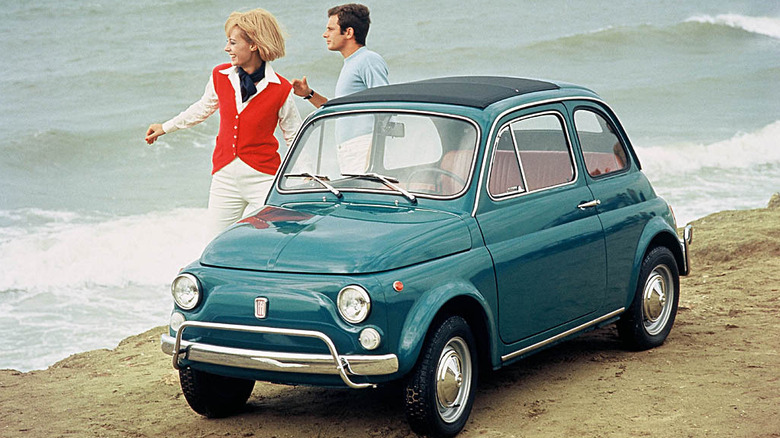
Fiat, and particularly its master engineer, Dante Giacosa, already cracked the city car code with the post-war 600. However, the company thought it could produce an even cheaper, smaller car to motorize post-war Italy. A successor to the pre-war 500 Topolino, the Fiat Nuova 500 was a simple, yet well-engineered rear-engine miniature designed to slot below the 600 in the pecking order. The goal was to produce a small family car that was no more expensive than a worker's annual salary.
But how do you miniaturize the Fiat 600, a car that's just 126.57 inches long and 54.33 inches wide? Giacosa used a similar but smaller self-supporting bodywork and a tiny 479cc twin-cylinder engine, which produced just 13 horsepower at 4,000 rpm. That's not much, but the car weighed just 1,036 pounds (dry weight), so the top speed was still respectable at 53 mph. Still, the car could only be registered as a two-seater, and buyers weren't exactly interested. So, quickly after the launch, Fiat introduced a Normale version with four seats and a more powerful 15-hp engine. The car retained the diminutive footprint of 116.9 inches long and 52 inches wide, but had a higher 56-mph top speed.
A year after the initial launch, Fiat further improved the formula with the Nuova 500 Sport. The performance model had a 499.5cc engine with 21.5 hp, enough to break the 100-km/h (62-mph) barrier with a top speed of 65 mph. An Abarth version with 26 hp followed, which could reach 75 mph. It even set an international speed record for a 350cc-to-500cc car, travelling 11,735.5 miles at an average speed of 67.26 mph.
1958 to 1971 Subaru 360
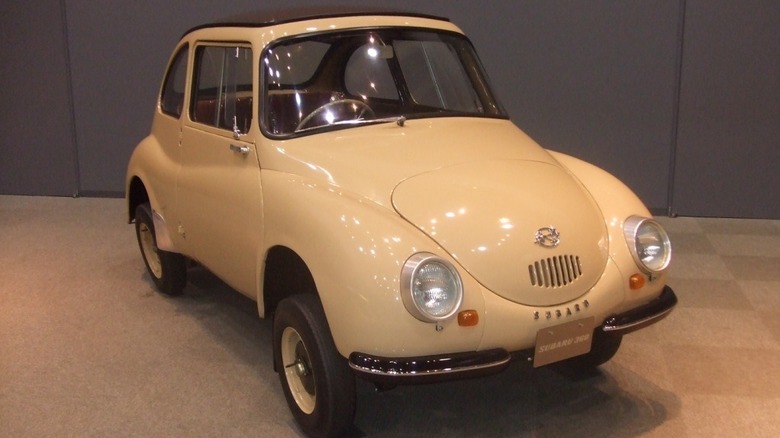
Subaru's first production car looks like it escaped an animator's desk, but this cartoony, bug-eyed creation was designed by an aeronautical engineer. Like with many post-war efforts, Shinroku Momose was tasked with building a small, cheap car for the masses, but he didn't miss the opportunity to leave his mark. The Subaru 360 had a monocoque chassis with a fiberglass top panel, so it weighed a virtually impossible 929 pounds! At 117.9 inches long and 51.2 inches wide, it was tiny, too, but it could still seat four people inside.
Since it weighed a tiny bit more than a motorcycle, the Subaru 360 was powered by a 356cc two-cylinder, two-stroke engine. Initially, it produced just 16 horsepower and propelled the whimsical car to a top speed of 52 mph. However, Subaru introduced more powerful versions in subsequent years, culminating in the 1968 Subaru 360 Young SS. The performance model had two carburetors and produced 36 hp, enough for a top speed of 75 mph.
Were it not for a 1969 Consumer Reports review (via My Subaru 360), we would've only remembered the Subaru 360 for its engineering prowess. The publication deemed the small car "not acceptable" because of the dangerous handling and non-existent crumple zone. Still, the Subaru 360 was never designed for the American buyer, and in Japan, it worked flawlessly. So, we really wish Subaru never discontinued this fascinating ugly duckling.
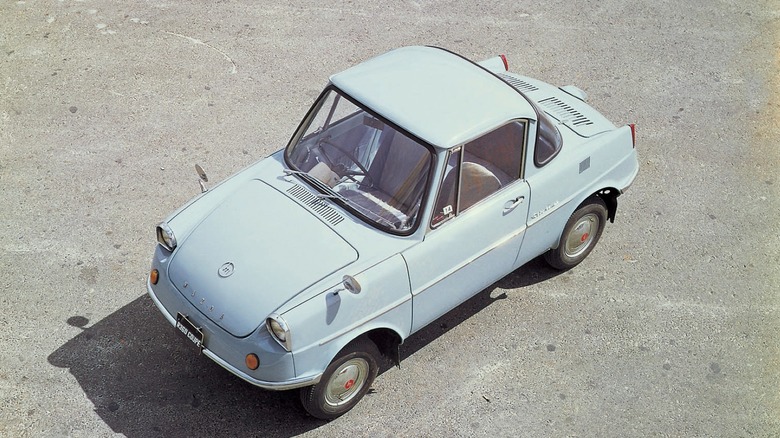
1960 to 1966 Mazda R360
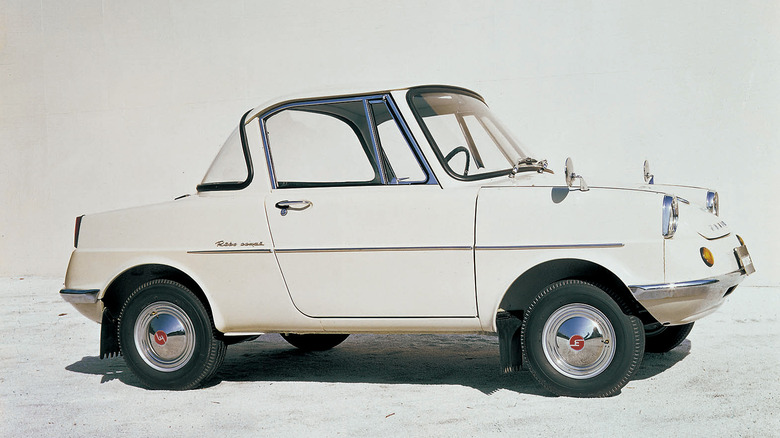
While the Subaru 360 was a utilitarian, cheap bug for the masses, the Mazda R360 was the more sophisticated, design-forward alternative. It still looks like a toy car, sure, but it has that futuristic Jetsons vibe that hits differently than the Subaru 360. Since it was built to meet the kei car standards, like its rival, the R360 was 118 inches long and 50.8 inches wide. The R360 could still technically sit four people inside, but the rear bench was only usable for small kids.
But it wasn't just the design that set the R360 apart. Mazda also wanted to differentiate itself with quality and make sure its kei car was built to a higher standard. So, instead of a two-stroke engine, the automaker opted for a more refined four-stroke V-twin. The rear-mounted 356cc unit produced 16 horsepower and propelled the likeable coupe to a top speed of 56 mph. As standard, the R360 came with a four-speed manual, but it was also the first car in Japan to be offered with a two-speed torque-converter automatic.
Weight reduction was also part of Mazda's strategy, which still hasn't changed to this day, as the next-gen Mazda MX-5 Miata is poised to be even lighter. The R360 had a lightweight monocoque chassis, an aluminum cylinder head, and a magnesium alloy transmission casing. The hood was also made from aluminum, while the rear wraparound glass was made from plexiglass. As a result, the R360 weighed just 838 pounds, making it the lightest car in Japan at the time!
1998 to 2014 Smart City-Coupe/ForTwo
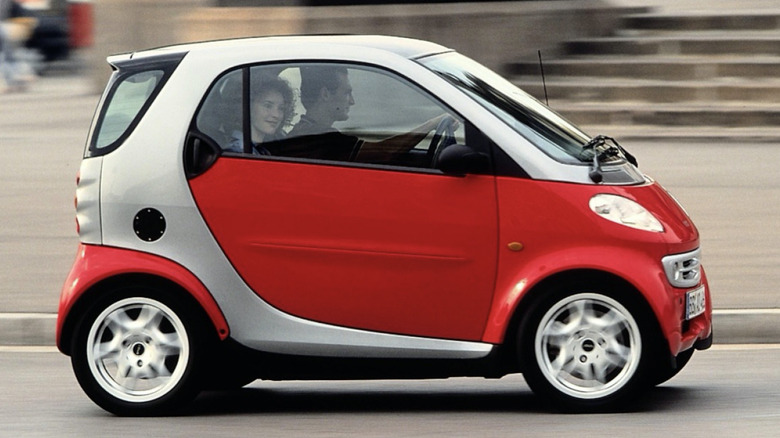
Back in 1998, Mercedes-Benz and Swiss watchmaker Swatch launched the Smart City-Coupe — Europe's smallest road car. At just 98.4 inches long and 59.8 inches wide, the City Coupe begged the question at the time — is it a real car? Of course it was. Not only that, but it was well engineered, safe, and decently quick.
Now, the Smart City-Coupe could only seat two people. But it also had a 5.3-cubic-foot trunk (up to the tonneau cover), which could easily swallow all of your shopping bags. In subsequent generations, the capacity rose to 12.36 cubic feet, making it a great vehicle for a weekend getaway for two.
Still, later models were also much longer at 106.1 inches long. That's still very short, but it made a big difference in urban scenarios. I drove multiple generations of Smart's tiny two-seater, and the first one was the most usable in the city. You could fit two of these in one parking spot, or park them perpendicularly in a parallel spot.
Oh, and for the driving experience, the Smart City-Coupe is rear-engine, rear-wheel drive, so it always felt agile in the corners. Yes, the first-gen's short wheelbase and narrow track compromised stability, but at urban speeds, it handled well enough. It wasn't fast, though. The 44-horsepower, 599cc turbocharged three-cylinder engine propelled the car to 62 mph (100 km/h) in 18.9 seconds and was paired to a slow sequential gearbox. However, power went up in later models — the 2007 Smart ForTwo had an 84-hp engine and sprinted to 62 mph in 10.9 seconds.
1957 to 1961 Piaggio Vespa 400
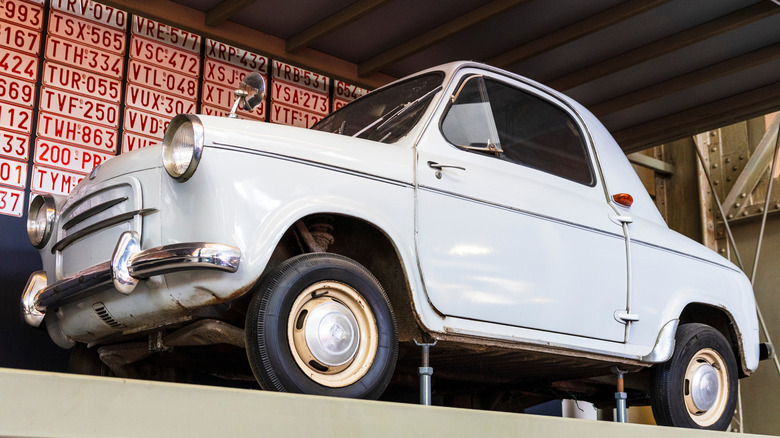
Wait, that Vespa? Yes, Piaggio, the Italian scooter manufacturer once developed a four-wheel vehicle. Of course, it carried the Vespa moniker, though it was built in France, not Italy. The story goes that Gianni Agnelli, Fiat's chief at the time, didn't want Piaggio to eat into his company's market share, so the scooter maker had to move production to France.
So, how did the Vespa 400 compare to its closest rival, the Fiat 500? Well, at 111.6 inches long and 50 inches wide, the Vespa 400 was appreciably smaller. It was also registered as a 2+2 seater, though the rear seats weren't a bench, but rather a cushion. On the outside, the Vespa 400 had more of a two-door sedan shape and a folding-top roof. However, since the engine was in the back and the driver/passenger legs were positioned under the hood, there was no trunk. The Vespa 400 was powered by a 393cc two-cylinder, two-stroke engine, good for 14 horsepower. Paired to a three-speed manual, it propelled the car to 40 mph in 23 seconds and to a top speed of 52 mph.
However, Piaggio's engineering prowess in making two-stroke engines really showed in the lubrication department. Unlike other two-stroke engines of the time, this one required a 2% oil-to-fuel mixture, so it didn't produce tailpipe smoke. To help drivers, Piaggio even introduced a semi-automatic mixing device later, which ensured the correct ratio entered the engine at any given time. Unfortunately, sales never took off, forcing Piaggio to cancel its car project entirely.
1955 to 1969 Goggomobil Sedan
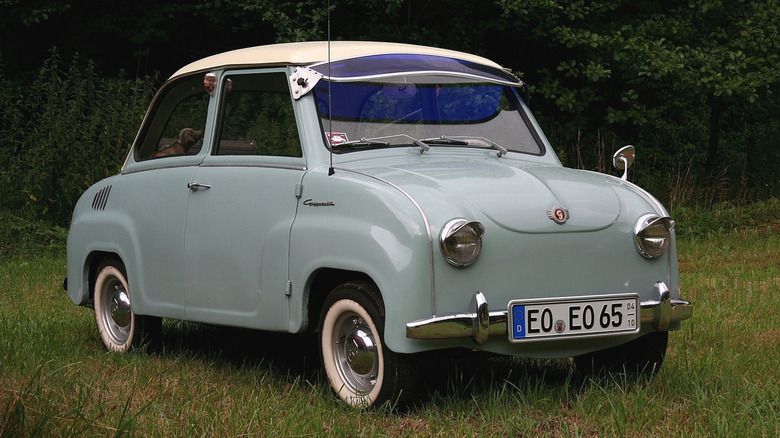
Much like Piaggio, Hans Glas, a scooter manufacturer since 1951, decided to enter the booming European microcar market in 1955 with the Goggomobil T250. The miniaturized sedan didn't have the cute looks of its rivals, but the 114.2-inch-long and 50.4-inch-wide footprint still gave it a caricatured personality. Inside, the Goggomobile T250 had 2+2 seating, meaning it could only accommodate kids in the rear.
But it was the tiny 245cc engine that set the T250 apart from its microcar rivals. The idea was to offer cheap transportation to customers with a category IV driver's license in Germany, which allowed operation of any type of vehicle with an engine of up to 250cc. This license was mainly meant for riding motorcycles, making it a huge sales advantage for the T250.
Glas installed the two-cylinder, two-stroke engine in the back and paired it with a four-speed manual or an electromagnetic pre-select transmission. With only 13 horsepower, it wasn't particularly fast, but let's be honest — no microcars were. Still, Glas followed the T250 with the T300 and T400, both featuring larger 296cc (14.8 hp) and 393cc (18.5 hp) engines.
The Goggomobile sedan proved very popular, with Glas selling around 250,000 units. Some were even exported to the U.S. and sold at a significantly lower price than other cars. The Goggomobil Sedan was also praised by critics for its excellent ride, good handling characteristics, and spirited engine.
1955 to 1964 Messerschmitt KR175 & KR200
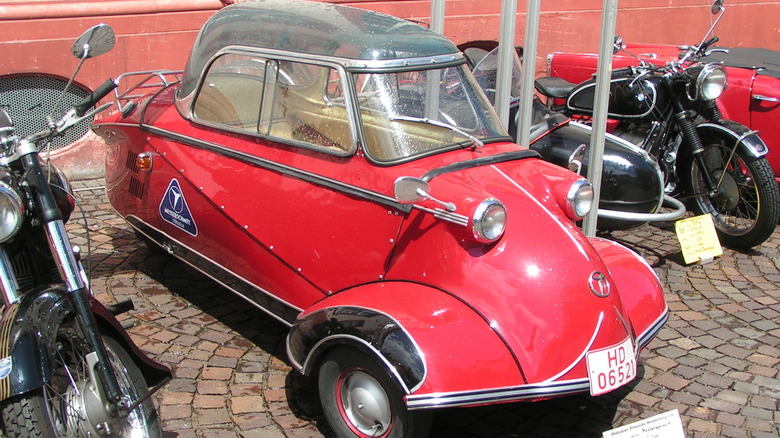
Messerschmitt started as an aircraft manufacturer and developed arguably the most feared Me 262 aircraft for Germany during WWII. However, the company had to stop with its aeronautical endeavors after the war and instead turned to making cars.
But Messerschmitt wasn't ready to bury its aeronautical past just yet, so its first car, the KR175, looked like an aircraft, but with no wings. Crucially, thanks to the narrow teardrop shape (111 inches long and 48 inches wide), it had a slippery design. Messerschmitt soon replaced it with the charming Messerschmitt Kabinenroller KR200, which had a larger engine but the same footprint. To fit the aeronautical theme, designer Fritz Fend opted for a plexiglass canopy on both cars, which opened sideways, so entering the KR200 was similar to a fighter plane. Inside, these cars had two seats, albeit in tandem configuration, and a steering yoke, rather than a steering wheel.
Messerschmitt's three-wheelers had tiny engines — The KR175 had a 175cc one-cylinder, two-stroke engine with 9 hp, while the KR200 had a 191cc unit with 10 horsepower. Still, thanks to its aerodynamic shape, the more powerful KR200 had a top speed of 65 mph. Heck, it could do 87 mpg, an unbelievable feat for the era. Messerschmitt's three wheelers handled well, too, thanks to their low center of gravity.
The KR200 had some quirks, though. Notably, to go backward, you had to stop the engine and restart it in the opposite direction. This meant the driver could theoretically use all four gears when going in reverse and potentially achieve a higher top speed due to the more aerodynamic shape.
1953 to 1962 ISO/BMW Isetta
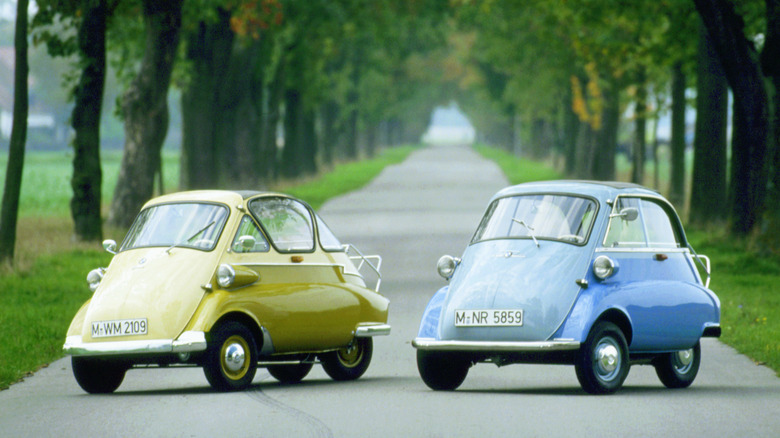
You probably know about the Isetta, the cutest clown car ever that saved BMW from bankruptcy in post-war Germany. What you might not know is that BMW borrowed the design for the car from Italian refrigerator manufacturer ISO. Yes, now the front-opening, fridge-like door makes more sense.
As with most post-war microcars, Iso wanted to design a small, fuel-efficient car for the masses. Oh, it was also developed by aeronautical engineers Ermenegildo Preti and Pierluigi Raggi — see a theme going on? To keep the costs down, they decided on a three-wheel layout and a one-cylinder engine. The 236cc two-stroke unit produced just 9.5 horsepower. The Isetta (little ISO in Italian) was also incredibly tiny, measuring just 89.96 inches long and 54.33 inches wide,
For its version, BMW didn't just copy Iso's design. The German automaker opted for a two-wheel axle in the back to improve stability and replaced the two-stroke engine with a 250cc four-stroke unit that produced 12 hp. Then, in 1956, BMW introduced an even larger 298cc engine with 13 hp. Curiously, BMW also built a three-wheel Isetta for the UK market to make it legal to drive for people with a motorcycle license. All versions retained the incredibly small footprint.
The original Isettas were strictly two-seaters, though, which limited their appeal. To make it more approachable for families, BMW launched a stretched Isetta 600. Although significantly bigger, at 114.2 inches long and 55 inches wide, the four-seater is still tiny compared to a modern compact car.
1964 to 1966 Peel Trident
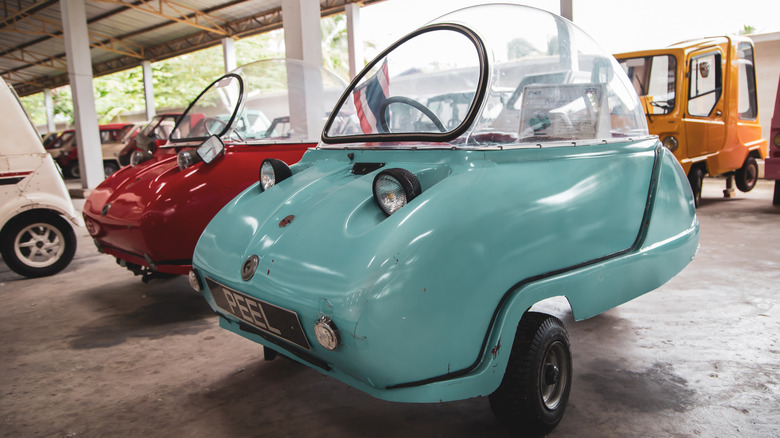
Did you find all these cars amusing? Well, get your magnifying glass ready, because for Peel, nano cars are in a whole different category of tiny. Launched in 1964, the Trident three-wheeler truly looks like it came out of "The Jetsons." The glass bubble top and cutesy body design take the cartoonish looks to a whole new level, but it's really the small footprint that sets the Trident apart. It's just 75 inches long and 42 inches wide, so it will look tiny even when compared to the BMW Isetta. The real kicker is that the Peel Trident is designed to fit two people, but you'll probably need to take a yoga class first.
To power this weird concoction, Peel opted for a 49cc single-cylinder, two-stroke engine from Zweirad Union, good for just 4.2 horsepower. Yes, that's as much as a scooter. However, the Trident weighs just 330 pounds, so the top speed is respectable 38 mph. More impressively, it was good for 100 mpg. Like any normal car, the Trident is equipped with a steering wheel and a three-speed transmission. However, it was legal to drive with a motorcycle license in the UK.
If you want to realize your Jetsons dreams, you can buy a brand-new, four-wheel Trident EV today from P50 Cars. It has a range of up to 100 miles and retains the original's cool, small-footprint design. There is even a performance version with a top speed of 55 mph, which sounds scary in a car this small.
1962 to 1965 Peel P50
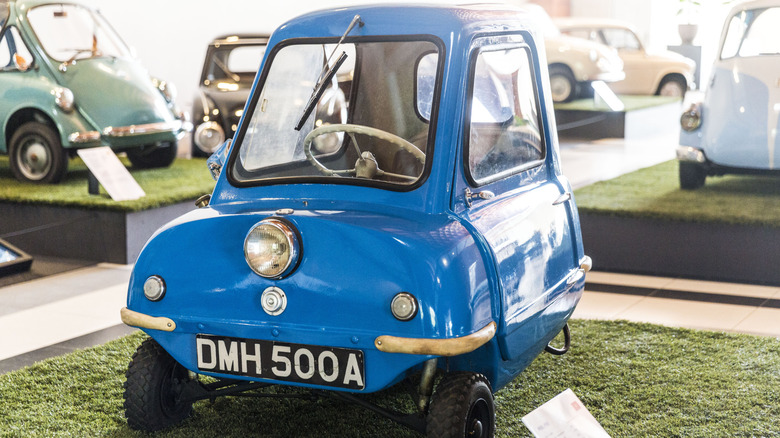
The Trident was Peel's second, more upscale attempt at making a nano car. In 1962, the British company launched the P50 — a car so small it beggars belief. At an unbelievable 54 inches long and 41 inches wide, the P50 is the world's smallest car. Lengthwise, that's smaller than a standard 60-inch bathtub and even a 65-inch TV.
Obviously, the P50 is designed only as a personal mobility vehicle, so it has one seat inside. As we can attest from the Top Gear episode "The Smallest Car in the World," it has enough space to fit Jeremy Clarkson, who is 6 feet 4 inches tall. There is also a steering wheel and a shifter inside, but not much else. For propulsion, the P50 utilizes the same 49cc two-stroke engine and three-speed transmission as the Trident, good for a top speed of 38 mph.
However, P50 Cars also builds replicas of the P50, with multiple powertrain options. The two-stroke engine is still available, alongside more modern four-stroke engines with capacities of 49cc to 125cc. Two electric versions with 50 miles of range are also available, with the more powerful performance model reaching a top speed of 50 mph.