

10 Used Crossovers With Surprisingly Large Cargo Capacities
We own more stuff than at any point in human history. Naturally, we are also hauling more stuff than ever before in our cars, so we need vehicles with big trunks. Station wagons would be an obvious choice, but only a few such models remain on sale in the United States. Nowadays, crossovers are a better option than sedans, as they provide 1.5 times the cargo capacity while costing just 5% more on average, according to Consumer Reports.
And while modern crossovers have tremendous cargo capacities, they can be expensive. Used crossovers won't break the bank but will still provide you with enough space for all your belongings — and we aren't talking just about mid-size or large crossovers. Many used subcompact and compact crossovers have surprisingly large cargo capacities, no matter if the back seats are in place or not. So let's have a closer look at some used crossovers that punch above their weight.
2014 to Present Kia Soul (24.2 cu. ft. / 62.1 cu. ft.)
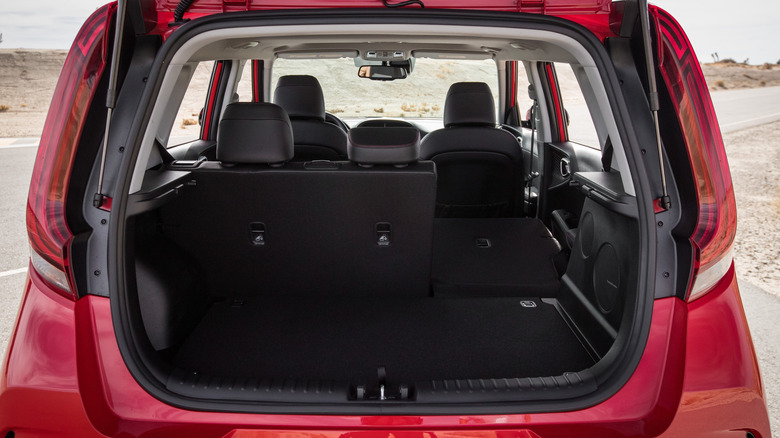
The Kia Soul is a case study in how boxy shapes maximize interior volume. The third-generation model, which has recently been discontinued, measures just 165.2 inches long, 70.9 inches wide, and 63 inches high, yet it has a sizeable 24.2 cu. ft. cargo capacity with all seats in place. Fold the rear seats, and the capacity grows to an astonishing 62.1 cu. ft. The second-gen Kia Soul is also great for hauling cargo. It has the same 24.2 cu. ft. capacity with the seats in place, and 61.3 cu. ft. with the rear seats folded. And at 163 inches long, it's even shorter than its successor.
But the last two generations of the Kia Soul are also good for carrying people, with both seating rows offering enough room for adults. The trunk also has a dual-level floor, which can be raised to deliver a flat loading floor with the rear seats folded. Yes, it's a very practical little thing, but we also found the 2023 Kia Soul GT-Line very charming. It's just a cool-looking car, and with the 1.6-liter turbocharged engine with 201 hp, it's peppy off the line.
Unfortunately, the turbo-four was short-lived, with Kia discontinuing it for the 2023 model year. Still, you can get the third-gen Soul with a 2.0-liter four-cylinder with 147 hp. Prices for the third-gen model range from $13,000 to $18,000. Meanwhile, the second-gen Soul came with a weak 1.6-liter engine with 130 hp, a 2.0-liter unit with 164 hp, or as an EV. Prices for the second-gen model range between $7,000 and $16,000.
2003 to 2011 Honda Element (25.1 cu. ft. / 74.6 cu. ft.)
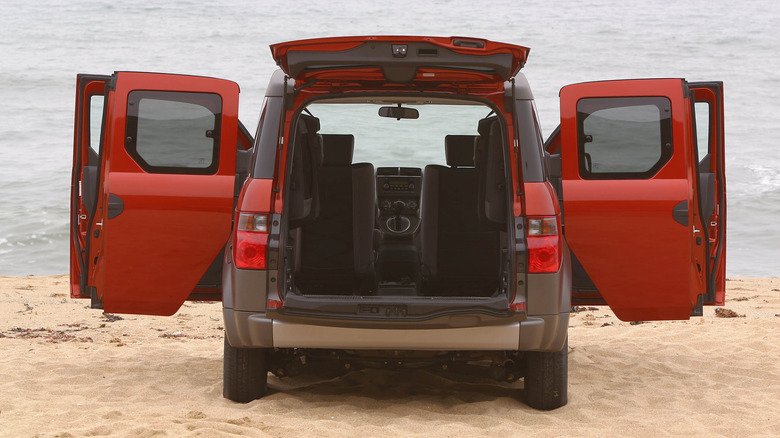
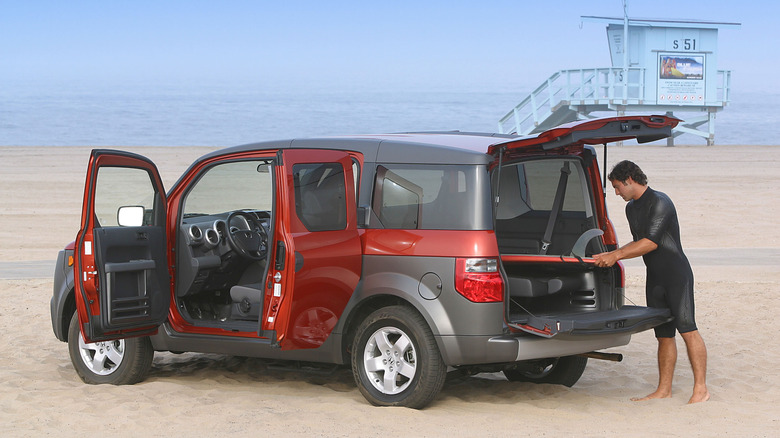
The Honda Element is easily one of the weirdest cars sold in the U.S. since the start of the millennium. Some would say it looks dorky, others might find it cool, but there is no question that the Element is a practical little thing. How little? Well, at launch, it measured just 166.5 inches long, 71.5 inches wide, and 70.4 inches high, meaning it was only slightly bigger than the Kia Soul. The facelifted Element grew a tiny bit, but at 169.9 inches long and 71.6 inches wide, it retained its tiny footprint.
Inside, the Element felt like a crossover from the class above. Both seating rows could comfortably accommodate adults, and you could fold all seats flat to turn the interior into a giant sleeping area or surfboard storage. One can only hope that Honda brings back the Element. It would be perfect for the overlanding crowd — no tents required. And it gets better. The Element's cargo area can swallow 25.1 cu. ft. with the rear seats up, or 70.1 cu. ft. with them folded. However, you could also remove the seats entirely and get a cavernous 74.6 cu. ft. of volume.
You must be thinking that Honda botched it in the engine department, but no — the Element was equipped with the legendary K24 engine. With 160 hp initially and 166 hp after the upgrade, the 2.4-liter four-cylinder was never fast, but it's a very stout, reliable engine. The Element was also available with 4WD, making it an outstanding surfer car. Used Honda Elements range between $4,000 and $10,000.
2022 to Present Volkswagen Taos FWD (27.9 cu. ft. / 65.9 cu. ft.)
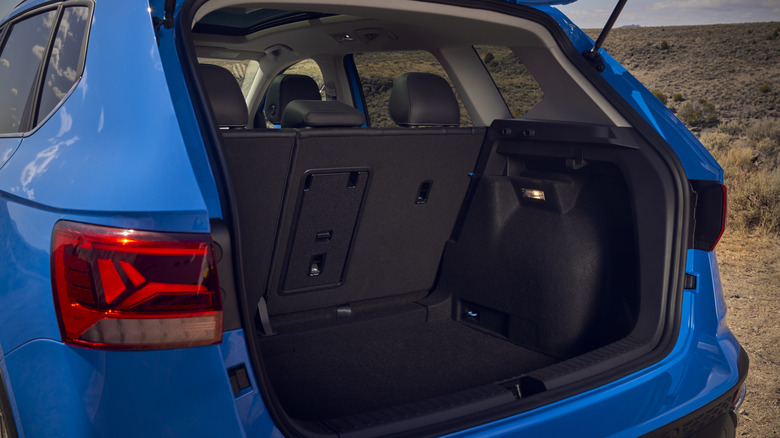
The Volkswagen Taos lacks the personality of the Kia Soul and Honda Element, but hey, the same is true for most current crossovers. Crucially, the front-wheel-drive version of this subcompact crossover packs a surprisingly large cargo capacity of 27.9 cu. ft. with all seats in place, or 65.9 cu. ft. with the rear seats folded. The 4WD Taos has a smaller, but still usable 24.9 cu. ft. trunk, which grows to 60.2 cu. ft. with the rear seats folded.
Unfortunately, the Taos' seats don't fold flat, which limits practicality a bit. To its credit, Volkswagen equipped its smallest crossover with a spare tire, which is increasingly rare nowadays. What's more, the Taos has plenty of room for adults in both rows — impressive considering it is just 175.8 inches long and 72.5 inches wide.
The Taos was first introduced in the U.S. in 2022, and came exclusively with a 1.5-liter turbocharged four-cylinder engine. With 158 hp and 184 lb-ft of torque, it's not hugely powerful, but gets the job done. The facelifted 2025 Volkswagen Taos we reviewed was bumped to 174 hp, though, giving it a bit more oomph.
There are some caveats you need to be aware of, though. Notably, the FWD model is equipped with a torsion beam at the rear, while the AWD model has a multilink setup. Moreover, before the facelift, the Taos FWD came with a regular eight-speed automatic, while the AWD was offered with a seven-speed dual-clutch automatic. Prices on the used market start at around $17,000 and go up to $28,000.
2006 to 2012 Toyota RAV4 (37.2 cu. ft. / 73 cu. ft.)
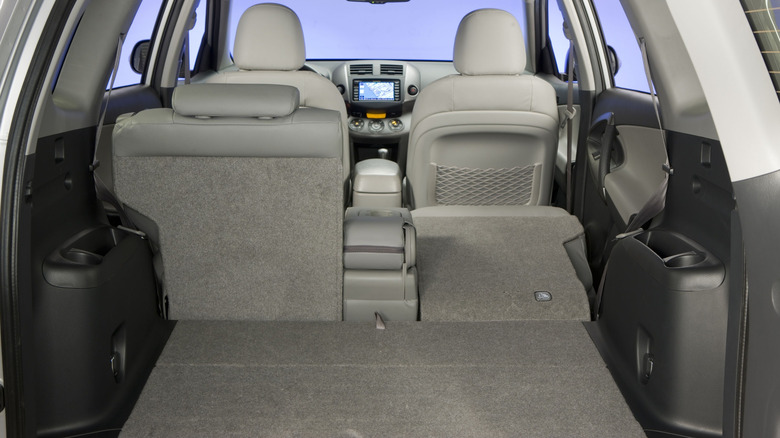
At 181.1 inches long, 71.5 inches wide, and 66.3 inches high, the third-gen RAV4 is significantly larger than the previous entries on this list. However, it was also the first compact crossover with seating for seven! The optional third row was a bit cramped, but it could accommodate young children.
Perhaps more problematic was the 12.3 cu. ft. cargo volume with all three rows in place, which was somewhat limiting. However, the five-seat model had a spacious, 37.2 cu. ft. trunk with all seats in place, and up to 73 cu. ft. with the rear seats folded. Passengers could enjoy ample space in both seating rows, too. Do we need to mention the third-gen RAV4 also came with a full-size spare?
This was also the first RAV4 to be equipped with a V6 engine, which gave it performance on par with some sports cars from its era. With 269 hp and 246 lb-ft on tap, the 3.5-liter unit brought Toyota's compact crossover to 60 in 6.3 seconds, according to Car and Driver. A five-speed auto was standard on the V6. The base RAV4 came with a more sedate 2.4-liter unit, good for 166 hp and 165 lb-ft of torque, or 179 hp and 172 lb-ft of torque in later models. The four-cylinder came exclusively with a four-speed auto. Third-gen RAV4 prices range between $5,000 and $12,000 on the used market.
2022 to Present Hyundai Tucson (38.7 cu. ft. / 73.8 cu. ft.)
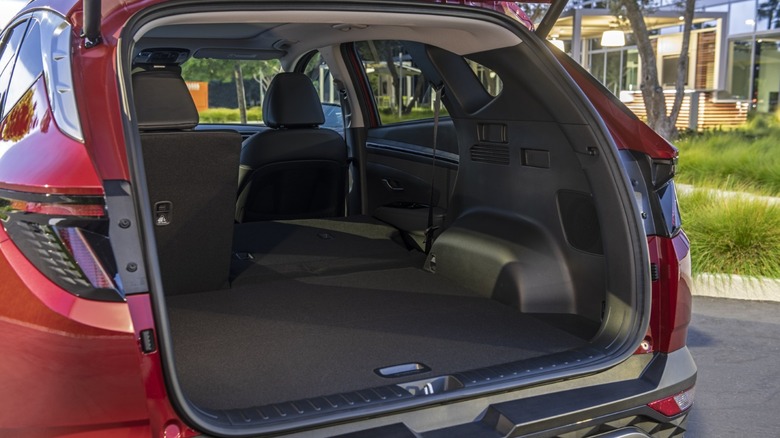
Hyundai introduced the latest Tucson for the 2022 model year, and it was quite the upgrade. It looked way more futuristic than its bland predecessor, and brought new hybrid and plug-in hybrid powertrains. The Tucson got bigger on the inside, too. While the previous generation model had a middling 31 cu. ft. trunk capacity, the 2022 Tucson offered significantly more usable cargo space of 38.7 cu. ft. With the rear seats folded, the capacity grew to cavernous 73.8 cu. ft.
Crucially, the Tucson Hybrid had the same cargo capacity as the regular model. The electrified version is also faster and more efficient. Equipped with a 1.6-liter turbo-four and a 59-hp electric motor, the Tucson Hybrid produced 226 hp and returned an EPA-rated 36 mpg combined. Meanwhile, the base 2.5-liter four-cylinder produces only 187 hp and is only good for 29 mpg combined. With 261 hp on tap, the Tucson PHEV was the most powerful of the bunch, though. It could also travel 32 miles on electricity alone, thanks to the 13.8-kWh battery. Unfortunately, the large battery reduced the cargo capacity to 31.9 cu. ft. with the seats up and 66.3 cu. ft. with the seats folded.
Hyundai further refined the formula in the refreshed 2025 Hyundai Tucson, which came with an upgraded infotainment system. The regular hybrid was also bumped to 231 hp, while the PHEV version produced 268 hp. Cargo capacity remained the same, though. Depending on the model year, used Tucson prices range from $20,000 to $30,000 or more.
2007 to 2013 Mitsubishi Outlander (39.3 cu. ft. / 69.2 cu. ft.)
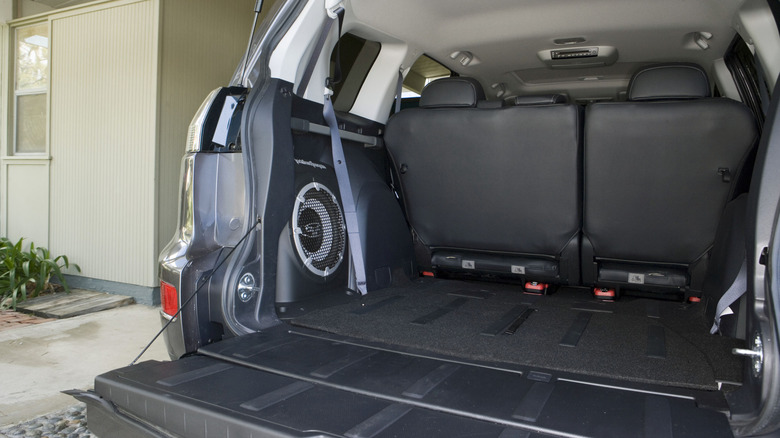
The latest Mitsubishi Outlander is one of the few compact crossovers with three seating rows, and a great showcase of practicality and comfort. But Mitsubishi's popular crossover has always aced the practicality game since the second-gen model, which had a massive cargo volume of 39.3 cu. ft. with all seats in place. This figure remained the same in 4WD models and grew to 69.2 cu. ft. with the rear seats folded.
Much like the third-gen RAV4, the Outlander was also available with a third row, suitable for young children. Meanwhile, space in the first two rows was sufficient even for taller adults. An interesting feature was the flip-down liftgate, which extended the trunk when you needed to load longer items. It helped with loading the trunk, too.
The third-gen Outlander was available in the U.S. with a 3.0-liter V6 and a six-speed automatic, though that powertrain was exclusive to the top-tier GT trim, while other models came with a 2.4-liter four-cylinder and a CVT. With 220 hp and 204 lb-ft on tap, the engine wasn't as potent as the RAV4's 3.5-liter V6, but it was an upgrade over the base four-cylinder engines of its rivals. According to Car and Driver, the Outlander needed 8.1 seconds to reach 60 mph. Prices for the third-gen Mitsubishi Outlander range from about $8,000 to $20,000.
2020 to 2025 Subaru Outback (32.5 cu. ft. / 75.7 cu. ft.)
The new 2026 Subaru Outback stretched the boundaries of what we previously considered a lifted station wagon. It still has a wagon-type body, but it now leans more toward crossover territory. Meanwhile, the previous Outback was primarily a wagon, based on the Legacy sedan, but with more rugged, off-road bits added.
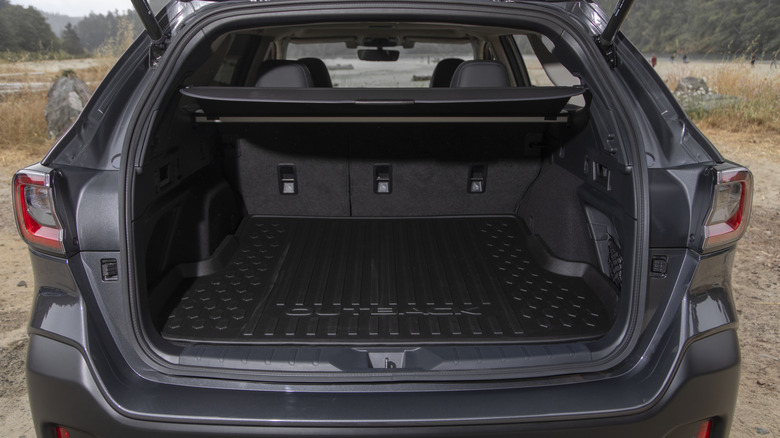
What mattered was that the wagon body translated into a very practical interior. The sixth-gen Outback could swallow 32.5 cu. ft. with all five seats in place, growing to an excellent 75.7 cu. ft. with the rear seats folded. Furthermore, the Outback's low trunk lip made loading heavier items easier than in a regular crossover.
Okay, those are some standard features for a station wagon, but what about the crossover part? Well, despite its wagon roots, the sixth-gen Outback is actually a more capable off-roader than most crossovers. Every trim came standard with AWD and 8.7 inches of ground clearance, making it usable on light terrain.
Prices of the sixth-gen Outback range between $17,000 and $35,000. You can choose between two engines paired with CVTs. The base 2.5-liter boxer produces just 182 hp and feels lethargic, while the 2.4-liter turbocharged boxer produces 260 hp. The latter may be better suited for the Outback, bringing it to 60 in 6.3 seconds according to Car and Driver.
2014 to 2020 Nissan Rogue (39.3 cu. ft. / 70 cu. ft.)
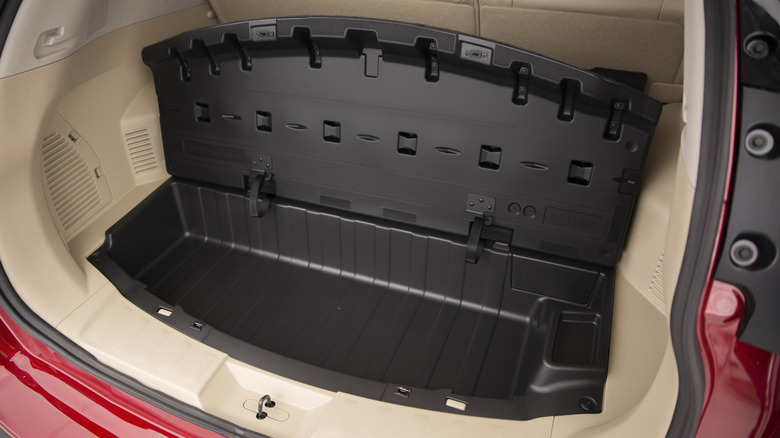
The current generation of the Nissan Rogue debuted in 2021, bringing sharper looks, improved driving dynamics, and a high-tech interior. Now, the previous, second-gen model looked duller, but it's the more practical crossover. With all five seats in place, it can swallow 39.3 cu. ft. worth of cargo, compared to 36.5 cu. ft. for its successor. In addition, the 2014-2020 Rogue came with the Divide-N-Hide removable shelf, which allowed different loading configurations. That said, the newer Rogue has more space with the rear seats folded (74.1 cu. ft. vs. 70 cu. ft.).
Unlike the latest Rogue, which is strictly a five-seater, the previous model was also available with an optional third row. Those seats were tiny, though, and really suited only for toddlers. Not to mention, with all seven seats in place, the cargo capacity is down to a barely usable 9.4 cu. ft. Still, the saving grace are the first two rows, which offer plenty of room for adults.
Perhaps the biggest limitation of the second-gen Rogue was the underpowered 2.5-liter four-cylinder engine with 170 hp and 175 lb-ft of torque. Nissan kept the same engine in the facelifted 2017 Rogue, which made it the least powerful base AWD compact crossover at the time. What's more, it was only available with a CVT, though at least you could get AWD. Prices for the second-gen Rogue range from $7,500 to $16,000.
2019 to 2025 Honda Passport (41.2 cu. ft. / 77.9 cu. ft.)
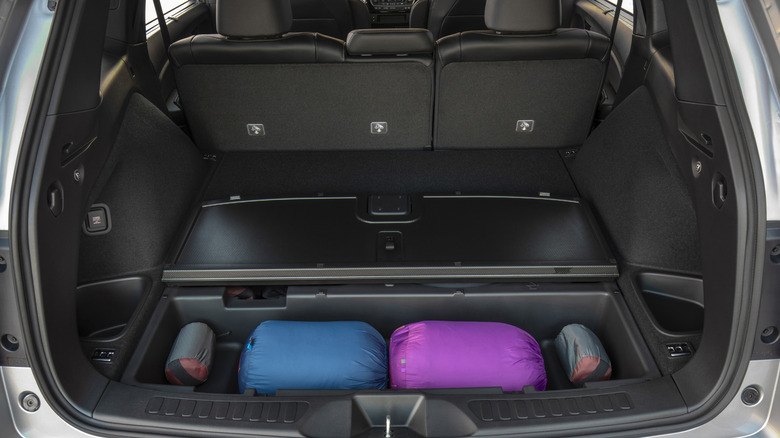
With a more rugged design and new off-road hardware, the brand-new 2026 Honda Passport has dipped its toes deep into adventure territory. But that's not to say it threw practicality out the window — the 2026 Passport has a class-leading cargo space of 44 cu. ft. with the rear seats up, and up to an astonishing 83.8 cu. ft. with the seats folded.
Still, at $46,445 (including destination fees), the latest Passport is quite expensive. Fortunately, you can purchase the previous model for as little as $20,000 without losing much on the practicality front. Launched for the 2019 model year, the third-gen Passport packed a sizeable 41.2 cu. ft. trunk behind the rear bench and 77.9 cu. ft. with the seats folded. The cabin is also plenty spacious for adults, with seats that make longer journeys more comfortable. That said, despite competing in the mid-size category, the Passport wasn't available with a third row.
Like the current model, the 2019 Passport came with a 3.5-liter V6, good for 280 hp. Paired to a nine-speed automatic, the V6 brought the Passport to 60 in just 5.8 seconds according to Car and Driver. And it's not just straight-line speed; the Passport also drives well in the corners without sacrificing ride comfort. Not to mention, the 2019 Honda Passport is still solid as a casual adventure SUV. 4WD models had a decent 8.1 inches of ground clearance, including the TrailSport trim, introduced in the refreshed 2022 Passport.
2009 to 2019 Ford Flex (20 cu. ft. / 43.2 cu. ft. / 83.2 cu. ft.)
Ford discontinued the Flex after the 2019 model year — not at all surprising for a vehicle with a station wagon shape, though with 5.9 inches of ground clearance, it's more of a crossover. But we'd argue that people didn't appreciate the Ford Flex enough. After all, it's a perfect remake of the classic American station wagon, with a sleek, squared-off design that stands out from the crowd. This is particularly true for the refreshed 2013 Flex, which is quite the looker.
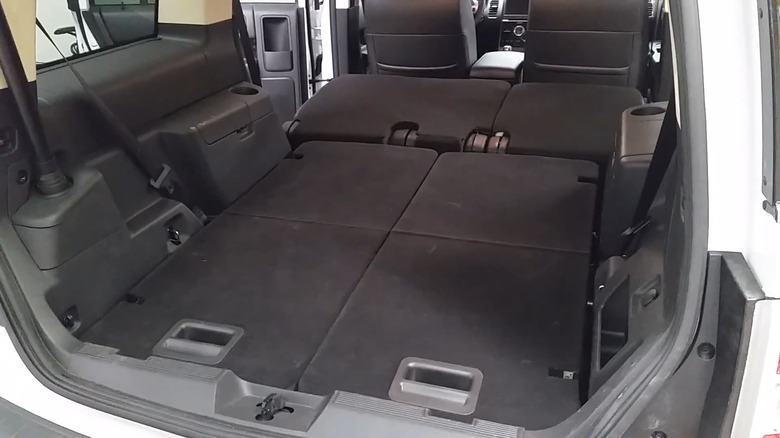
That boxy design paid its dividends inside. The Flex had three seating rows inside, with the first two providing passengers with ample space in all directions. Behind the third row, there was a decently sized 20 cu. ft. cargo area, which grew to 43.2 cu. ft. with the third row folded. With only the two front seats in place, the Flex transformed into a cargo van with an excellent 83.2 cu. ft. capacity. The best part? The second and third rows folded completely flat.
But the Flex was not only practical; with the right engine, it was also a rocket in a straight line. And that engine would be the 3.5-liter EcoBoost V6, which produced a whopping 365 hp. Accompanied by the standard six-speed auto, the EcoBoost brought the Flex to 60 in just 6.2 seconds, according to Car and Driver. The boxy crossover was also available with a naturally aspirated V6, initially good for 265 hp, or 285 hp after the 2013 refresh. Prices of used Ford Flex crossovers range between $8,000 and $26,000.