

The Main Differences Between Motorcycle And Car Engines
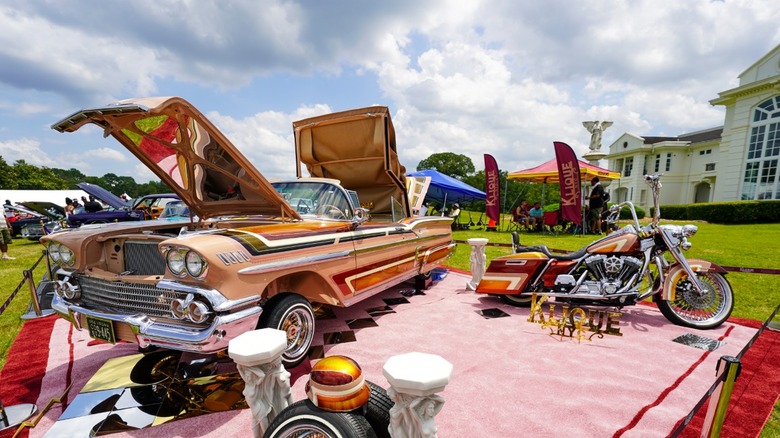
Are you ready for a ground-shattering truth? Motorcycles and cars are different. We know, shocking, isn't it? But those differences become even more apparent when it comes to their engines. While it's true that both gas engines in cars and motorcycle engines are driven by internal combustion and share parts like pistons, cylinders, spark plugs, crankshafts, and other components, they are built to move their respective vehicles in different ways.
Because motorcycles are very light, speed is prioritized over torque. Their engines rev much higher than cars. Car engines have the opposite priorities, because they have much more weight to move. At the same time, motorcycle engines have to be designed to be compact due to space and weight constraints. Along that line, engine configurations are more varied in motorcycles than they are for automobiles. Motorcycle engines are a lot more integrated with their transmissions than car engines are, as they share the same pump and use the same oil. And you can still find motorcycles that are air-cooled and don't use liquid coolant. There are, in fact, pros and cons for both liquid-cooled and air-cooled motorcycle engines.
Motorcycles are generally much more fuel-efficient than cars, but at the same time, especially in the case of older motorcycles, can be worse for the environment. In fact, the EPA has been far more lenient with motorcycles than with cars in that regard, though regulations have tightened up for bikes.
Motorcycles have a wider variety of engine and cylinder configurations
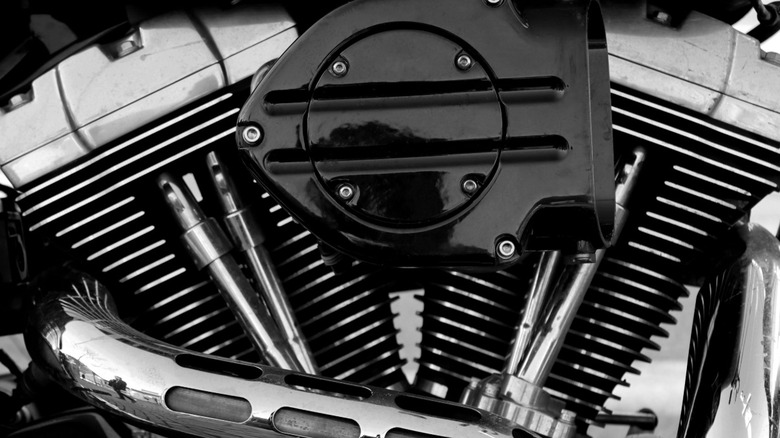
The engines in most cars today have all of their cylinders lined up in a row, like inline-4s and inline-6s, or they're arranged in a "V" formation, like V-6s, V-8s, V-12s, and so on. There are occasional odd configurations, like Wankel rotary and horizontally opposed engines — think the flat "boxer" engines found Porsches and Subarus — but for the most part, you're looking at either an inline or a V.
Motorcycle engines also come in inline and V configurations, but horizontally opposed "flat" or "boxer" engines are much more common. Generally found in two-cylinder form, and known as flat-twins, the cylinders are positioned straight across the crankshaft from each other. On some models, the cylinder heads stick out from the side of the frame, making them vulnerable to scraping the asphalt. The Honda Gold Wing also sports flat fours and flat sixes, which are big, heavy, engines that are expensive to manufacturer, and suited for luxury touring models. And let's not forget the single-cylinder motorcycle engines. They tend to shake and need to be counterbalanced with components like heavier flywheels. But these little engines have their place among motorcycles, especially where simplicity is prioritized over power, like with off-road, dual-sport, and enduro style bikes.
A real aberration in the bike world is the Boss Hoss. These motorcycles basically have automobile engines, specifically Chevy V8s, strapped to them. They sport semi-automatic transmissions with reverse and some have stick shifts. They start for the low, low price of $70,000.
Motorcycle engines need more frequent maintenance than cars
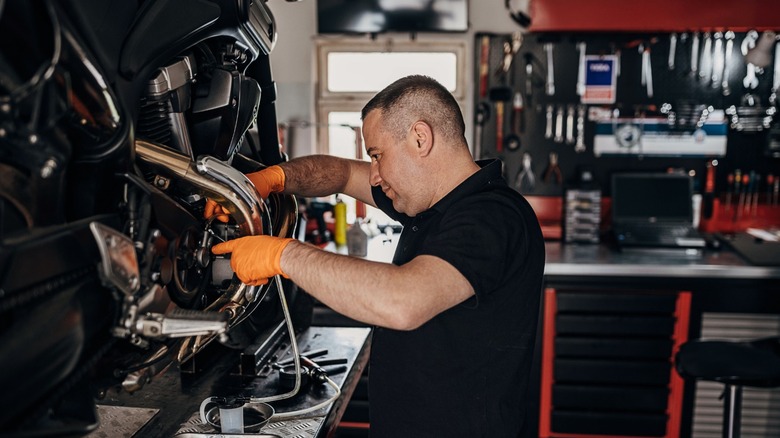
That little sticker you get from the oil change shop tells you to get your car's oil changed every 3,000 miles, but that 3,000-mile "recommendation" is usually exaggerated. Many manufacturers nowadays say to get the oil changed at intervals of 7,500 to 10,000 miles. Other than that, maybe you're doing things like changing your spark plugs every 10,000 miles or so.
Motorcycles need maintenance, especially oil changes, to be done more frequently than that. Older motorcycles and some newer ones are primarily air-cooled. Unlike car engines, they don't have liquid coolant running through them. In those cases, engine oil often picks up the slack, also being used partly as a coolant. More than that, motorcycle oil is used, not just to lubricate the engine, but the transmission as well. That's one of the reasons why you can't use the same motor oil for cars for motorcycles. But all of that also means that more of a strain is put on motorcycle oil than automotive oil, requiring more frequent oil changes. If you ride your bike mostly in stop and go traffic, Haynes recommends changing its oil every 2,000 to 4,000 miles. Not too bad, right? Well, if you mostly make short trips with your bike, it's recommended to change the oil every 1,500 to 2,000 miles. And if you take your motorcycle off-road a lot? Haynes says to change it every 500 to 1,000 miles.
You can rev a motorcycle engine much higher
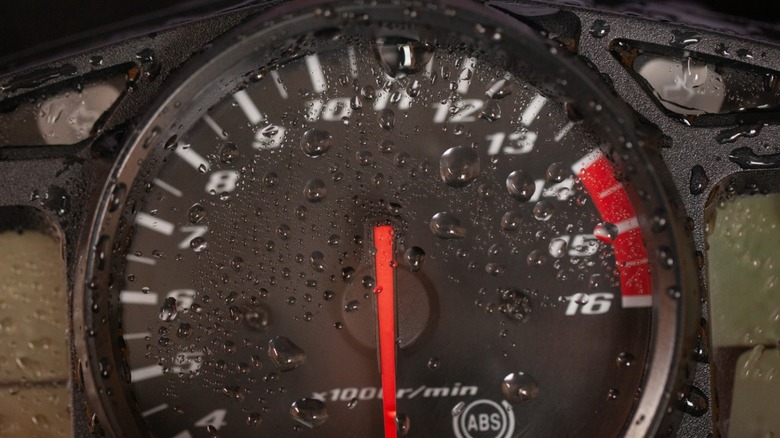
Motorcycle engines operate at much higher revolutions than car engines. While it differs by model, a car will typically run in the 1,500 to 3,000 RPM range. It runs at much lower RPM when idling, usually 600 to 1,000. Hard acceleration can take you to 5,000 RPM or beyond, depending on the engine. Typically, you can damage a lot of car engines by running them consistently over 4,000 RPM. Rev limiters on most cars will max out at 6,500 or 7,500 RPM, and only a handful will get somewhere in the region of 9,000 RPM.
The right running RPM range for a motorcycle depends on the type of bike. For example, the ideal range for cruisers is generally 2,500-4,000 RPM, not too much higher than for a car. But dirt bikes operate between 6,000-9,000 RPM and sport bikes often run well between 7,000-10,000 RPM after a good warm up. Of course, max RPM are much higher. Ducati, for instance, says its Desmo450 MX engine can reach 11,900 RPM.
Why the difference? It comes down to how much torque an engine needs to do its job. Motorcycles are far lighter than cars, so their engines need less torque to move them. Cars are much heavier, and so need to prioritize torque. There are exceptions on both sides. Harley engines rev lower because they are tuned for more torque than power, while some racecar engines are tuned to rev very high, but the car itself has to be really light.
Gas mileage, the EPA, and emissions
The EPA requires car manufacturers to test their car's gas mileage in different ways, putting then through multiple cycles that are meant to represent various driving routines. The testing has to account for, not only city and highway driving, but also faster speed and acceleration, the use of air conditioning, and cold winter temperatures. And they have to do that for every variant combination of engine with transmission and loaded weight. But the EPA doesn't just trust the automakers to report gas mileage numbers for their own cars.
The agency doesn't require fuel economy testing for motorcycles. But everyone knows motorcycle engines get better gas mileage than a car anyway, right? Surely that means motorcycles are better for the environment? Not quite. While motorcycle engines use less gas and therefore put out less exhaust, the volume of the exhaust isn't as important as the pollutants it contains. You see, it has been mandatory in the U.S. since 1975 for new cars to have catalytic converters, which catch nitrogen oxide, hydrocarbons, and carbon monoxide before they get a chance to exit the tailpipe. It wouldn't be until the early and mid-2000s, when emissions standards for motorcycles tightened up in the U.S. and E.U., before cats began to be widely used in new bikes. That means there are a lot of motorcycles still on the road putting out dirtier exhaust than the average heavy-duty pickup.
Transmissions, clutches, and shifting are handled differently

We don't need to tell you that gears are shifted differently on a motorcycle than they are in a car with a manual transmission. Usually on a motorcycle, you shift the foot lever down from neutral into first, then back up once through neutral, than up once again to get to second. You shift up once again to get to third, and the same for fourth and so on. Shift positions for a manual car's gears are usually arranged in an "H" shape with additional right angles.
Clutches are different in bikes and cars, as well. Most motorcycles have wet clutches, which means they're bathed in oil, mostly for cooling and lubrication. A motorcycle's setup is ideal for this, because the engine and the transmission share the same sump, making it easy for the oil to flow between them. That is completely different from cars, of course, because automotive engines and transmissions are separate. On the other hand, most cars with manual transmissions have dry clutches, which provide better feedback to the driver and don't have to deal with fluid drag. The lack of fluid drag is why racing bikes often have dry clutches instead. The downside of dry clutches is that the clutch plates wear out faster and can overheat more easily.