

Was This Oldsmobile Actually America's First Muscle Car?
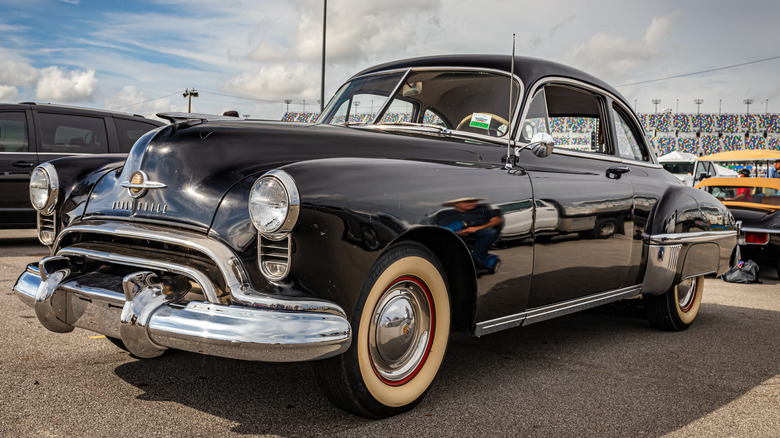
By most people's definition, a "muscle car" is V8-powered, front-engined, rear-wheel drive, made in America, and generally has a coupe body style. So by these metrics, the 1949 Oldsmobile 88 would certainly qualify. It has a big honkin' Rocket V8 under the hood, so check. Those 303 cubic inches were decently voluminous for the era, and it featured go-fast goodies like a dual-plane intake, forged crank, and aluminum pistons, even if the horsepower was only 135 gross ponies. It's rear-wheel drive, so check there, too. The 88 was offered as a two-door coupe, and Oldsmobile is as American as a bald eagle wearing blue jeans. So there you go. The Rocket 88 is a reminder of Oldsmobile's good old days before its sad death, and was America's first muscle car.*
Oh no, an asterisk! All right, there are other possible firsts. How about the 1932 Ford V8? It ticks the boxes and Clyde Barrow of "Bonnie and Clyde" fame allegedly wrote a letter bragging about its speed. And the 1935 Duesenberg SSJ was a 400-horsepower monster, though its supercharged straight-8 didn't have a V configuration.
The answer may lie in intent. Those '32 Fords brought V8 power to the masses, though not for the purpose of drag-strip acceleration, but rather to offer power formerly available only to luxury-car buyers (and crush Chevrolet's inline-6 in sales). As for Duesenbergs, well, they were the epitome of luxury and expense.
The ethos of a true muscle car goes beyond its layout and country of origin. It must provide power and speed, but be within the financial reach of the average person. With this in mind, two cars usually get the attention as possible alternate first muscle machines over the 88: The 1955 Chrysler C-300 and the 1964 Pontiac GTO.
Challenger one: The 1955 Chrysler C-300
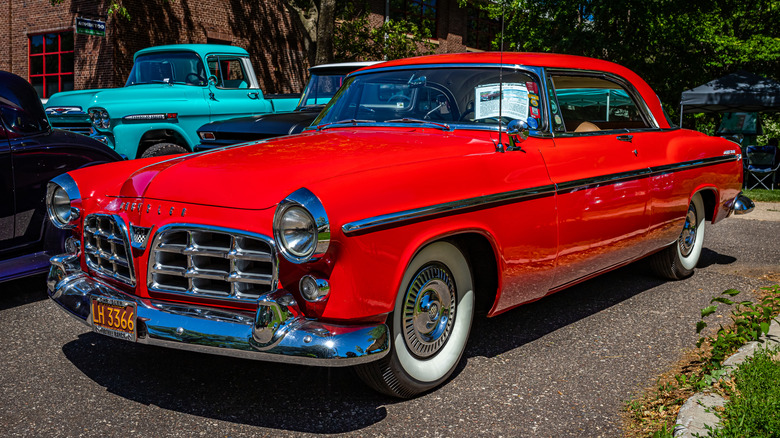
Like the Olds 88, the Chrysler C-300 raced in NASCAR, had V8 power driving the rear wheels, and only came in a two-door body style. And boy, did it have power. The Rocket V8 had grown to 324 cubic inches by 1955 and put out a solid 202 gross horsepower, but the C-300 made that Olds seem like a golf cart with lofty aspirations. The C-300's hood was filled with 331 cubic inches of Chrysler FirePower Hemi, and it was the first American V8 the average consumer could buy with 300 hp (gross though it was).
Despite the softness that later 300s would acquire, 1955's C-300 was a real performance effort that could hit almost 130 mph. It didn't come with air conditioning, outside mirrors, fog lights, or backup lights. With the exception of standard leather interiors, the C-300 turned its nose up at any frivolities that didn't help it go faster.
There are two problems with calling the Chrysler C-300 the first muscle car, though. First is MSRP. The base price of Oldsmobile's 88 series in 1955 was $2,436 ($29,523 today), while the Chrysler C-300 cost a comparatively house-like $4,109 ($49,799 today). This was Cadillac territory. That said, cost isn't the only consideration. If it were, then the $7,200 ($63,721 today) Fred Gibb 1969 COPO ZL1 Chevrolet Camaros wouldn't qualify as muscle cars, either. The difference may be that there was only one level of C-300 in 1955, the pricey one, and Camaros spanned a range of performance tiers that began at just $2,727 in 1969 ($24,134 today).
Problem two is that the C-300 was designed for top speed, not rowdy, tire-smoking acceleration (9.8 seconds to 60 mph!). It's just not rough enough around the edges.
Contender two: The 1964 Pontiac GTO
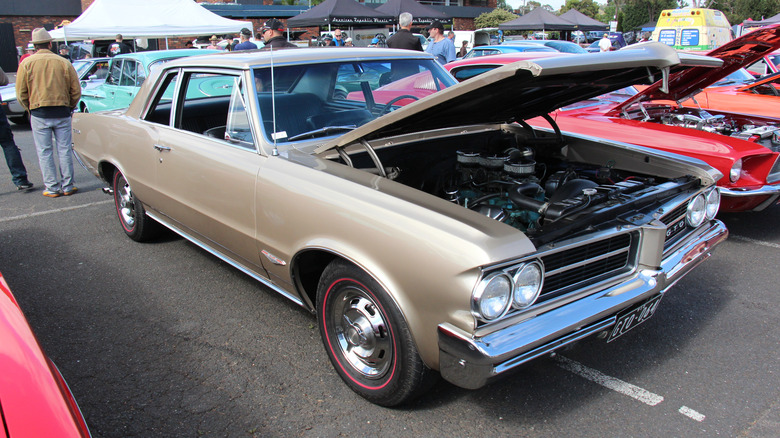
When John Z. DeLorean had Pontiac jam the 389 V8 into the Tempest/LeMans, the template was set for what muscle cars were supposed to be. The faux-racing-branded 1964 Pontiac GTO wasn't as fast as Ferrari's 250 GTO (even Car and Driver itself refers to its infamous March 1964 comparison as "fictional"), but it was still built with speed as the ultimate goal. Plus, it was affordable. The MSRP for a '64 GTO when new was $2,780 ($29,127 today). Buyers could choose the "Tri-Power" triple two-barrel setup for 348 gross hp and, if they had self-respect, a Muncie four-speed manual transmission.
The reason the GTO gets brought up so often as the first real muscle car is likely because of its image. Muscle cars are generally brash, loud, and marketed toward younger demographics (or those who want to feel younger). One 1964 Pontiac GTO ad began with the line, "For the man who wouldn't mind riding a tiger if someone'd only put wheels on it." Meanwhile, Oldsmobile Rocket 88 ads featured the comparatively lame "Make a date with the '88,'" and both "Rocket" 88 and Chrysler 300 ads featured a drawing of a suit-wearing man driving his wife around at a safe speed. If Chrysler's and Oldsmobile's ads depicted someone spinning doughnuts in a parking lot, maybe they would get more consideration.
As for music, one can debate the merits of "Little GTO" by Ronny and the Daytonas vs. "Rocket '88'" by Jackie Brenston and his Delta Cats (who really were Ike Turner's Kings of Rhythm). The '55 Chrysler C-300 never got a song, but it did get a movie called "300," which starred Gerard Butler. That's what that movie's about, right?