

Honda's 'The Cog' Commercial Is Legendary, Here's Why It Was Accused Of Plagiarism
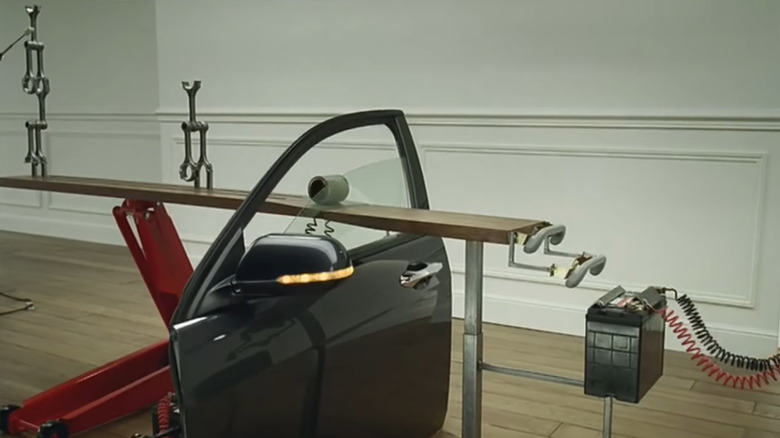
The Honda Accord had already been on sale for 27 years when it was redesigned for the 2003 model year, and while it achieved plenty of success along the way, that new seventh-generation version marked "the most dramatic change" yet for the car. In fact, we gave it the top spot when we ranked every single Honda Accord generation. With that in mind, Honda debuted an equally dramatic television commercial that would go on to garner multiple industry awards — along with loud cries of plagiarism from at least one quarter.
The Honda ad, dubbed "The Cog," features a Rube Goldberg-style chain reaction made from actual Accord parts. A single cog enters the picture, setting things in motion, and you're treated to about 2 minutes of various Accord components bumping, rolling, and falling into each other in a carefully laid-out progression that ends up showing off a completed 2003 Honda Accord station wagon. Rube Goldberg was born in 1883, and he had already become well-known for drawing his distinctively complicated machinery by 1922. In fact, the concept became famous enough that his name was included in the 1931 edition of the Merriam-Webster dictionary.
Jalopnik readers of a certain age may remember the game Mousetrap, which premiered in 1963 and required players to build Goldbergian contraptions for catching toy mice, which goes to show that plenty of people were familiar with the concept before Honda tried its hand at it. Among them were a pair of artists, Peter Fischli and David Weiss, who had made their own much-lauded 30-minute film of a Goldberg device in 1987 titled "The Way Things Go." So, when they saw the Honda ad, they were pretty sure that the creatives behind it had seen their film and plagiarized it.
Honda avoided a lawsuit but admitted its mistake
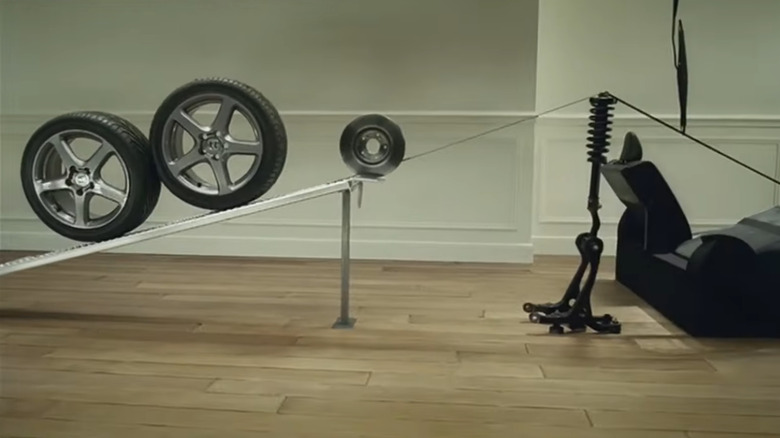
Fischli and Weiss never filed a lawsuit over the commercial, but they did go public with their concerns. The artists didn't claim the chain-reaction idea was theirs, of course. Instead, they pointed out several specific instances where it seemed like Honda directly copied their film. For instance, there are scenes in each video where tires seem to roll uphill — thanks to some carefully placed hidden weights. It could have still passed as a coincidence, but a member of the creative team behind Honda's ad eventually flat-out admitted the Honda scene was taken from the Fischli/Weiss production.
Unfortunately for the artists, proving a copyright infringement case like this can be difficult, time-consuming, and expensive. So, once Honda had publicly acknowledged its debt to the earlier film, Fischli and Weiss seem to have backed off. They may have been satisfied with knowing that this ad won Honda a Gold Lion award at the 2003 Cannes Lions International Advertising Festival, which is better than being known for the cringiest car marketing you've ever seen.
There was also some question about whether the Honda commercial used CGI or not. However, except for stitching together two separate takes and adjusting some lighting near the end of the spot, the rest of the ad was the real deal.
The Honda Accord, on the other hand, appeared to be unaffected by the furor. It may not have been one of the greatest Japanese cars ever, according to our readers, but the 2003 Accord was the second-best-selling car in the United States for 2003, with 397,750 deliveries and was named both Japan Car of the Year and mentioned in a Car and Driver's 10Best list that year.