

When Talking About Corvettes, Is It Stingray Or Sting Ray?
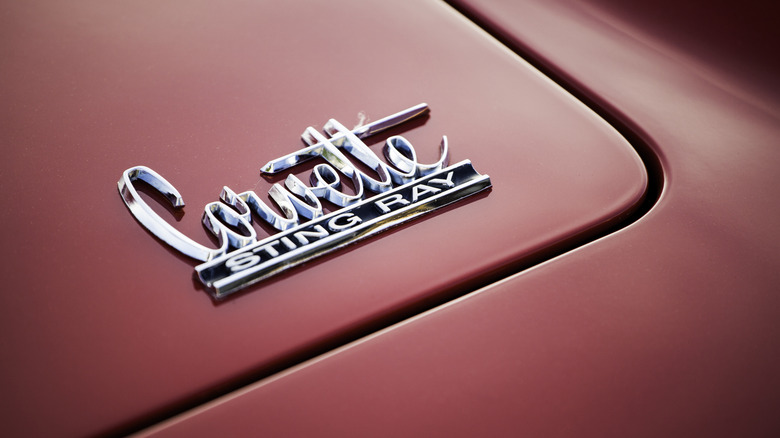
From the modest 150-horsepower Blue Flame-powered C1 to the insanely quick 1,250-hp Corvette ZR1X, America's iconic sports car nameplate has come a long way during its 70-year-plus history. Equally worthy of cherishing is the Stingray moniker, which has adorned several Corvettes since the early 1960s. However, it wasn't always spelled as a single word. In fact, C2-generation Corvettes (and even some C3s) were marketed as "Sting Ray" rather than "Stingray," the latter being the standard in modern Corvette lingo. So yes, both are valid.
It was in 1963 that the "Sting Ray" script first became part of a production Corvette. While no one disputes the C2s, certain C3 model years can cause some confusion. According to Hagerty, when the C3 came out in 1968, brochures were seen marketing the Corvette as the Sting Ray (two words), but for 1969, GM began using the Stingray script on the C3's fenders as a single word. It's worth pointing out that the '68 model did not have either of those emblems, which could be the reason behind the confusion. Technically, though, a '68 C3 isn't a "Stingray" but more precisely a "Sting Ray," going by the marketing blurb. The Stingray moniker (single word) was retired in 1976, only to return years later in the C7 generation. While the C8 Corvette ditched the front-engined layout for a mid-engined setup, it carried on with the Stingray naming scheme, albeit with an exotic outer shell.
Sting ray versus Sting Ray?
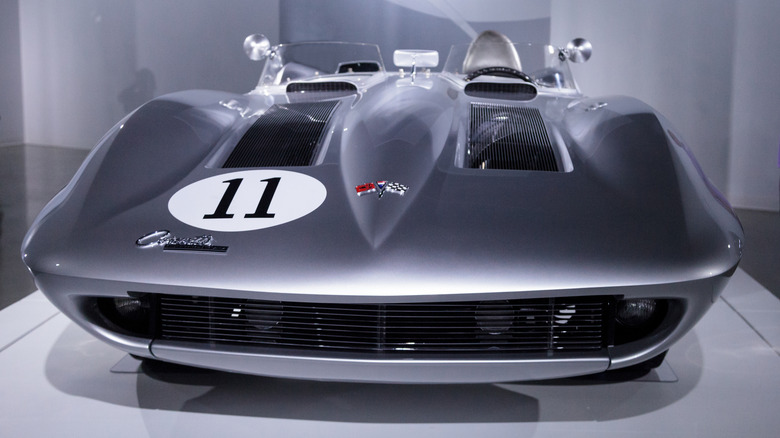
Something else that may be of interest is the "Sting ray" versus "Sting Ray" debate — separate words but with a lowercase "r." This, however, is not necessarily about road-going cars but more about Bill Mitchell's ex-racecar, popularly known as the XP-87 Stingray Racer. Arguably, while the ex-racer may not have been the best-looking of all the XP cars, it was certainly beautiful. The design concept played a crucial role in the C2-generation looking the way it did.
The controversy, however, revolves around the naming, specifically the side badge. Although the '59 racer was badged the Stingray (one word) with no Corvette lettering anywhere, when GM bought it, someone from the graphics department may have split the Stingray emblem into "Sting" and "ray," while preparing for the '63 C2 reveal, writes Martyn Schorr — an automotive journalist, historian, and the founder of Vette Magazine — in this piece for Dean's Garage.
While it was officially called the XP-87, Martyn explains in detail — using enhanced photographs and renderings — that Bill Mitchell's racecar-turned-GM show car did, in fact, feature "Sting ray" on its fenders as two separate words, with a lowercase "r." GM later added the production Corvette Sting Ray emblems (that you'd find on the C2), which the racer never had when it was conceived. The funny thing, however, is that according to Christo Datini, the manager of GM Design Archive and Special Collections, even the internal documents used both iterations, though GM's original intentions were to use "Stingray" as one single word.