

How To Choose The Right Replacement Battery For Your Old Harley-Davidson
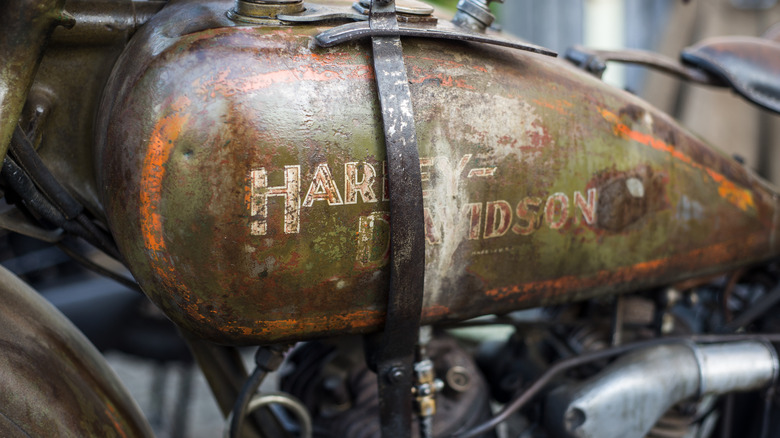
Click. Click, click, click. Your headlamp flickers. These are the unmistakable sights and sounds of a Harley-Davidson with a flat battery. Bummer. Even worse, this particular battery won't hold a charge even after you attempt to coax some life into it using jumper cables or a portable jump starter, meaning it's a properly dead battery. Double bummer. Let's face it, some things can't be helped. So, when a battery is past its usable lifespan and won't maintain enough juice to turn over your V-twin, it's best to replace it with something else — ideally, something with the ability to hold a charge just as well as or better than the stock battery.
But how do you pick the right battery to swap into your hog when the old one gives up the ghost? There are a few things to consider, especially when we're talking about an older Harley or working on a budget. On the one hand, the tried-and-true absorbed glass mat (AGM) batteries are affordable and dependable. And on the other, lithium batteries offer benefits like weight savings and cranking power.
Always check your owner's manual to ensure you're buying a battery with enough cold cranking amps, the correct voltage, and the right case size. Picking the right battery can yield benefits like easier startup in colder temperatures and a slowed discharge rate. Then again, opting for the latest and greatest lithium-ion battery can also be much, much more expensive than other applications.
AGM vs. lithium-ion batteries
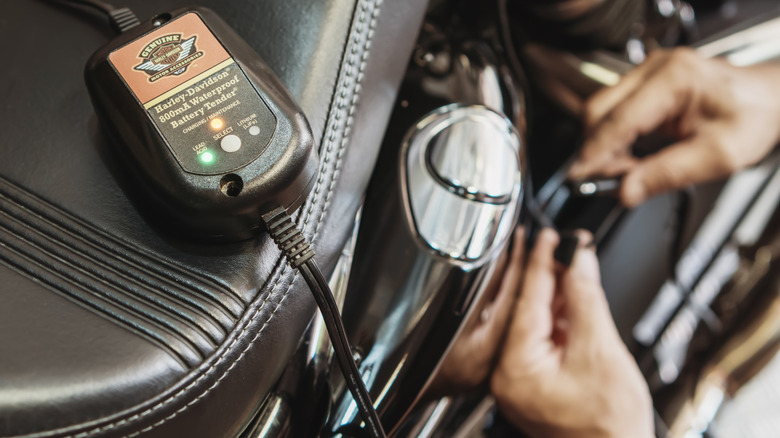
As your motorcycle ages, electrical and charging system components deteriorate. To compensate, your battery is going to have to work hard to turn over your V-twin. So, how do you pick the right battery for your ride? Depending on the age of your Harley-Davidson, you likely have a sealed 12-volt AGM battery. An AGM battery is a type of lead-acid application, meaning the battery uses a liquid electrolyte solution to enable the electrochemical reaction that converts chemical energy into the juice that powers your bike. AGM batteries use a glass fiber mat to absorb battery acid and a sealed case to better resist spillage.
Then there are lithium batteries, which incorporate a lithium-based material for the positive electrode, a carbon or graphite negative electrode, and an organic electrolyte solution. On the plus side, Lithium batteries typically offer more cranking power. Sounds good, right? Well, an AGM battery may still be the ticket for your aging Harley. For starters, lead-acid batteries are typically much more affordable than their lithium counterparts. How much more? Lithium batteries may cost three to four times more than an old-school lead-acid alternative.
For a 73.4-cubic-inch or larger V-twin, 300 to 350 of those vital, starter-spinning cold cranking amps (CCA) will often do the trick. As a rule of thumb, a minimum of 1 CCA per cubic inch of displacement is a good way to ensure your engine has enough juice to turn over. Applying that logic, the popular Twin Cam 96 requires at least 96 CCA to turn over. What it doesn't require, however, is that you over spend when less cranking power will do the job.
Charging, weight, and staying juiced-up in the cold
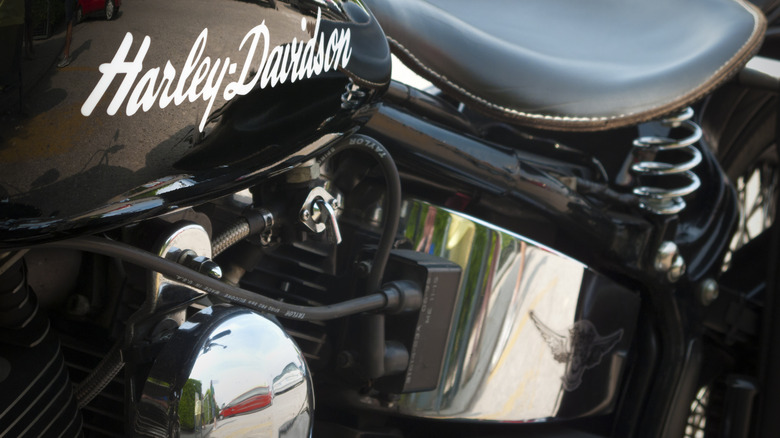
Being unnecessarily spendy isn't the only strike against lithium-ion batteries for older Harley-Davidsons. A lead-acid battery tends to bounce back from a deep discharge better than its lithium counterparts. Don't ride your old Harley every few days? You'll want to use a charger to keep your battery topped up, whether it's a fancy lithium unit or an AGM package. That said, you'll likely need a lithium-compatible charger to keep the former in tip-top shape. See? The AGM is simple, cheap, and plays well with your old equipment.
Just like when it comes to the car batteries that experts consider the best in cold weather, cold weather performance should also be on your list of considerations when buying a motorcycle battery. AGM batteries may retain around 80% capacity at freezing temperatures. Lithium batteries, on the other hand, may not charge as well at temperatures below 32 degrees Fahrenheit.
That said, no battery is perfect. An AGM battery, for example, may weigh 70% more than a comparable Lithium battery. And with a 608-pound 1994 Harley-Davidson Super Glide producing 57.5 horsepower, extra weight can really slow things down. Still, while a lithium battery's robust CCA rating and lightness may be tempting, your old Harley can still turn over happily with a more affordable AGM battery.