

9 Affordable Convertibles That Show Automakers Used To Make Cool Cheap Stuff
Most people don't really need a convertible. They lack space, make a bunch of wind noise on the highway, and are mostly useless if you live in a climate with discernible seasons. But the feeling of a top-down drive (we're talking about the car's top, to clarify) is an event of euphoria sweet enough to transcend the confines of climate. Whether your region has just one month of sun a year or 12, it's hard for us to disregard that convertible experience.
We'd argue that more cars should be convertibles. With the right scenery and sunshine, a regular car with a drop top can be even better than the same drive with a fixed-roof sports car. The only issue is that the car industry has largely ditched the idea of an affordable convertible. Blame it on sedans going extinct (which many older convertibles were based upon), the rise of the SUV, or a general lack of whimsy in the modern car industry; the answer is the same — we don't have as many affordable convertibles nowadays.
To demonstrate this argument, we went on a mission to present you with a group of convertibles that prove two things: that you can still own a convertible for cheap, but in order to do so, you'll almost certainly have to go back a decade — or two, or four — to find it. Additionally, we didn't want to cop out and present a bunch of heavily depreciated Jaguars or Aston Martins that would've cost six figures when new, meaning that all of these picks would have been considered "affordable" when they sat on the showroom floor. And who knows, maybe you'll see some convertibles you completely forgot about.
MGB Roadster (1962-1980)
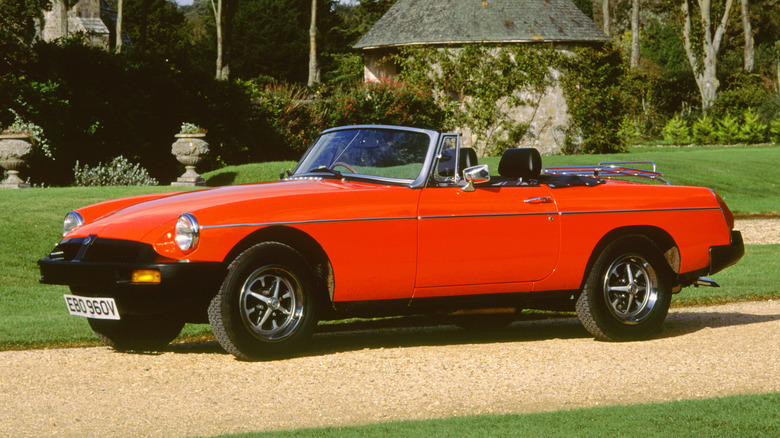
They may look like antiques to the current enthusiast, but the MGB was a major driving force in bringing this British brand into the modern era. The new unibody construction (as opposed to the older wooden-framed T-type cars), a more modern powertrain, and a fresh, sleek design meant that MG could now seriously compete for North American market attention. Long story short, it worked, and the B quickly became MG's most popular vehicle, remaining in production for nearly thirty years, between 1962 and 1980.
There were many small changes to the B over the decades, but a few stand out when looking for one's preferred example. One such item is the 1.8-liter inline-four, which debuted in the U.S. with around 95 horsepower in the 1960s, but would be choked down to around 65 or 70 horses by the 1970s emissions era. Also important to remember is that early MGBs (up until around 1968) had an unsynchronized first gear, so don't try any cheeky first-gear downshifts in the hairpins. Additionally, if you're looking for maximum build quality, the pre-1970 era was better, as after that point, British Leyland took over MG's parent company and replaced much of the accented metal and leather interiors with cheaper materials.
When new, the MGB was properly affordable, ranging anywhere from about $2,500 to $5,000 (mid-$20,000 range in 2026) throughout most of its production run, putting it firmly within reach for young buyers. Today, even after several decades of market fluctuation, the average MGB will cost about $10,000, according to Classic.com But of course, decent examples will exist in the $6,000-$7,000 range depending on where you look.
Fiat 500C Abarth (2012-2019)
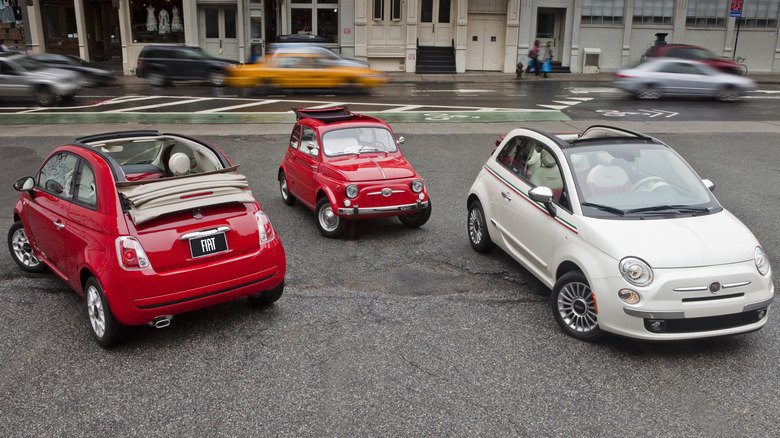
The Fiat 500 was a direct result of the post-war need for mass mobility in Italy, similar to how Japan's small motorized bikes and personal cars began to boom in the 1950s and 1960s. Its tiny stature, approachable (and very cute) design, and minuscule fuel-efficient engine made the "Cinquecento," as it was nicknamed, a wildly popular car, selling nearly 4 million units during its original production cycle from 1957 to 1975.
Then, in 2007, more than 30 years after the petite icon left the factory floor, it would resurface, this time with a front-mounted engine and more than 500,000 customization options (you read that correctly). It wasn't originally sold in the U.S., but by 2012 it finally arrived, having already sold around 1 million units abroad. In keeping with the fun, vacation-esque image that America had bestowed upon the 500, Fiat would give us a cabriolet version of the 500 called the 500C, which had a retractable cloth roof. Even cooler, Fiat also decided to give the base 1.4-liter gas four-cylinder a turbocharger for its high-performance Abarth trim, bringing output up from 101 horsepower to 160.
Customers could have the 500C convertible body style in Abarth trim, along with a standard five-speed manual. The Abarth also came with sporty Koni shocks, lower and stiffer springs, wider tires, larger brakes, and Abarth-branded door decals, creating the perfect little Italian ball of anger. In 2013, this exact spec would have cost $26,700 to start, which was a steal for a top-trim version of anything at the time. Now, thanks to depreciation and maybe some general fear of Italian reliability, the 500C Abarth currently sells for somewhere in the mid-$15,000 range.
Toyota MR2 Spyder
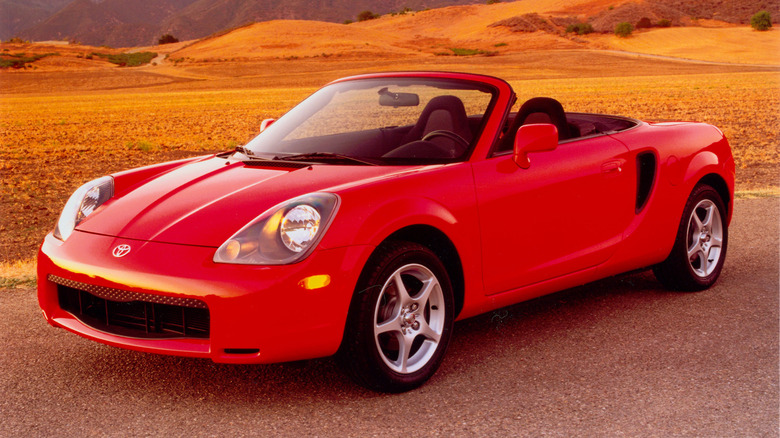
According to some enthusiasts, the third-generation MR2 is the wrong one. It doesn't have the rigid cyberpunk lines of the original 1980s AW11, or the optional turbocharged power and slick looks of the SW20, but we've fallen in love with the MR2 Spyder, and believe it deserves just as many kind words. It debuted for the 2000 model year with a radically new design — something in between its bubbly Miata competitor and the sexy Porsche Boxster. Most obvious, though, was its convertible body style being the only one available, and while MR2 purists may have preferred a hard top version, that lack of sheet metal meant the newly named MR2 Spyder would weigh less than any MR2 before it, coming in at around 2,200 pounds.
This car was, in a word, approachable. The 138-horsepower 1.8-liter inline-four, dubbed the 1ZZ-FED, was the only engine option throughout its 2000-2005 run, and while it didn't possess the outright grunt of the older Turbo models, it was plenty to toss around this drop-top lightweight. Additionally, the Spyder all but eliminated the nasty snap oversteer the SW20 became infamous for, giving inexperienced drivers a chance to ring out their MR2 without stepping beyond its limits. In its debut year, the MR2 Spyder cost customers $23,558, only about $2,000 more than the Miata it was targeting.
In the end, though, just under 28,000 total Spyders left the factory, making it rarer than both the first and second-generation MR2s. Luckily for you, in the MR2's case, its rarity doesn't correspond to its value, as in 2026, the average second-hand sale price for a third-generation MR2 comes in at about $11,200 — cheaper than both its predecessors.
Pontiac Solstice
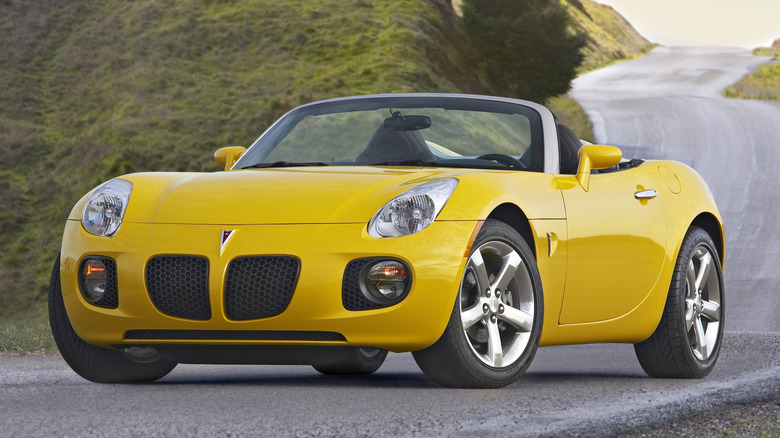
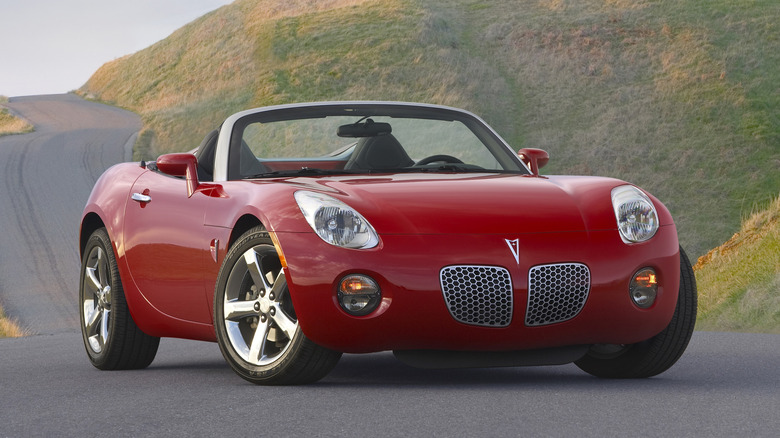
A topic like the Pontiac Solstice deserves a feature all its own. From Bob Lutz's personal involvement to its Vauxhall concept car roots to its $250 million development (that didn't really pay off), it's a genuinely fascinating story. But you only need to know the basics about this convertible to justify its position on this list of cool, cheap drop-tops. The Solstice originally debuted in 2002 at the Detroit Auto Show and was supposed to have an accelerated trajectory into production. But the car business is, well, the car business, and that show car would have to wait four years before officially hitting the streets for the 2006 model year.
The Solstice was curvy yet bold, and went directly after the NC Miata that also debuted in 2006. Powering the Solstice was GM's 2.4-liter Ecotec inline-four, putting down 177 horsepower and 166 pound-feet of torque, very similar to the Mazda's 170 horsepower and 140 pound-foot output. Interestingly, the Solstice was slightly cheaper than the Miata, with a base price of $19,915. Period reviews were generally positive despite its lack of gravitas in today's classic roadster conversation, with outlets like Car and Driver praising its sharp corner entry, predictable limit handling, comfort, and surprising sports car purity. But at nearly 2,900 pounds, the base convertible wasn't as inspiring as the lightweight Miatas or recently discontinued MR2 Spyders of the world.
In base form, the roadster retained the same powertrain until its discontinuation in 2009, but for those who thought the Solstice needed more power, there was a turbocharged, 260-hp GXP variant (though those are far more expensive now). Across all trims, including the high-performance GXP, average used sale prices are only around $13,500, meaning base models are floating out there for even less.
Chrysler Sebring Convertible
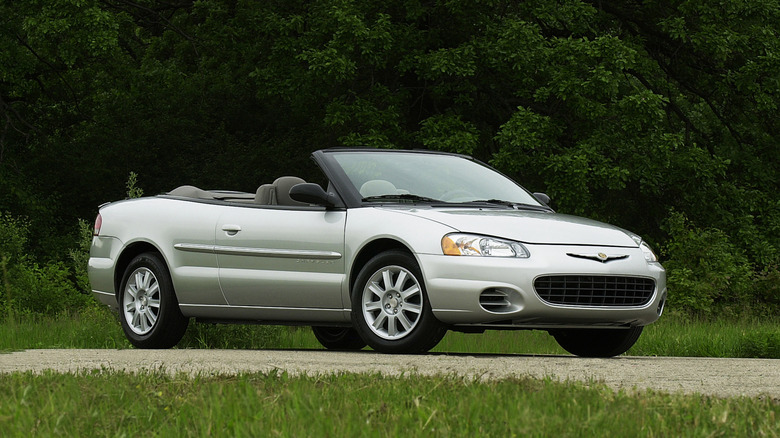
In 1995, Chrysler introduced what it called the JA platform. This new base was initially designed for models like the Dodge Stratus, Chrysler Cirrus, and Plymouth Breeze, all of which were a part of the new "Cloud Car" group. The cloud imagery in their names denoted feelings of spacious, open passenger cabins, and their names were all meteorological in nature. Ironically, the airy cloud car concept wouldn't be fully realized with the JA platform, but rather with the slightly modified JX chassis, which included a true open-air vehicle in the new Sebring Convertible.
At the time, the Sebring Convertible was a welcome newcomer to the Chrysler lineup, as it replaced the outgoing and convincingly outdated LeBaron convertible for the 1996 model year. Its attractive modern looks, Mitsubishi-sourced inline-four and V6 engine options, and four-seat capacity made the Sebring Convertible a strong competitor in its class at just around $20,000 in base form. And it proved to be a solid lineup supplement for Chrysler, as the convertible would be sold continuously from its 1996 debut until its ultimate demise in 2010.
When calculated for inflation, $20,000 in 1996 comes out to around $43,000 in 2026, which most of us would say isn't very cheap. However, upon digging into the current values, we just couldn't pass this one up. Most won't have to spend more than $5,300 for an average Chrysler Sebring convertible across the first two generations (1996-2006).
Fiat 124 Spider (1966-1985)
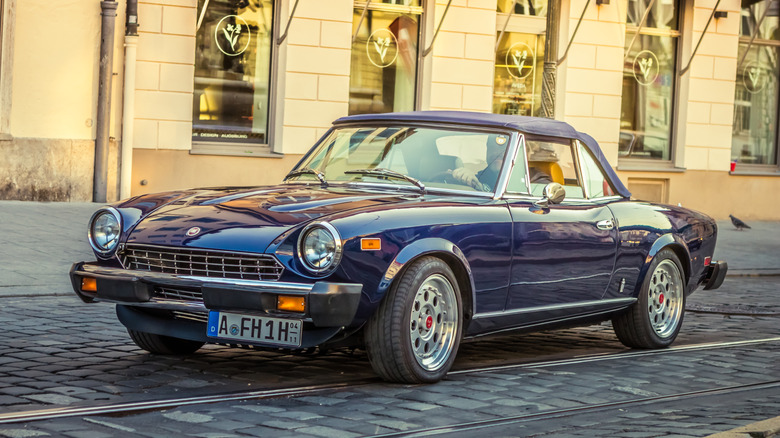
Roadster enthusiasts were spoiled in the 1960s. Depending on what you could afford, and what country you lived in, your options included the first-gen Corvette, Shelby Cobra, Honda S600, Alfa Romeo Spider, and the MGB, among others. But we often forget that the Fiat 124 Spider qualifies for that conversation as well. Debuting in 1966, the Fiat was about as close to the epitome of a small roadster as you could get with simple yet attractive lines, a convertible top, a small peppy engine, and a manual transmission. It didn't do enough to outshine its flashier competitors throughout its 20-year production run, but to us, all that shows is a potential for far more affordable fun 40 years later.
The Pininfarina-designed 124 Spider debuted with a 1.4-liter twin-cam inline-four capable of 90 horsepower, and was paired exclusively with a five-speed manual transmission. Over the years, there would be several notable changes, such as the upgraded 110-horsepower 1.6-liter engine in 1969, the additional 1.6 and 1.8-liter powerplants in 1972, and even a one-year-only turbocharged version in 1981. Sadly for us Americans, though, the U.S. examples only got 86 horsepower from their U.S.-spec 2.0-liter motor for most of its production cycle.
Even with this American handicap, the U.S. was the roadster's largest market, and with an original MSRP in 1980 of just around $8,800, the Fiat was within reach for the low-buck crowd. Compare that to 2026, where the average market value is $9,500 across all years, with lower-quality examples dipping down into the $6,000 range, according to Hagerty's evaluation. We must say, though: if a 124 finds its way into your garage, be prepared for those old Italian car quirks.
Pontiac Sunfire Convertible
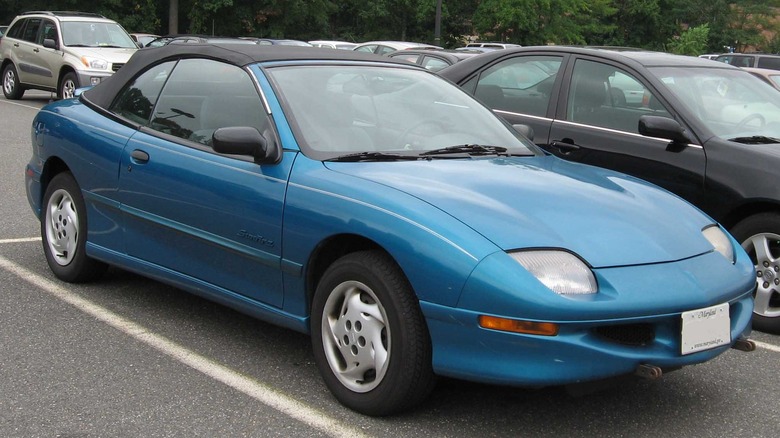
Some may not agree with the Pontiac Sunfire being "cool," but we decided to give it the go-ahead anyway. The car has unique, unconventional styling, it was and still is affordable, and for a short time between 1995 and 2000, Pontiac sold a convertible body style, which, to us, is enough to celebrate this mostly forgotten car. Oh, and don't forget, the convertible was offered exclusively in the special GT trim for 1999 and 2000.
The Sunfire was a replacement for the compact Sunbird, which had served the segment for nearly 20 years between the mid-1970s and mid-1990s as the sibling of cars like the Chevrolet Monza and Cavalier. Now, the Sunfire would bring the compact platform toward the new millennium with dramatic styling and more refined powerplants while still providing customers with the body styles they had come to expect. One such body style was the convertible, which was sold only until 2000 in the United States. Base convertibles used a 120-horsepower 2.2-liter engine while upgraded cars (particularly those with the GT package) came with a 150-horsepower 2.3-liter inline-four. Just one year after its debut, a new 2.4-liter engine would also arrive, with very similar outputs as the previous "Quad 4" engine, but with optimized mid-range torque performance.
While the Sunfire wasn't as spirited as, say, a Miata or compact BMW 3-Series from the same era, its original MSRP of around $20,000 was attractive and falls far below the current average new car price when adjusted for inflation. In the modern day, the Sunfire convertible's value continues to be its main attraction. Not much data is available for these cars, but current averages are usually around $6,600.
Mini Cooper Convertible (2002-2006)
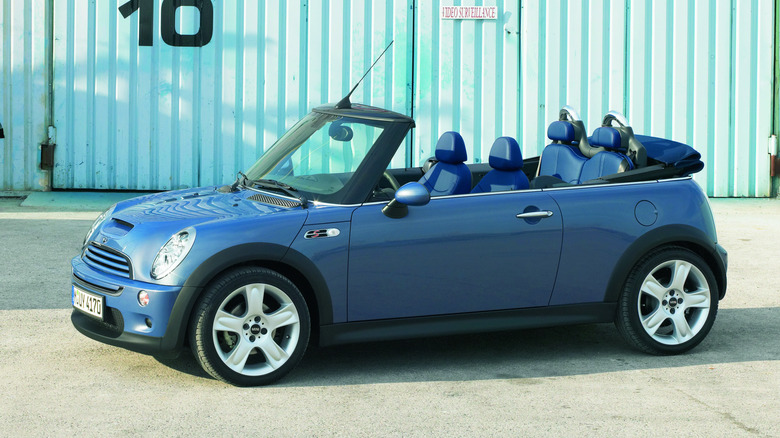
In a similar vein to the Fiat 500 Abarth, we've decided on another compact hatchback convertible — the first-gen (R50/R53) Mini Cooper. Of course, there was an original that debuted in the 1950s in Europe, but our focus is on the early 2000s, when the now BMW-owned Mini brand debuted a brilliantly retro-modernized version of the Mini Cooper. It first hit American streets for the 2002 model year and has since thrived as both cheap transportation and a fun weekend car.
The convertible variant debuted two model years later for 2004, and in base trim, sported the Cooper's regular 115-horsepower naturally aspirated 1.6-liter inline-four and your choice of a five-speed manual or CVT transmission. For a base MSRP in the low-$20,000s, the soft-top Mini was affordable, quiet enough, spacious, and had plenty of character to satisfy journalists at the time, and we can concur that these early Coopers are great to drive on a windy road.
We also won't rule out the Mini Cooper S Convertible, which added a supercharger to the 1.6-liter for 168 horsepower. They are more expensive on the second-hand market, but if you can swing it, those examples are like caffeinated go-karts. Speaking of expenses, the regular first-gen Mini Cooper Convertible should only cost between $6,000 and $10,000 for a decent example, while the S version stays convincingly in the mid-$11,000 ballpark.
Mazda Miata (NB)
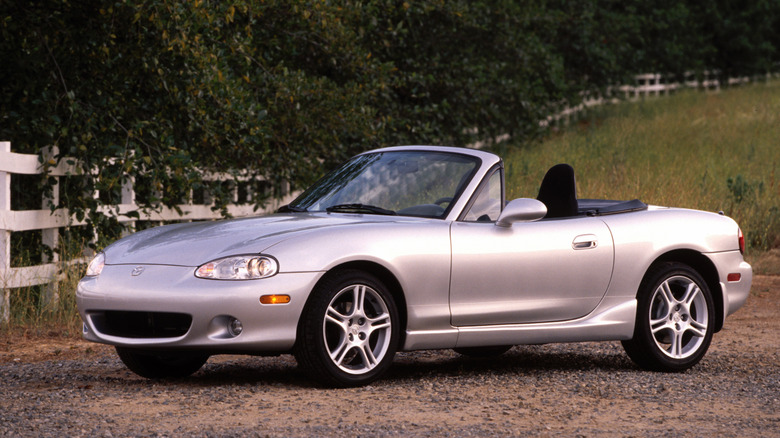
Call it unoriginal, derivative, or lazy, but omitting the Miata from this discussion is like leaving LeBron James out of a top three all-time NBA list. Simply, this car has been the benchmark in the roadster segment for more than 30 years now, and to many folks, the Miata is the best convertible of all time. For this list, we chose the NB-generation car, mainly due to the fact that its current average values of $10,500 are about the same as the NA, with both being cheaper than the newer NC and ND generations.
Why not the NA, then? While both are fantastic, the earliest NBs came with a 140-horsepower 1.8-liter engine, while the NA could only muster between 116 and 133 horsepower. There's also the argument for its updated suspension, interior, and mature bodywork, as well as its slightly younger age as it relates to mileage. Anyway, the NB generation continued throughout the early 2000s with minor changes, like a bump up to 155 horsepower in 2001 and the addition of standard 15-inch wheels. By 2005, the NB was in its last year, making way for the NC in 2006.
The NB is also notable because of its plethora of special editions. There were the 10th Anniversary models, Blazing Yellow Micah and Titanium Gray Metallic special editions, the Shinsen edition, Club Sport edition (only 50 of these exist), and, of course, the turbocharged Mazdaspeed Miatas, all with different combinations of wheels, interiors, paint colors, or weight-saving changes. Though, regardless of the spec, the NB is a car every enthusiast must drive. Its balance, versatility, cute looks, and exceptional manual shifters represent exactly what a top-down drive should strive to be.