

Why The Strongest Bolt Grade Isn't Always The Best For A Safe Car Repair
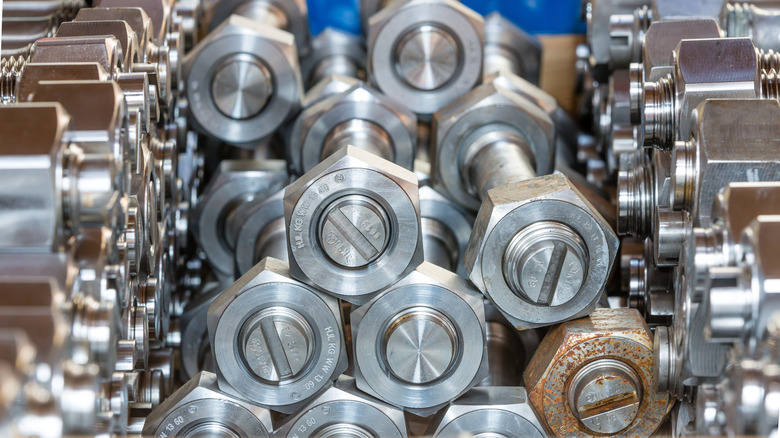
A single car can be made up of some 30,000 individual parts, and holding them all together for the long haul can be quite the challenge — one that requires a wide range of fasteners, too. Nor is it all fancy laser welding and high-tech adhesives. The humble bolt — and its partner the nut — are still used extensively when manufacturing cars and trucks.
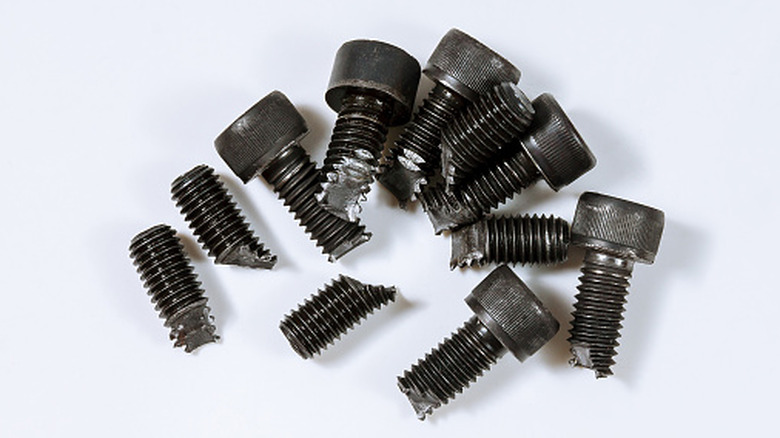
In some automotive applications, though, their role has changed a bit. Instead of being engineered to be strong enough for the life of the vehicle, using the strongest possible materials, certain bolts are sometimes purposely designed to be weak enough to let parts come apart — in very specific scenarios. For example, consider what happens when a car hits a pothole. The damage can definitely be extensive and lead to unsafe driving conditions, but shear bolts can prevent things from being even worse. They're uniquely engineered to be a weak point in the system so they're among the first things to break in a high-stress scenario. After all, replacing a simple bolt or two is usually cheaper and easier than replacing an entire component.
The secret is in how the bolts themselves are made. Shear bolts consist of a threaded body, which provides the main structure of the bolt, and an integrated shear pin that serves as the weak point. The concept is that the shear pin can only stand up to a certain amount of force, and too much will cause it to break. With that in mind, the very strongest bolt grades wouldn't be appropriate here.
A look at the bolt-grade basics
The Society of Automotive Engineers (SAE) typically sets bolt standards for the U.S. auto industry, but keep in mind that the bolt grades are more than just an abstract measure of "strength." Yes, the SAE takes into account yield strength (the minimum amount of force required to permanently put a bolt out of shape) and tensile strength (the maximum force before the bolt breaks). Yet that's only the beginning, and further SAE tests analyze the bolts' hardness, required heat treatments, and chemical composition. Bolts undergo a variety of mechanical tests as well.
Generally speaking, the higher the bolt grade the stronger it will be. Your basic Grade 2 bolt, for instance, will have a tensile strength of about 60 ksi – that's kilopounds per square inch — and be appropriate for components that operate in low-stress situations. Meanwhile, Grade 8 bolts, like those used in powertrains (where forces can be much higher) have a tensile strength of approximately 150 ksi.
You should also be aware that the SAE grades sometimes have sub-grades. Grade 5 bolts are a case in point. The 5.1 designation is for pre-assembled setups with captive washers, and the 5.2 grade covers bare bolts and screws only.
Moreover, since most U.S. automakers have switched to metric bolts at this stage, there is a separate grading system for those, with strength measurements done in megapascals. As a result, if you need a metrically measured bolt for a car's powertrain, you'd probably be looking for a Grade 10.9 unit with a tensile strength of roughly 1,040 MPa. And some people think the SAE autonomy levels are confusing!