

Yes, There's A Difference Between Austin-Healey Bugeye And Frogeye Sprites
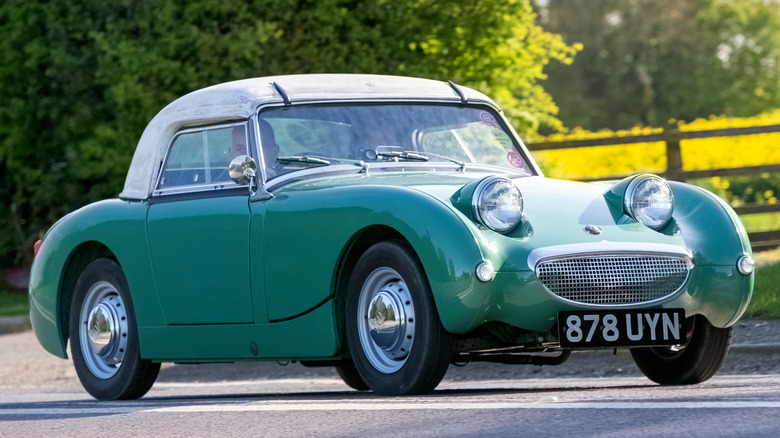
The British are great at a few things, and one of them is building excellent lightweight sports cars. Another is cooking up fun nicknames for their cars. Enter the Austin-Healey "Frogeye" Sprite.
A charming little sports car from the golden era of British car manufacturing, the humble little Sprite was the perfect solution for drop-top fans who couldn't stretch for a thoroughbred six-cylinder Healey, still one of your favorite British sports cars of all time. Under its hood sat a dinky little A-series engine, similar to what might be found in a Mini, albeit longitudinally mounted here. In the middle were four gears, two seats, and a steering wheel, and at the back were the driven wheels. A wonderful example of the back-to-basics sports car.
However, there was another variation of the Sprite, which instead of being dubbed the "Frogeye" is named the "Bugeye." Same, but different. Telling the two apart can be immensely difficult for the uninitiated, as this model, too, sports a little four-pot, two seats, four gears, rear-wheel drive, and one steering wheel. And therein lies the secret to discerning between the two — the steering wheel.
See, while Brits call Austin-Healey's little Sprite a "Frogeye," Americans instead call it the "Bugeye." So the way to tell is whether it's a left- or right-hand drive car – and that's it.
What's in a name?
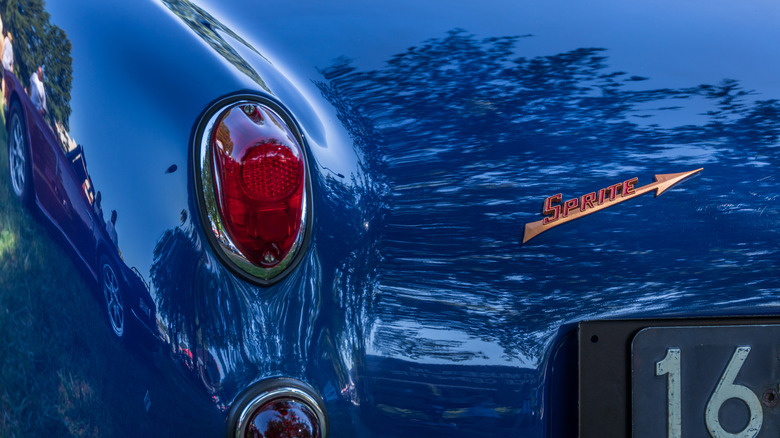
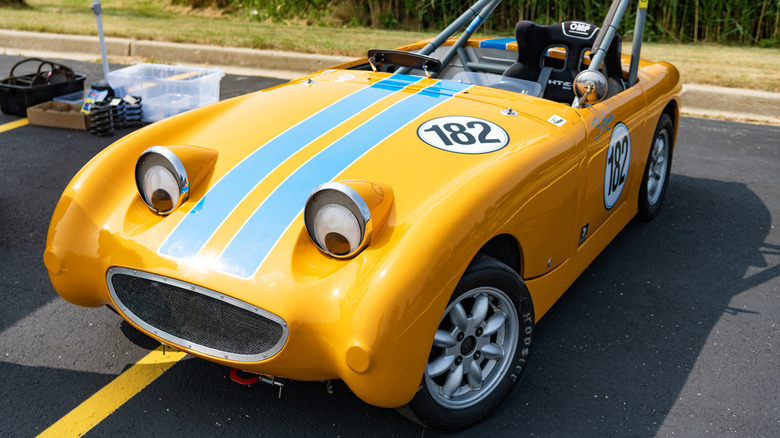
For anyone who hasn't seen one of these delightful little sports cars before, the nicknames of choice might seem a little unusual, although they do paint a picture of how the car looks. Upright headlights that poke out from the Sprite's otherwise classically smooth lines provide the reasoning for the nicknames, and the smiling grille just helps to further build the Sprite's cheerful persona.
Now, had the designers had their way back in the late 1950s when the Sprite was being born, it's likely that the diminutive sports car would have earned itself no nickname at all. To boost performance, aerodynamics were the order of the day, so the car's designer wished to have retracting headlights that would flip and lie flush with the bodywork when not in use.
Once the accountants had looked over the plans and totted up the numbers, though, that desire was quickly turned down. Instead, fixed and upright headlights would be installed, and thus the baby Healey would earn its playful nickname, both in its home market and abroad. While the Brits would liken the final design to that of Kermit the Frog, Americans would instead base its nickname on Jiminy Cricket from "Pinocchio" — both perfectly valid, but both totally incorrect in the other's market.
A closer look at the bug-eyed sports car
Refusing the designer's wish for retracting headlights wasn't the only time the accountants had their say in the development of Austin-Healey's Sprite. In fact, the whole point of the car was to provide a cut-price sports car that could sell in far greater numbers than the full-fat Healey 100.
Naturally, this meant raiding the British Motor Corporation parts bin, in which lay a whole heap of Morris and Austin parts. Motivation would come from a 948cc variant of the A-series engine, plucked straight from the grocery-getter of the decade, Austin's A35. A pair of dinky SU carburetors would feed the inline-four with fuel, and peak power — 43 horsepower — would arrive at 5,200 rpm, by which point you really should be changing gear.
Four manually controlled gears was the only choice, with synchromesh on three gears, while the steering came straight from a Morris Minor. The Sprite's suspension was more of the same, plucked largely from the Austin A35. Very little of the Sprite was developed solely for it, which surely the bean-counters at BMC loved — but still they couldn't let a simple retracting headlight system swing into production.
And yet. While usually decisions like this dampen the production car experience, in this instance the accounting team's decision to clumsily adorn the slippery Sprite with upright headlights created a lasting persona BMC never could have envisioned.