

Are Modern Truckers Still Using CB Radios?
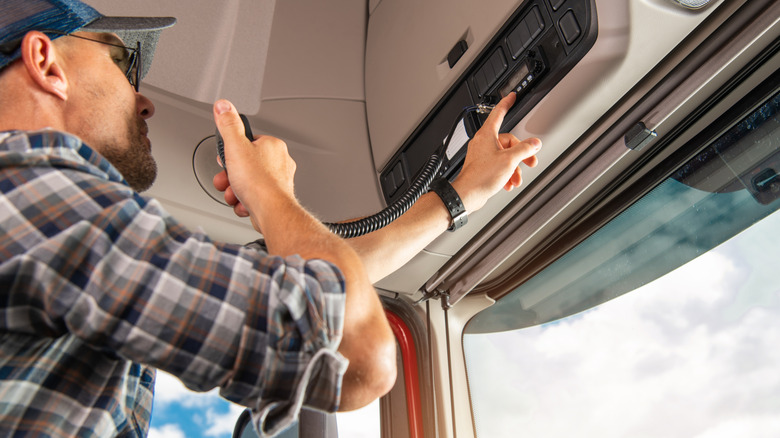
Like most things in the automotive world, the trucking industry has pretty well modernized itself over the past few decades. However, one piece of old-school tech is still around: the CB radio. Sure, with the advent of cellphones, navigation systems and other forms of entertainment, the CB radio is not used as much as it once was. Hell, they used to show up in regular passenger vehicles from time to time. Those days are long behind us, though.
Still, that doesn't mean it's not a vitally important tool for truckers traveling across the U.S. Big rig operators are still finding plenty of use cases for their Citizen Band radios because of their ability to provide immediate, localized information, according to Williams Logistics, a Missouri-based transportation company. They've also got the added benefit of fostering community among the drivers who use them, which it says is about 54% of the trucking population. Another 10% of truckers say they've got CB radios installed, but use them infrequently.
Other than providing faster communication with other drivers than alternatives, CB radios can also be operated hands-free or with just one hand — making them easier to operate than cell phones. They also don't carry any service fees or monthly plans, and they allow easy communication with multiple drivers simultaneously on 40 different channels.
Modern CB Radio uses
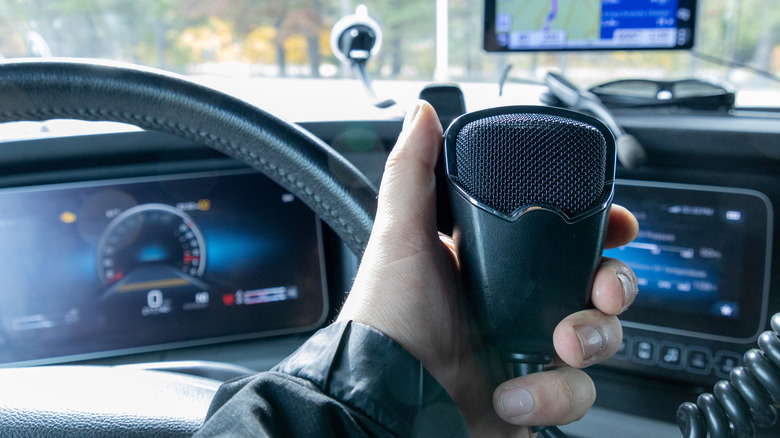
So, we've established that truckers are still using their CB radios because they make talking to other drivers that much easier, but what are they talking about? Well, it's a myriad of topics, as Moonraker, an international radio communications retailer and distributor, explains.
One of the biggest use cases is local travel advice and warnings about accidents and other road hazards. Sure, GPS and Google Maps can be very handy, but nothing is going to be more up-to-date than a guy a few miles up the road from you telling you live from the scene that something is blocking the roadway or that there's been an accident. In that same vein, if a trucker finds themselves in a bad situation, a CB radio's signal is never going to be down, not in the way a cell signal might be, at least.
Another use is more practical for the business of actually trucking. Something no trucker wants to deal with is waiting and looking for someone who can actually receive the goods they've been hauling for days on end. With a CB radio, they can communicate both with other truckers who may be arriving at the same time and with folks on the ground to coordinate on where to go. It just makes for a faster and more seamless way to communicate than to figure out individual phone numbers.
The final use for CB radios that Moonraker talks about is probably my favorite: personal interaction. Simply put, truckers spend a hell of a lot of time trapped in a small metal box, mostly cut off from the rest of the outside world. Yeah, they can use social media, make calls and text when they're not moving with their smartphones, but the CB allows them to just have simple chats with their fellow drivers.
What each channel is for

After doing a little digging, I found out which channels were used for what on a Reddit post. All in all, there seem to be 11 channels that are primarily designed for actual purposes. The other 29 channels are left open for the most part for folks to use as they like, depending on local need, of course. These fluctuate a bit throughout the country.
Channel 1: Used by truckers in the Eastern U.S. & Canadian Maritime provinces
Channel 4: Used by the off-roading community
Channel 6: Used by folks broadcasting very-powerful, illegally amplified radio
Channel 9: Emergency communications and travel assistance
Channel 10: Used by truckers on regional roads
Channel 11: Another channel for amplified radios, mostly for people talking over long distance
Channel 13: Used by marine and RV operators
Channel 14: Used to transmit/receive crystal for vintage radio parts
Channel 16: Used by the off-roading community
Channel 17: Used by truckers on North/Southbound highways on the West Coast (mostly I-5)
Channel 19: Highway trucker ban
Channel 22: Popular alternative to Channel 19