

How Goodyear Developed Tires For The Moon
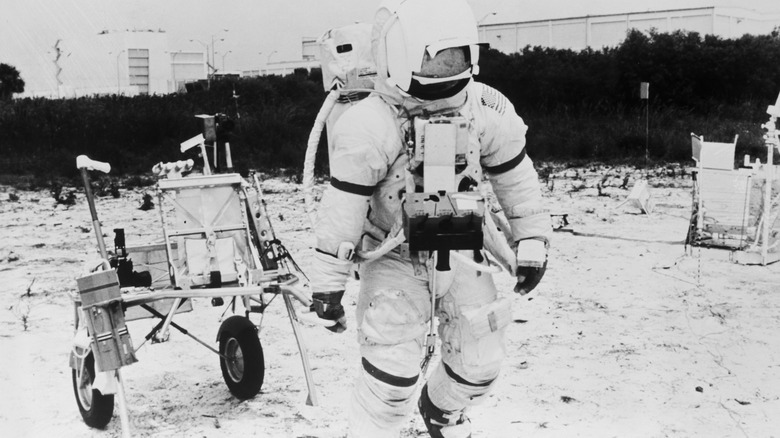
NASA's Artemis II mission sent four astronauts around our moon, marking the first time humans have been anywhere near our nearest celestial buddy since 1972. The bravery of those four astronauts and the celebration of such an achievement can remind us all of previous trips to the moon and the engineering brilliance that got humankind there. Those design triumphs are many, but some of them came from sources you may not know of, like Goodyear, which developed the first rubber tires to touch down on the moon. However, the first rubber tire there wasn't used for any of the awesome lunar rovers. It was actually built for a hand cart.
During the Apollo 14 mission in 1971, a set of Goodyear non-pneumatic XLTs let Cmdr. Alan Shepard and Lunar Module Pilot Edgar Mitchell haul equipment and lunar rocks around on their two-wheeled cart, called the Modular Equipment Transporter (MET). It might sound silly to say that a two-wheeled cart is responsible for much of what we know about space and the moon's geology, but the equipment hauled back and forth from the lunar lander provided NASA with massively important data. And since the MET's pair of Goodyears were the first gas-filled rubber tires used in space, they had a big job to do.
How did Goodyear develop the MET's tires?
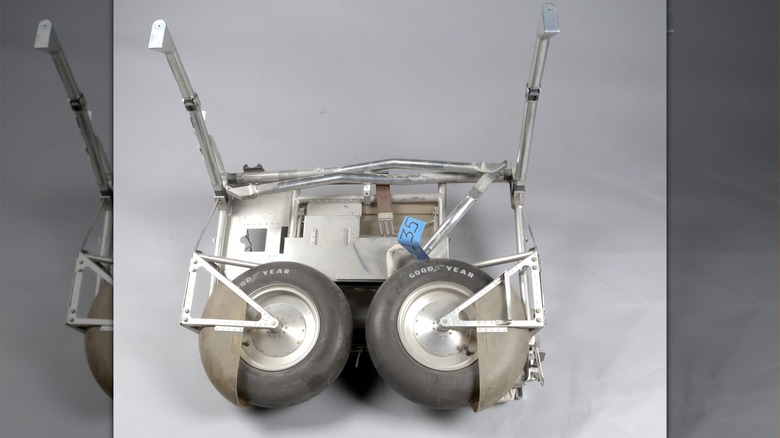
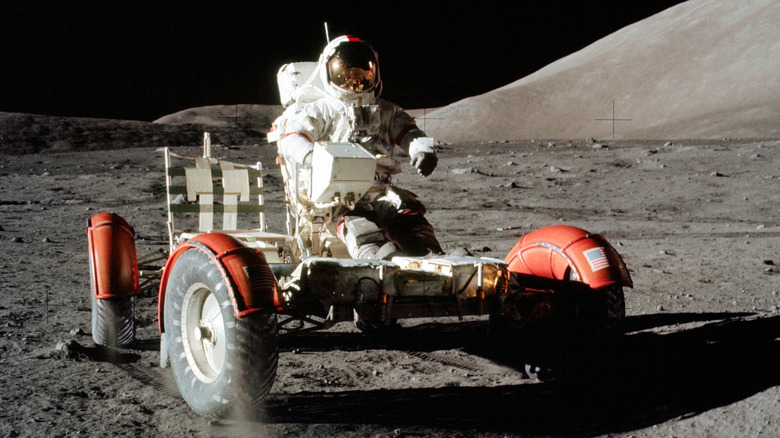
Tires for moon traversal were still a novel idea in 1971. When the lunar rover landed and drove on the moon, its tires were made of woven metal, not rubber. The moon's surface isn't exactly a Swiss highway, so sharp rocks and dangerous craters are real concerns. There isn't AAA to come help you fix a flat when you're nearly 239,000 miles from home. So Goodyear had to develop a rubber tire that could handle the weight of MET's payload while being hauled by hand over a rocky surface without popping. One puncture and the tire is done for, without a spare in sight.
What Goodyear came up with was a smooth rubber tire filled with nitrogen. While Goodyear doesn't say if there was a specific moon-based reason for using nitrogen, it does say that here on Earth, nitrogen is used due to its lower permeation pressure loss. The smooth lack of tread of the MET's tire is odd to see, making it like a lunar racing slick. However, without any rain on the moon, there isn't a need for tread.
The MET needed to carry up to 360 pounds and was pulled by hand. So it needed to roll smoothly over long distances, sometimes while hauling priceless equipment, without suffering a puncture. During Shepard's and Mitchell's second moon walk, they pulled the MET almost two miles round trip. The moon's rocky terrain often proved too difficult for even the MET and Goodyear's tires, however, so sometimes the two astronauts decided to just pick the MET up and carry the damn thing. Of course, the moon's gravity is only about 16.6% of Earth's, so its weight was easier to handle up there than it would have been down here.
How have Goodyear's moonfaring tires improved since then?
In the 2000s, Goodyear teamed up with NASA yet again, to develop a new tire for a new generation of lunar rover. Its old-school design was difficult enough to use on a cart, so it was never going to work on a lunar rover that weighed significantly more. What Goodyear and NASA came up with was the Spring Tire, an airless tire made from 800 helical springs woven together. Not only was the Spring Tire capable of traversing punishing terrain while bearing heavy weight without permanently deforming, its inherent redundancy made it more reliable.
"A hard impact that might cause a pneumatic tire to puncture and deflate would only damage one of the 800 load bearing springs," Vivake Asnani, principal investigator for the project at NASA's Glenn Research Center in Cleveland, said in a 2010 Goodyear news release. "Along with having this ultra-redundant characteristic, the tire has a combination of overall stiffness yet flexibility that allows off-road vehicles to travel fast over rough terrain with relatively little motion being transferred to the vehicle."
Goodyear continues to work with NASA in developing new chemical compounds for tires on all celestial bodies. In 2019, the company sent equipment up with astronauts to the International Space Station to study silica, which it hoped would help develop new tire compounds. As NASA aims for two moon missions a year, it's worth looking back at this longstanding relationship that has helped humankind explore the universe.