

The Science Behind Voorhees Law
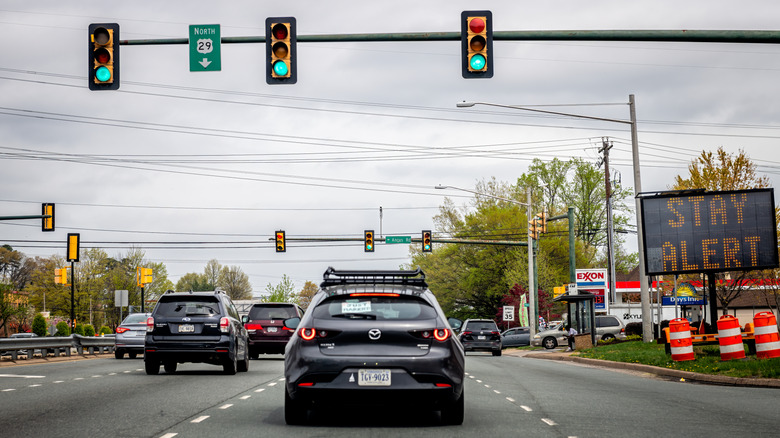
You're in your car, minding the law, keeping to the speed limit, when someone scurries past you as if they're running late for work. Then, a minute or so later, that very same car is now waiting at the stoplight, watching you emerge from the distance in their rearview mirror. And to rub it in further, you pull up right next to the driver with a bit of smugness plastered across your face. We've all been there, but it begs one question: What's the point of speeding past someone if that person, who isn't in any hurry, catches up eventually?
Fortunately, that question now has a scientific answer, and it's called the Voorhees law of traffic, authored by Dublin City University assistant professor Conor Boland. According to the law, the chances of a slow car catching up — or the fast car's time lead collapsing to zero — are higher as you encounter more stoplights. In this piece for RTE Brainstorm, Boland says in an urban environment, arriving first is more about probability and the random traffic light cycles than speed itself. These probabilities compound as the number of traffic lights increases, resulting in the statistical likelihood of a re-encounter.
According to Boland, mathematically, there are only four outcomes for the participants, which in this study are simply two cars, where one has a time lead over the other. At each signal, the outcomes are neutral, gain, catch-up, or partial loss, with contributing factors being the time advantage, the signal's cycle time, and its effect on the faster car's lead time. Put simply, the healthier the advantage, the better the chances of maintaining that lead, and vice versa.
Don't discount human psychology
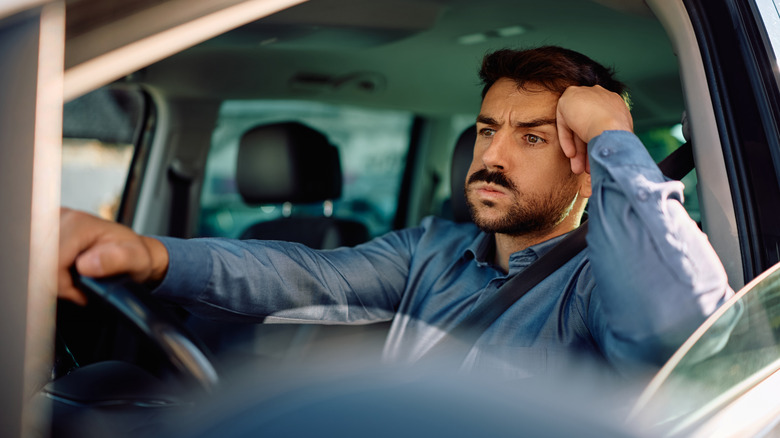
It's one thing to have math prove stuff that we already experience, but Boland goes one step further and delves into the psychological aspect of what is a paradoxical event. From the fast driver's perspective, you're unlikely to remember the cars you've passed unless one of them pops up behind you, reckons Boland. That's because humans tend to store those frustrating encounters more actively than neutral ones, as explained using the availability heuristic, where negative events are often easier to recall thanks to the brain storing them with more emotional charge. So, seeing that red car right behind you, which took a lot of effort to overtake, is just an example of the brain's negativity bias at play.
Boland thought that it'd be a nice touch to name this traffic phenomenon the Voorhees Law. The name "Voorhees" should ring a bell if you've watched "Friday the 13th", where a masked Jason Voorhees chases down his victims. No matter how fast they run, he always catches up — not through pace, but through persistence. Boland published his work in the Royal Society Open Science journal, which is an interesting read if you're into maths, probability, and fancy equations. The model, however, did not assume sensor-based traffic lights and instead relied on the lights changing after a certain time cycle.
All told, the idea of slow cars catching up can be concluded as being part statistical and part psychological. Funnily enough, Ireland's influence on traffic-related stuff is nothing new, as evidenced by this one-of-a-kind upside-down traffic light in New York.