

How Body-In-White 911s Birthed The Seven-Figure Porsche Restomod
The word restomod is a mashup of restoration and modification. The idea is to teach old cars new tricks, imbuing them with modern features and reliability, while preserving their vintage style and vibe. Restomods are not replicas. Original factory specs are largely tossed out the window in favor of new, custom interpretations, using original bodies and bones. By that standard, Alois Ruf, Jr., isn't really a restomodder. But the modern world of Porsche restomods might not be what it is without him.
By 1987, when Herr Ruf placed his dreams in the body-in-white shell of a contemporary Porsche 911, he had over a decade of Porsche 930 Turbo tuning wizardry under his belt, and decades of automotive passion in his blood. RUF Automobile was founded in 1939 by Alois Ruf, Sr., and the company was recognized as a bona fide manufacturer in 1981 — meaning RUFs would have their own VIN codes. This would be critical to RUF's later success.
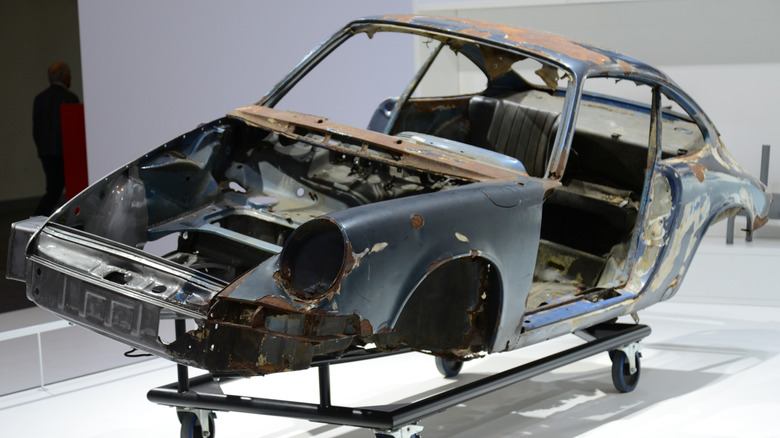
When making that jump from tuner to builder, starting with a body-in-white (BiW) gives you a head start. It's a blank slate, a tried-and-tested skeleton, a safe and rigid monocoque or frame structure, factory-designed and -built, waiting for an engine, brakes, and other assorted components chosen to suit their own needs, wants, or visions. Alois's vision was to build a better Porsche 911, starting with BiWs, purchased from a dealer like any other part. With the 1987 RUF CTR, he not only succeeded, but cleared a path for others to take the Porsche restomod scene to new heights.
Body-in-white shell hatches Yellowbird
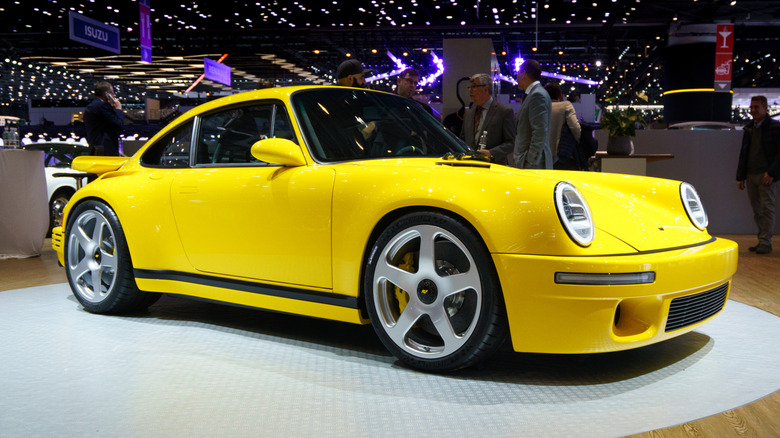
Racing teams will buy and use BiWs to customize a car to their liking — but, as these come without a VIN, they aren't legal for public roads. RUF had that caveat covered. To create a CTR from a new Porsche 911 BiW, Ruf added a unique suspension, interior, body sculpting, and, most importantly, a 3.2-liter turbocharged flat-six that churned out 463 horsepower.
For context, when the Porsche 911 Turbo — known by its model code 930 — debuted in 1974, it had 256 hp and could hit 60 miles an hour from a standstill in 5.4 seconds. It came to be known as the Widowmaker for its characteristic on/off boost that, coupled with its rear-engine weight bias, could induce surprise rotation events. In 1987, the 930 had (only) 282 hp; the CTR was absolutely bonkers. Dubbed the Yellow Bird in a Road & Track test, it famously hit 100 mph in 7.3 seconds, and topped out at 211 mph, making it the fastest production car in the world. It lives on in lore as the Yellowbird, and its skeleton has evolved.
With BiW bones, the first RUF CTRs weren't technically restomods, so much as divergent lives borne from the same delivery room. But when Porsche factories went robot, it became impractical to get BiWs, so RUF had to buy new 911s as donor cars, strip them down, and rebuild. Around a decade ago, RUF started using its own chassis design. Like the original CTR, a modern RUF may have Porsche DNA, but it's very much its own animal. Want a factory-fresh RUF that hearkens back to the Yellowbird? RUF builds just the thing: the 2026 RUF Tribute. It goes for $1.7 million.
From Yellowbirds to Singers
RUF wasn't the only Porsche tuning game in town in the 1980s. TechArt was founded in 1987, and Gemballa launched its flat-nose rendition of the factory 911 Turbo Slantnose in 1981. There were others, but RUF shifted the industry, carving a path for hot rod Porsches to come.
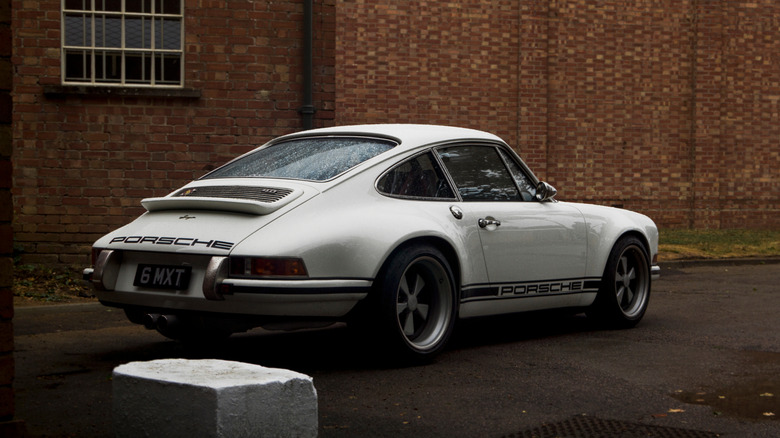
Amongst the most well-known of these is Singer Vehicle Design. Singer is not affiliated in any way with Porsche, but it's in the business of reimagining what a vintage Porsche can be, like this 930 Turbo Tribute. In 2025, another example of its creations, the Singer Dynamics and Lightweight Study (DLS), went for $3 million at auction. If that's too steep for you, a new Porsche 911 Carrera Coupe Reimagined by Singer runs around $500,000. It starts with a reclaimed 1984-to-1994 era 964 donor car.
Gunther Werks also specializes in 911 reinterpretations, while Emory Motorsports will painstakingly build you one of its "outlaw" custom restomods out of your Porsche 356 donor. Russell Built, meanwhile, specializes in creations that pay tribute to Porsche's off-road racing heritage.
As for RUF, it now offers several different models, built to suit individual tastes, with roots that trace back to the original. They physically resemble Porsches, but they're RUFs. If you'd prefer to stick with something custom that's 100% factory, Porsche will gladly take requests through its Sonderwunsch program. Whatever you do, if you can afford any of these machines, drive them like they're meant to be driven — which is what the original Porsche vibe that inspired them was all about in the first place.