

How Goodyear Tires Made The McLaren F1's 240-MPH Top Speed Possible
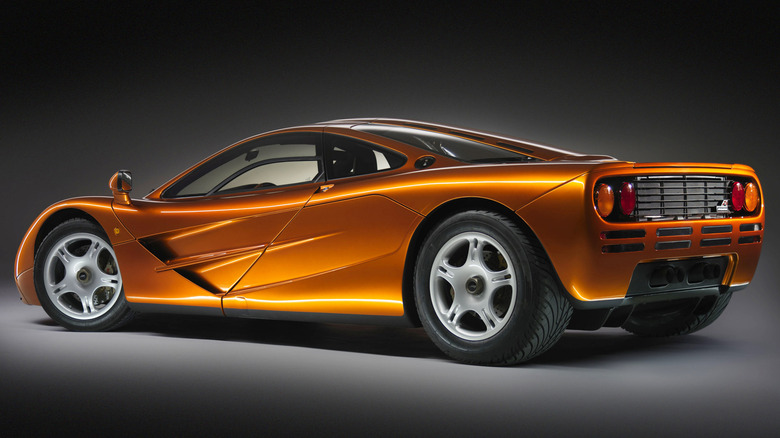
Every once in a while, a car comes along that shatters records and completely changes the game. While the industry is always making incremental improvements, as brands compete with each other to be better, faster, and more capable, sometimes a car will move the needle so far out of reach that it takes a decade for the industry to catch up. The McLaren F1 was one of those cars. However, the F1's impact would have never been possible without the help of brands like BMW, who made the engine, or Goodyear, who created a specific tire that helped the F1 achieve its unprecedented speeds.
The F1 was the brainchild of legendary automotive engineer Gordon Murray, who set out to make the ultimate sports car after spending decades in Formula 1. Murray and his team broke new ground in several areas, like creating the first production road car to use a carbon fiber monocoque chassis. But its most impressive achievement was its record-breaking 240.1 mph top speed run in 1993. That record stood for 12 years until Bugatti beat it with the Veyron in 2005, hitting 253 mph.
However, the Bugatti needed four additional cylinders, four additional turbos, and two additional driven wheels to do it. McLaren still holds the record for the fastest naturally aspirated car in history. And yet, it would never have been possible without a special set of Goodyear tires carefully designed to handle those blazing speeds without falling apart.
The tires were an integral part of the McLaren F1's development
Few cars in history have ever been built with the sort of singular focus that the McLaren F1 had. When developing the F1, Murray wanted to build the greatest sports car in history. Performance figures didn't matter much. Instead, it needed to provide the best driving experience that was possible at the time, which meant that everything about the car needed to be perfect. That's why Murray insisted on a naturally aspirated BMW V12 engine with more than 100 horsepower per liter, a six-speed manual transmission, no power steering, and no ABS. No wonder it was so tricky to handle.
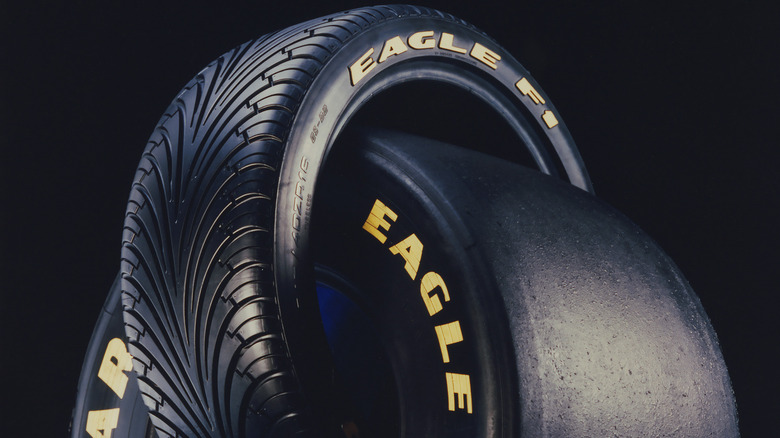
When it came time to select a tire, that same demand for perfection remained, and Goodyear stepped up to the challenge. A dedicated Eagle F1 tire was developed specifically for the McLaren F1, marking the first time Goodyear would use that name. Both Goodyear and McLaren worked together to design the tire from scratch; everything from the tire size to the rubber compound was carefully thought out to optimize the F1's performance. The P235/45ZR17 front and P315/45ZR17 rear tires were wrapped in custom OZ racing wheels cast from aerospace-grade magnesium alloy. As reported by Evo, McLaren even claimed that the tire was an "intrinsic suspension element" in the car's ride, handling, and comfort calculations.
How the McLaren F1 set a speed record that still stands today
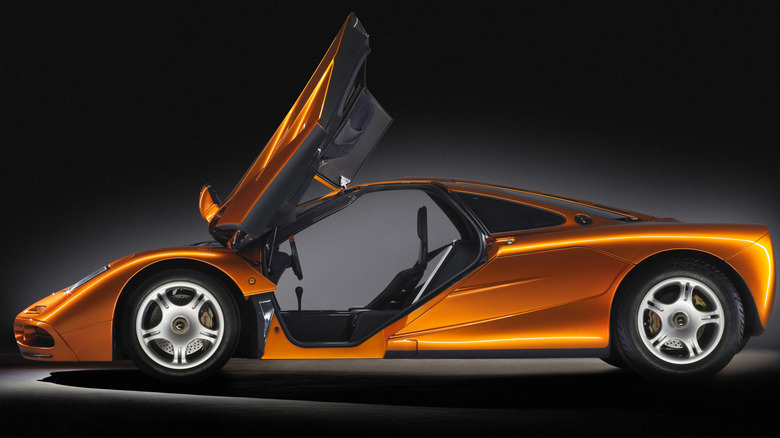
On March 31, 1998, Murray and McLaren visited Volkswagen's Ehra-Lessien test track in Germany to see just how fast the F1 could go in a straight line. Le Mans racer Andy Wallace was tasked with driving the F1 into unknown territory. At speeds of well over 200 mph, tires play a massive role in not only allowing the car to achieve its top speed, but keeping it safe, too. A tire failure at that sort of speed would be catastrophic. "For any tire, you start going this fast, it's not as easy as it sounds," said Wallace when recounting his record-breaking run 20 years later (as seen on YouTube).
Without tires that could handle the heat and tearing forces of such speeds, the F1 would have never been able to break the record. And to best that record, tires had to improve dramatically. When Bugatti broke McLaren's record in 2005, it used specially-designed Michelin PAX tires that were chemically bonded to the wheels. And when Bugatti broke the 300 mph barrier with the Chiron in 2020, it needed tires reinforced with carbon fiber to handle it. Obviously, those are higher speeds than what the McLaren F1 reached, and those two cars are significantly heavier. But it still proves just how important tire technology is, and Goodyear was able to develop such record-breaking tech more than three decades ago.