

You've Seen That Seatbelt Loop, But Do You Know What It Does?
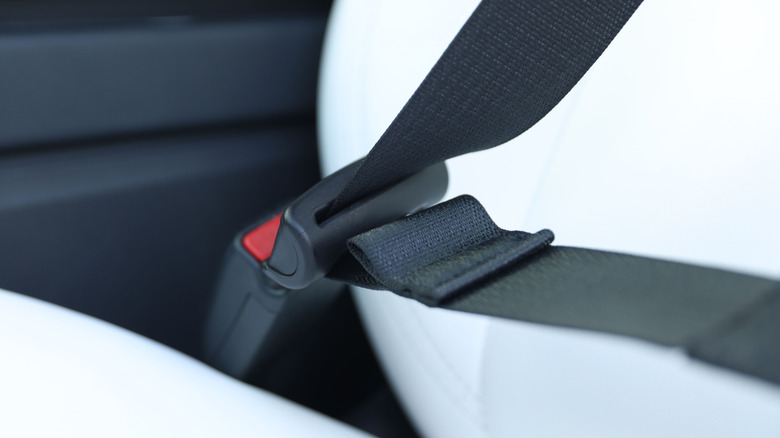
The three-point seatbelt in a modern car may look like nothing more than buckles and webbing straps, but there's a bit of genius in its construction. Cars are now equipped with numerous airbags for added crash protection, including a new type of airbag that prevents passengers from hitting each other during a crash. However, airbags and seatbelts go hand in hand like hamburgers and ketchup, and buckling up is still the most effective way to keep you and your passengers safer and more secure when on the road.
The seatbelt consists of a tongue-shaped latch plate that clips into a buckle on the seat base, which essentially holds the strap across your body. Next, there are spring-loaded retractors that do two things: They allow the belt and the occupant to move even when buckled up, and they lock to keep you in your seat when they sense a quick tug of the belt. Finally, there's a pretensioner that pulls the belt tighter to restrict forward movement, essentially preventing you from hitting a deploying airbag during a crash.
However, have you noticed that some cars have seatbelts with loops near the latches, more notably on passenger-side belts? The obvious function of those loops is to keep the latch plate at or near shoulder-height when seated while preventing the latch from sliding down to the floor. But then again, there's more to the seatbelt loop than just an extra fold of stitched webbing. It can keep you safer in a collision and prevent injuries, much like the seatbelt mechanism itself.
That seatbelt loop provides more slack

In short, the seatbelt loop in some cars is an added safety feature. Safety engineers and experts refer to it as an energy management (EM) loop. While the loop is nothing more than an extra fold on the strap that's stitched in place, it can absorb some of the devastating forces acting on your body during a crash.
The stitching can rip apart and add a few inches of slack on the belt during a high-impact collision. If you can imagine the sheer magnitude of forces acting on your body during sudden deceleration, the loop on the seatbelt helps cushion the blow and prevent bodily injuries.
NHTSA data suggests that wearing a seatbelt can reduce fatal and critical injuries by 45% and 50% percent, respectively. However, there's such a thing as seatbelt syndrome, a collective term referring to possible injuries caused by the restraining effects of wearing a seatbelt. It includes intra-abdominal injuries and abrasions on the chest, neck, and abdomen.
No available data proves that seatbelt loops can prevent injuries caused by seatbelt syndrome. However, we unearthed a General Motors recall bulletin from July 2005 that describes a problem with the loop in the second row center seat belts of the Cadillac Escalade, GMC Sierra, and Chevrolet Suburban, to name a few. As it turns out, the loop makes it hard to position the lap belt around the hips and may increase the risk of abdominal injury during a crash. The interesting part is that the recall instructed dealerships to remedy the issue by stitching the loop closed using a size 16 upholstery needle (no kidding) and some thread.
Does the driver's side seatbelt have a loop?
In most cars, the seatbelt loop is on the front passenger side only. You see, the slack that the loop can provide in extreme scenarios is not so helpful when you're on the driver's side, and it's all because of the steering wheel.
Instead of being a potentially life-saving and injury-preventing device, a few inches of forward slack could mean the difference between walking away unharmed and waking up in the emergency room. Simply put, the steering wheel is nearer to the driver, and extra seatbelt slack can lead to a higher risk of fatal injuries when the airbag deflates.
Because of this, the driver's side seatbelt will most likely have a small button instead of a loop to hold the latch at a convenient height. The button will also keep the latch from retracting too far from the ideal position when unbuckling. The seatbelt loop can be mostly found in older cars, but we can't help but wonder why a modern Tesla, like the Model Y from the Eddie M Cars YouTube video shown above, has a seatbelt loop on the driver's side.
Meanwhile, we all know that renowned Swedish automaker Volvo, now under the wings of Chinese auto conglomerate Geely, is the inventor of the three-point seatbelt (thank you, Niels Bohlin). Now, Volvo has taken seatbelt technology to new heights with its multi-adaptive seatbelts that customize protection based on the occupant's size, weight, crash severity, and other factors – no loops required.