

As Artemis II Heads To The Moon, We Look Back At The Rovers That Made Lunar Exploration Possible
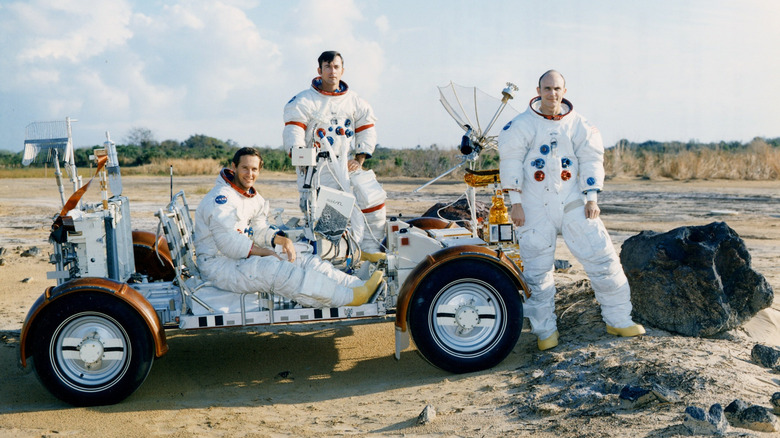
With NASA's plans to establish a permanent human presence on the Moon over the next decade, there will be a new Moon buggy with a new generation of astronaut drivers. The original Apollo-era Lunar Roving Vehicle was the first wheeled vehicle driven by a person on another astronomical body. The rudimentary electric vehicle's place in humanity's history isn't just preserved in NASA archives, but also the tire marks left on the lunar surface itself.
Despite the indelible mark left on the popular memory, the lunar rover was only used during the latter three of the six Apollo landings. The LRV's purpose was straightforward. NASA wanted to increase the amount of ground that astronauts could travel during a mission. The awkward bunny-hopping on foot a few hundred yards wasn't going to cut it. The rovers were driven a combined 56.2 miles on the Moon across Apollo 15, 16 and 17.
The Lunar Roving Vehicle was designed by General Motors and built by Boeing for a unique task. The first dilemma for engineers was getting the rover there. The LRV had a hinged aluminum alloy chassis that could be folded and stored inside the Lunar Module. Moving the rover wasn't too much of a burden for the crew, as it only weighed 462 pounds moonside.
To propel itself, the LRV was fitted with four Delco 0.25-hp electric motors at each wheel. Two 36-volt silver-zinc potassium hydroxide batteries gave each rover 57 miles of range. However, those batteries weren't rechargeable. It wasn't a significant problem because the LRV was left on the Moon after each mission.
The tracks they left behind in the lunar soil
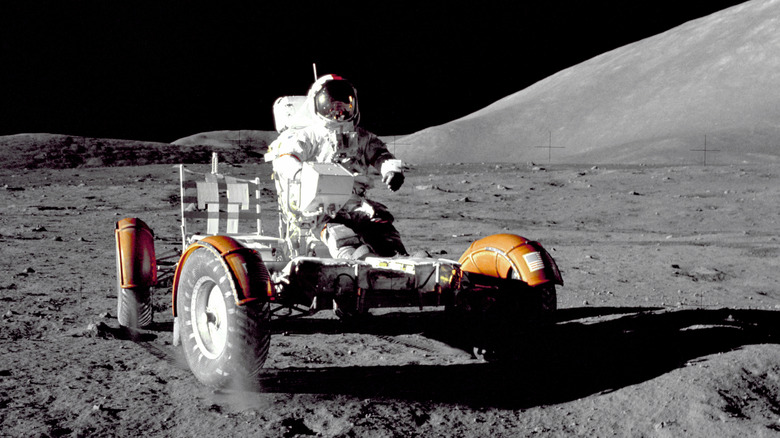
Apollo's legacy is still visible on the lunar surface. NASA's Lunar Reconnaissance Orbiter, launched in 2009 to create more detailed maps of the Moon, has overflown the Apollo landing sites and spotted traces of the mission. LRV tire tracks along with footpaths, U.S. flags and descent stages are visible in images. NASA lunar geologist Noah Petro told PBS in 2011, "We can retrace the astronauts' steps with greater clarity to see where they took lunar samples."
The LRV wasn't fitted with conventional rubber pneumatic tires. The crew couldn't afford to suffer a puncture 238,900 miles away from Earth. Each rover was fitted with woven metal tires, featuring zinc-coated piano wire and titanium chevron treads. It was a smart decision because the soil was harder than expected, according to the Smithsonian.
In all, four Lunar Rover Vehicles were built: three left on the Moon during missions and the fourth was built from spare parts after Apollo 18 was canceled. LRV-4 is currently on display at the Kennedy Space Center Visitor Complex at Cape Canaveral, not far from where Artemis' Lunar Terrain Vehicle will be prepared for its journey to the Moon in the future.