

How Honda Pioneered Pre-Chamber Ignition Long Before Formula 1
Formula 1 has always been at the forefront of cutting-edge automotive engineering, be it vehicle dynamics or engine tech. Unsurprisingly, the pinnacle of motorsports has seen a lot of change since the days of yore, including the F1 evolution from V12s to V6s. It was during the 2014 hybrid era when fans were introduced to something called pre-chamber ignition, a specialty item which has been a mainstay in Formula 1 engines for many years now. For those not in the know, this combustion design improves the engine's overall thermal efficiency by igniting a rich air-fuel mixture inside a separate, smaller combustion chamber — typically located above the regular, larger one, which, conversely, contains a much leaner mixture.
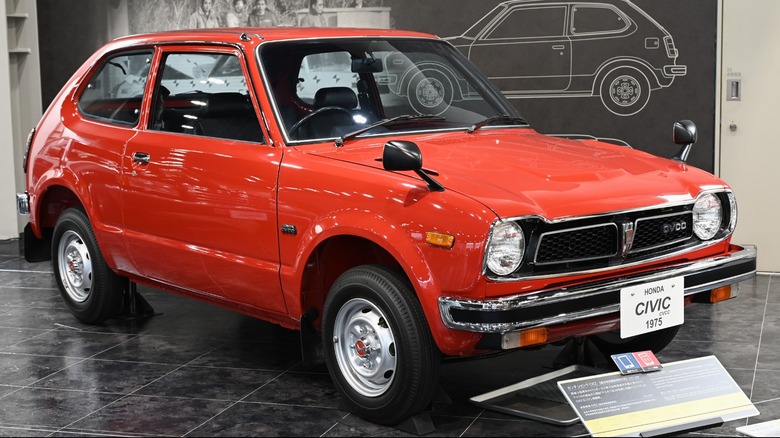
You may find this surprising, but pre-chamber ignition isn't all that new. In fact, diesel engines have used it since the early 1900s. However, even before Formula 1 adapted it for gasoline engines, a certain Japanese automaker pioneered the technology during the 1970s. Honda introduced pre-chamber ignition in its 1975 Civic CVCC to comply with the EPA's strict emission rules. The technology was so good that Honda managed to breeze past the EPA tests without even having a catalytic converter installed.
Although Honda's CVCC, short for Compound Vortex Controlled Combustion, is similar in principle, its design is very different from modern iterations of the technology. Unlike today's four-valves-per-cylinder design, the CVCC had three – specifically, two conventional valves (one each for the intake and exhaust) and a much smaller intake valve to work its pre-chamber magic. Additionally, while modern designs (used in F1 and elsewhere) involve fuel injection, Honda designed its pre-chamber system to work with carburetion. And unsurprisingly, the carburetor was quite unique as well.
The past and present
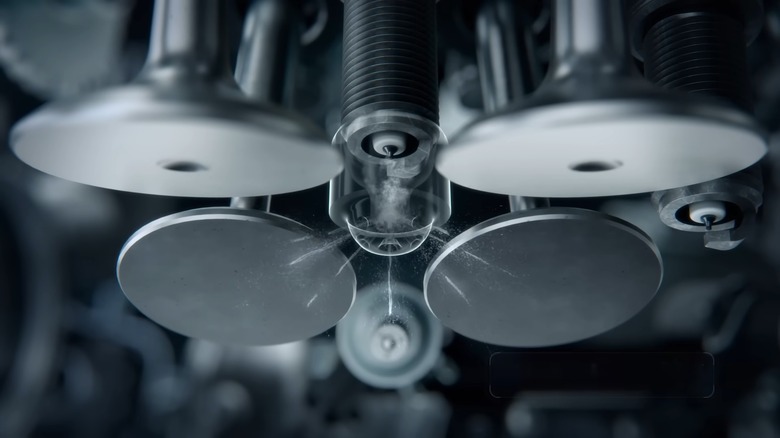
During its operation, the CVCC's carburetor sends a rich mixture to what is a thimble-sized combustion area, in which you'd find the spark plug. The carburetor also supplies a lean mixture to the main combustion chamber, which ignites after the charge inside the pre-combustion compartment shoots out via a flame hole designed into the head. For its time, the CVCC was pretty revolutionary, to the point where Toyota, Ford, Isuzu, and Chrysler licensed it from Honda.
This, however, is very different from what you'd find in F1 and in engines like Maserati's Nettuno V6 and the 2026 Jeep Grand Cherokee's new Hurricane inline-four. Understand that there are active and passive pre-chamber ignition types. The active kind has the ability to send air, or fuel, or both directly to the pre-chamber, whereas the passive variety leans on the piston pushing some of the intake charge into the auxiliary chamber.
Maserati and Jeep employ the latter, with both using a combination of port and direct fuel injection. But unlike road cars, F1 rules don't permit the use of multiple fuel injectors per cylinder. Although things in F1 land are a bit hush-hush, Mercedes, Ferrari, and Honda are believed to have been using passive pre-chamber ignition very early on. Mercedes was the first to do so in 2014, followed by Ferrari in 2015, and Honda in 2017.
The advantages are apparent. Not only did the teams manage to improve their engines' fuel efficiency, but they were also able to extract more power. Similar benefits are also touted in the case of Jeep's latest Hurricane 4 engine, as well as the Maserati MC20 that evolved into the MCPura with a Nettuno V6 – all while keeping them emissions compliant.