

Is There A Difference Between Stealth And Satin Paint Protection Film?
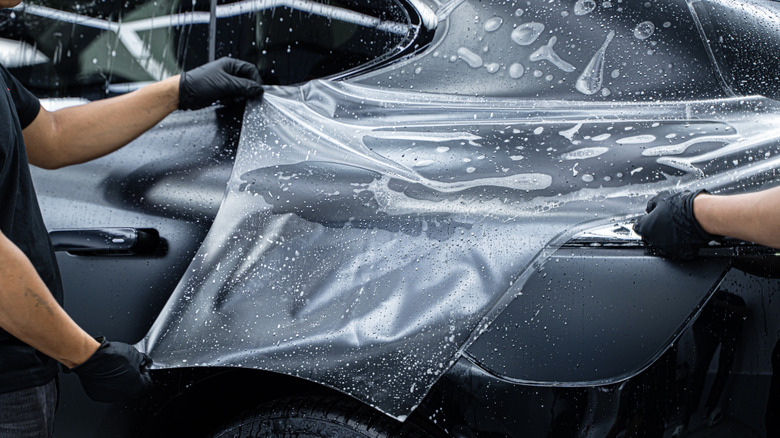
You probably know why paint protection films (PPFs) exist. It's like your phone's screen protector, only scaled up to car-like proportions. In case you didn't know, these polyurethane films help protect your pride and joy from minor scuffs and scratches, as well as UV damage and general wear and tear. PPFs can last anywhere from five to 10 years, depending on several factors, including product quality, environment, and how well it was installed. Mind you, this is fairly expensive compared to alternatives like ceramic coating.
Whether you want a satin or glossy PPF comes down mostly to personal preference. Satin is flat, with hardly any reflections. Gloss, on the other hand, is typically shiny and pops under direct sunlight. Companies often use terms like "stealth," "matte," and "satin" loosely. And while someone with a trained eye might be able to tell the difference, for the vast majority of people, these finishes are all pretty much the same.
Leading PPF brands like XPEL and LLumar, for example, use the terms interchangeably, as do STEK and SunTek. What you must pay attention to, however, is the quality of the thermoplastic polyurethane (TPU) used, broadly categorized as high-quality or low-quality PPFs. Additionally, there are a few things to keep in mind when you're choosing to apply a matte or satin PPF on your car, as all paint protection films have their fair share of pros and cons.
Different PPF qualities and maintenance tips
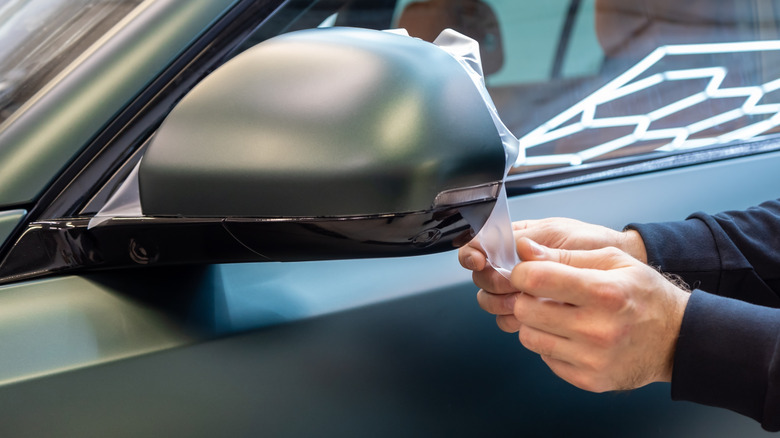
High-quality PPFs rarely compromise on the TPU used, whereas low-quality films often use cheaper materials like PVC or filler-blended TPU. Not only that, but low-quality PPFs are typically thinner, which affects their durability. To demonstrate this, Texas Tint Masters compared the PPFs on two Toyotas. After four years, the PPF on one of the cars did not hold up well against the elements, yellowing, peeling, and losing its shine. The second car's PPF showed minimal wear, signaling superior quality.
When it comes to maintenance, satin, stealth, and matte PPFs each have their own set of cleaning and care guidelines. If you've ever used a matte-finish phone without a case, you know how much of a fingerprint magnet it can be, especially with darker shades. Likewise, the matte or satin PPF on your car is more susceptible to smudges and fingerprints. Additionally, dirt and bird droppings can find their way into the film's microtexture, as can road debris and rainwater. Although these are less of a concern on glossy finishes, they're not immune to them either.
Cleaning is important, and the frequency is much higher when it's a matte PPF, with stealth and satin films generally requiring a clean every week or two, while gloss PPFs typically need a wash every three to four weeks. Also, it's recommended to use PPF-safe cleaners and pH-neutral soaps, as well as non-abrasive cloths, since matte PPFs are typically softer than gloss films.