

Why Shaving Is The Secret To A Cheaper AWD Tire Replacement
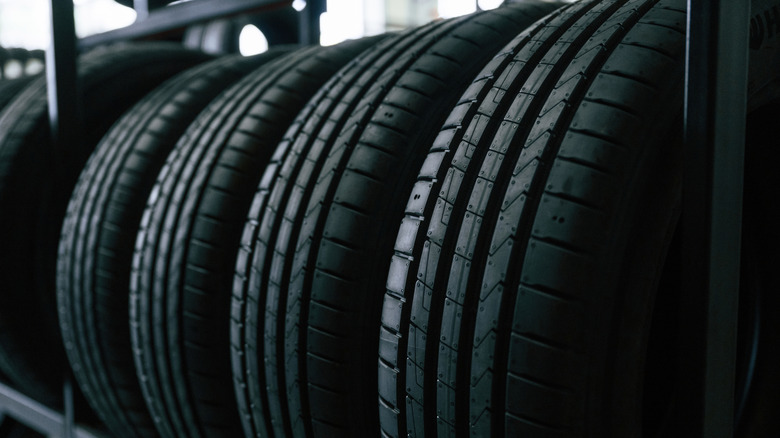
Did you know that if one tire on your AWD (all-wheel drive) vehicle goes flat, you're supposed to replace all four tires, even if the other three are fine? That's because the tread on a new tire isn't worn at all, meaning it will be a slightly different diameter than the tires that are currently on your vehicle. That's a problem when it comes to AWD. Your car's drive system will interpret that difference as slippage and the AWD will compensate. And if your AWD is compensating non-stop, then it's likely to fail before its time. The point being, AWD vehicles need matching tires.
The simple solution would be to get four new tires, since they will all be the same diameter — the simple solution, not the cheap one. Buying a set of four tires for a Hyundai Tucson, for example, can easily set you back $1,000 before installation. Seems like kind of a waste if three out of the four tires have a lot of life left in them. You might get away with just replacing one tire if the others are almost new. But once they're worn a fraction of an inch (check with your car's manufacturer to find out how much), introducing a brand-new tire will cause trouble.
That's where tire shaving comes in. With the right equipment, a tire shop can shave the new tire down to match the used ones. That's much cheaper than getting a set of new tires.
What tire shaving is and how it can help
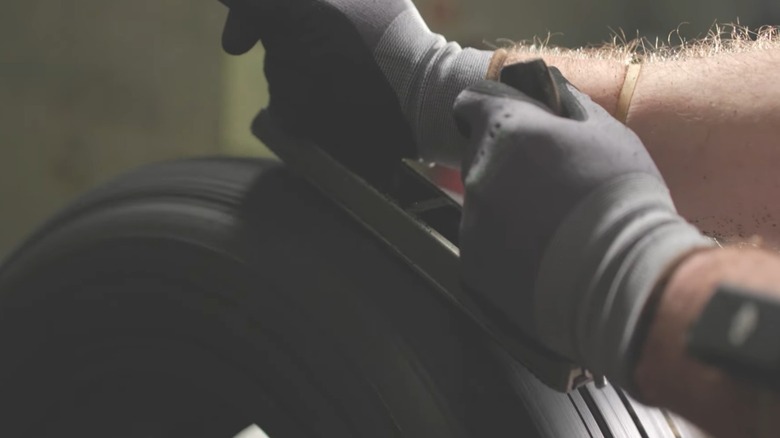
Tire shaving has often been used for race cars. A top layer of tread is taken off the tire so it grips the pavement better. It involves attaching a tire to what is essentially a tire lathe. The tire spins against a very sharp blade until it is shaved down to the desired diameter.
Fortunately, tire shaving isn't just for race car tires anymore. It can be a real money saver for regular consumers who drive all-wheel-drive vehicles. You see, the guy at the tire shop isn't telling you that all four tires should be replaced just to upsell you (though they're pretty good at that). A brand-new, mismatched tire really will rotate at a different speed than the other tires, creating havoc with AWD.
But if your tire shop is so equipped, it can shave the new tire down to match the other tires. There is usually a charge for shaving a tire, of course. Tire Rack will do it for $25 to $35. And it might still seem like a waste to "wear down" a brand-new tire. But considering tire shaving can easily save upwards of $700 compared to getting a new set of tires, we think we could live with it. Speaking of saving money, here's how to get the most miles out of your tires.
Some caveats and how to know when you shouldn't have a tire shaved
Tire shaving isn't always necessary. For example, sometimes a tire can be repaired, though only some areas can be patched. Do you have a full-size spare? Has that spare been included in your tire rotations? If not, it absolutely should be. If it's been rotated like all of the other tires, it should be worn about the same. Of course, at some point you'll have to replace the spare and shave the new tire, but at least the spare will give you some time.
As you can imagine, the warranty on your new tire probably doesn't cover tire shaving. You are slicing off part of the tire, after all. Warranties can be a big deal when you're talking about a tire that costs in excess of $250. And that's why not every tire shop will even offer tire shaving. Discount Tire, for instance, does not offer or endorse tire shaving, as it may void the warranty of your tire. And, of course, it makes no sense to buy a new tire and get it shaved if the other three tires are so worn down they're going to need to be replaced anyway.
Tire shaving isn't the perfect option, but it is a viable one under certain circumstances. And it's nice to know you're not necessarily stuck shelling out more than $1,000 over one flat tire.