

Ford's 6.0L Power Stroke Has A Reputation: Here's What's Actually True
Although Ford replaced the 7.3-liter Power Stroke with its 6.0-liter successor in 2003, the reception was less than stellar, shall we say. Depending on who you ask, the 6.0-liter diesel is either a fairly trusty workhorse or an absolute money pit that shouldn't be touched with a 10-foot pole. The truth, however, is that neither group is necessarily wrong. There is an overwhelming majority of people who consider the 6.0-liter Power Stroke a reliability nightmare, thanks in part to its EGR issues, head bolt/gasket problems, oil pumps, fuel injectors, and so on. However, in its defense, if the engine has been looked after properly and left untuned, the Power Stroke can prove decently reliable, according to MotorTrend.
Let's address the elephant in the room, the 6.0's EGR system. Although it was designed with good intentions, the execution left a lot to be desired, as is the case with many of the Power Stroke's auxiliary components. The EGR cooler, which uses engine oil as its coolant, has a reputation of cracking after prolonged exposure to the hot exhaust gases, which wouldn't be a problem if the oil cooler did what it was supposed to do — cool the oil. This is in addition to the EGR cooler potentially failing because of soot buildup and subsequent clogging. The EGR valve, which also had its own set of problems, is another one of the 6.0's documented headaches.
There's more
Bringing our attention to the oil cooler reveals how its location led to several contaminants clogging its flow paths, leading to inefficient cooling and raised oil temperatures. Not only did this affect the EGR cooler, but it also opened up a host of other issues, ranging from malfunctioning oil pumps to injector failure. The 6.0's reliability was so bad that Ford eventually ditched Navistar.
The HEUI injectors (short for hydraulically actuated electronically controlled unit injection) require high-pressure oil, supplied using a high-pressure oil pump or HPOP. But debris-ridden oil can potentially enter the HPOP through a faulty strainer design, causing it to fail, which consequently results in the HEUI system malfunctioning. Then you have oil leaks from faulty O-rings on the standpipes, which supply oil to the injector's oil rails. Apparently, even the low-pressure oil pump had problems.
Moving on from the HEUI system brings us to the 6.0's FCIM (fuel injection control module), infamous for its voltage-related tantrums, to the point where the entire FCIM could go out just from a weak battery. Problems with the variable geometry turbocharger (VGT) are not uncommon either.
You need to know what you're getting into
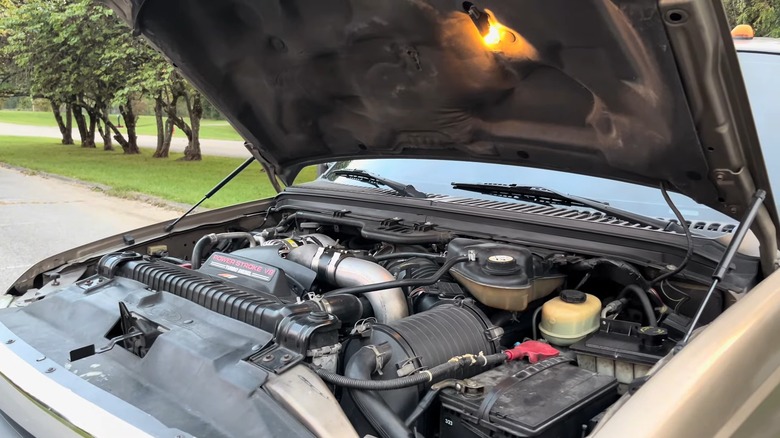
As for the head bolts/gaskets, it's not necessarily a Ford issue, but rather the result of chasing more horsepower. Understand that aftermarket tunes push the stock TTY (torque-to-yield) bolts to their functional limit, compromising their clamping abilities. This was not helped by the Blue Oval's decision to go with four bolts per cylinder, as opposed to six in the 7.3, which in itself was a fairly problematic Ford Power Stroke engine.
Although our readers say that the 6.0 is one of the worst engines, if you're still keen on getting this particular Power Stroke diesel, make sure to check if it's been cared for properly. Another alternative is to go with the later 2005-to-2007 model year trucks, which fixed a lot of the engine's early design flaws. Also, it's not hard to find "bulletproofed" engines that address these reliability issues with aftermarket upgrades. However, be sure to ask the seller for receipts and maintenance records — don't simply take their word for it. All told, the 6.0's towing abilities and half-decent fuel economy can be put to good use with routine maintenance and the right set of mods.