

Are Cars Really Cheaper In America Than Europe?
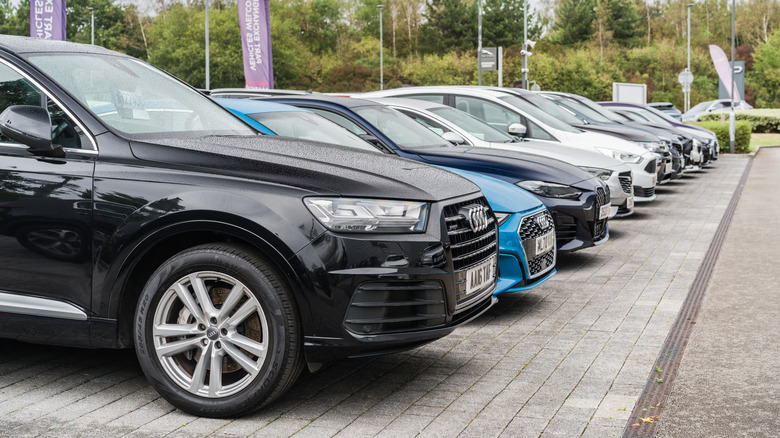
Auto prices have always been a major talking point, especially when comparing different markets, products, and regions. For instance, some enthusiasts claim that cars are more affordable in the U.S. than in Europe, pointing to lower sticker prices and a larger market, but are cars really cheaper in America?
Mainly due to the Value-Added Tax (VAT) and other taxes, the on-the-road price of a new car in Europe is a lot higher than its pre-tax price. VAT on new cars there ranges from 17% to 27% (except for Switzerland, which isn't a member of the European Union and has an 8.1% VAT). That typically increases the final price compared with the lower sales taxes (typically less than 8%) applied in the U.S. Americans also have to deal with destination fees, which is where automakers are hiding a lot of the rising costs of building a car. These fees can cost anywhere between $1,000 to over $3,000. Such fees are included in the VAT for a single, out-the-door price in Europe. But even that charge isn't enough to push American prices ahead of European ones.
Prices also vary drastically across the EU, as different member states apply different taxes, fees, and regulations on top of new car prices. Such a dynamic is far less pronounced in the U.S., where tax structures are generally not too different across states. Overall, California is the most expensive U.S. state to own a car, and its sales tax is 7.25%. Hungary's 27% VAT can make a new car cost far more than the same model in California, but the overall picture is more complex. Here's why.
New car pricing structures in the U.S. and Europe

In December 2025, Kelley Blue Book reported that the average transaction price for a new car in the U.S. reached a record $50,326. However, that figure is skewed heavily upward by Americans' preference for full-size pickup trucks and large SUVs. This makes a straight average-to-average comparison misleading. A more useful lens is a like-for-like model comparison.
Take the Toyota Corolla Hybrid. The 2026 model starts at $25,970 in the U.S. In Germany, the equivalent base model lists at 33,340 euros (about $38,450 at current exchange rates) with 19% VAT already included — almost 50% more than the American price. And in high-tax countries with no incentives, like Turkey, the same model lists at 2,720,000 liras (about $61,375) — well over double the U.S. price before sales tax.
The Ford Mustang GT, meanwhile, starts at around $46,560 in the U.S. In Germany, the same car starts at 64,800 euros — about $74,268, or nearly 60% more. And the suggested U.S. price of a new BMW 550e xDrive Sedan is $75,500, while in Germany a new BMW xDrive 550e Sedan starts at about 78,700 euros (a little over $90,000).
Beyond taxes, the size and uniformity of the U.S. market allows for more competitive pricing than the EU's patchwork of 27 markets, languages, and regulations. Still, while European cars are back on the menu in the U.S., after Trump's tariffs their American prices have been going up. If automakers stop absorbing tariff costs and pass them more fully onto consumers, the suggested U.S. price would rise accordingly.
Used car pricing structures in the U.S. and Europe
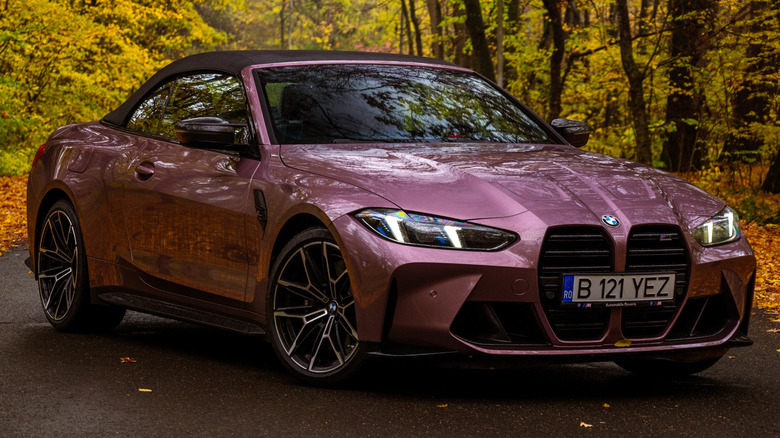
Used car supplies have been tight since COVID, due to reduced production and fewer off-lease vehicles on dealer lots. With tariffs expected to push new car prices higher, more buyers are expected to buy used. At the tail end of 2025, used car prices were at their highest since COVID. If we take a used 2024 BMW M4, and check listings on Autotrader and Cars.com, the cheapest M4s are hovering around $65,000, while the higher-end examples approach $95,000. On Mobile.de, one of the most popular European used car marketplaces, a 2024 BMW M4 for standard models is typically priced between 70,000 and 100,000 euros (about $80,600 to $115,200).
The American market is bigger, and in most situations, it offers greater variety. All of this makes the U.S. market more competitive. The average used car price in the U.S. is more than $30,000, while in Europe, it's closer to 20,000 euros (about $23,000). This isn't a contradiction: just as with new cars, Americans tend to buy larger and more expensive cars than Europeans. For a true apples-to-apples comparison, a car-to-car comparison tells the clearest story — and on that basis, the U.S. tends to come out cheaper.
If you were to buy a $70,000 used 2024 BMW M4 in California, with the tax included, you are looking at $75,075. If for example you live in Denmark, and managed to find yourself a $70,000 used 2024 M4 on sale in Germany, you would face Denmark's high registration tax upon import, potentially more than doubling the price. While this example is Denmark-specific, it illustrates how certain EU countries levy steep taxes on intra-EU car imports, making the used car market there more expensive and less flexible compared to the U.S.