

You're Not Prepared For How Cool A V14 Engine Would Sound
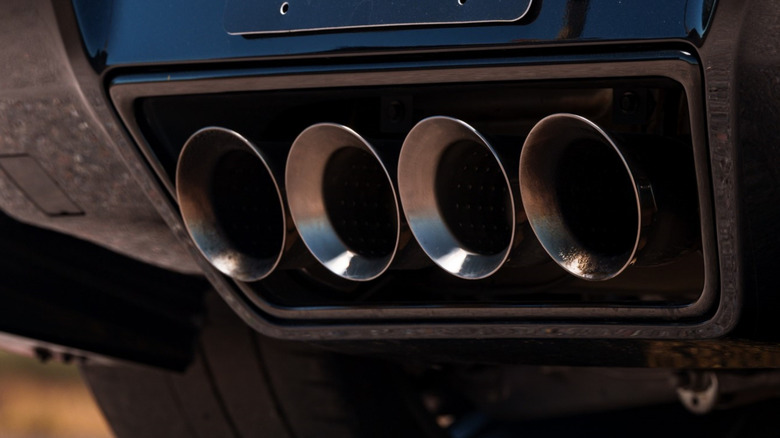
You're probably familiar with the high-pitched whine of a flat-plane engine or the deep rumble of a cross-plane American V8. If you're lucky enough, you may have heard and experienced the harmonious sounds of a V12 or the tremendously bassy W16. But have you wondered what a 14-cylinder engine would sound like, specifically one with a "V" configuration?
Unfortunately, there are no production cars with a V14. But a certain IceManV93 demonstrates what a simulated V14 could sound like. Spoiler alert: it sounds incredibly unrefined, like a really exotic lawnmower or a CNC machine. But a second video shows a more refined V14 that could find its way into a Ferrari, should the Italian marque ever decide to do so. Unlike the previous simulation, this V14 sounds more like an angrier V10. Some might say it sounds eerily similar to Bugatti's new V16.
Inspect closely, and you'll realize the first V14 has a 90-degree bank angle and seems to be firing unevenly. The second V14 has a narrower bank angle, and judging by the sound, it's likely closer to its natural 51.4-degree firing interval (720÷14). This is an assumption, though, based on examples like the even-firing LFA V10 and many 60-degree V12s that share similar bank angles and firing intervals. For context, the LFA's V10 contrasts (in both sound and design) with the Lamborghini Huracan's uneven-firing V10, which uses a 90-degree bank angle instead of 72. In practice, however, the weird 51.4-degree angle is nothing more than an inconvenience, and using a common 90-degree split makes the engine almost sound like it's falling apart.
Why don't cars use a V14 engine?
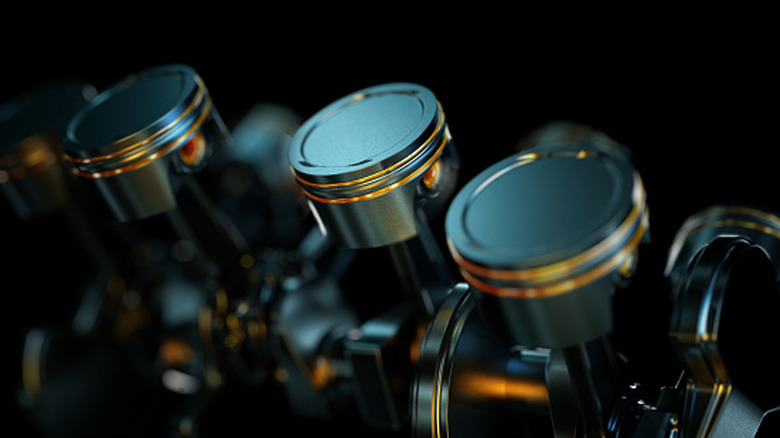
Understand that a V14 is basically two inline-sevens. DRIVETRIBE explains why seven-cylinder engines are not commonly used — at least, not in the automotive space. Without getting too much into the weeds, a seven-cylinder (and consequently a V14) essentially ruins the primary and secondary forces in perfectly balanced six-cylinder and 12-cylinder engines. Not only that, but you're looking at a relatively longer crank to accommodate the added hardware, which will likely result in more flex and weight. Packaging is also something that's worth mentioning.
Still, odd cylinder configurations aren't rare. There are three-cylinder, five-cylinder, and 10-cylinder automotive engines out there. But these typically feature a balancer shaft to smooth things out. However, an inline-seven simply makes things more complex when there isn't much to gain. The risk-reward ratio warrants going with either a six-pot or maybe even a straight-eight. Sure, the latter demands making the crankshaft even longer, but the engine is more balanced than a seven-cylinder because it's basically two inline fours. And a V16 is two straight-eights. So if you really want to push past 12 cylinders, going up to 16 is a much better bet.
That's not to say there aren't any seven-cylinder or 14-cylinder engines out there. You'll typically find them in industrial or marine applications. Take the MAN 49/60DF, a mammoth of an engine available in seven- or nine-cylinder configuration, in addition to a V14 setup. Keep in mind that this engine's max rpm rating is 600, which is a whole different engineering challenge compared to Bugatti's Cosworth-supplied V16 with 9,000 rpm.