

How Speed Cameras Measure Your Speed So Accurately
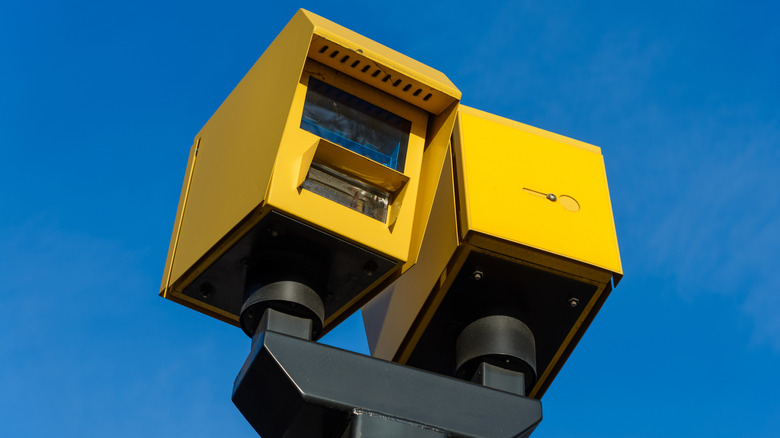
You see the yellow box, you check the speedometer an then, two weeks later, a ticket lands on your doormat. How? You barely had time to register the camera. Here's the thing — it didn't need much time at all. Speed cameras measure your velocity with remarkable precision using physics; specifically, the Doppler effect.
It's basically the same phenomenon that makes a passing ambulance siren sound higher-pitched as it approaches, then lower as it recedes. Radar-based cameras emit a microwave beam when that beam bounces off your moving car, the reflected frequency shifts in proportion to your speed. The camera does the math in milliseconds. Still, radar is just one piece of the puzzle. The speed camera as we know it was born in 1964, when a Dutch race car driver named Maurice Gatsonides — the 1953 Monte Carlo Rally winner, no less — adapted a device he'd invented to measure his cornering speeds on track. He quickly realized the same tool could catch other people speeding instead.
Today's cameras are dramatically more sophisticated than Gatsonides' original creation, but not infallible. Over 40% of New York City speed camera tickets get thrown out, often due to technicalities. Knowing what you're dealing with changes everything, and here's the why, the how, and the what.
Three very different ways of accurately catching you speeding
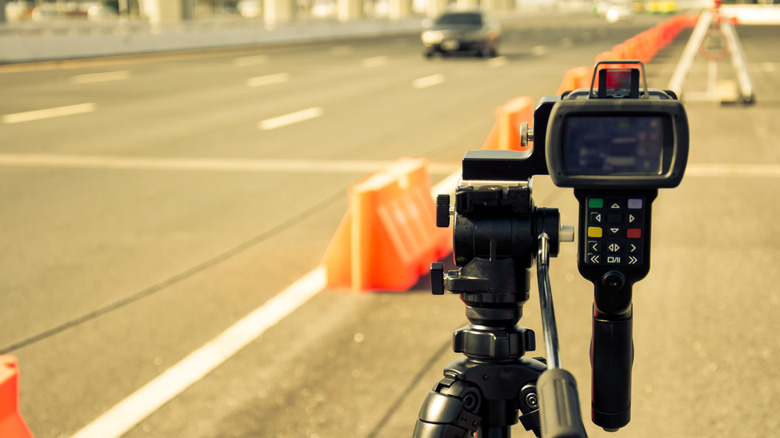
Just like every F1 car has a high-speed camera that's never used for broadcasts, modern traffic cameras quietly record critical data — though instead of monitoring crashes at 400 frames per second, these cameras are there to give you a front-row seat to the universe's cruel sense of timing. According to the U.S. Department of Transportation, camera can be divided into three distinct groups: stationary cameras, mobile cameras, and average-speed cameras.
Fixed-spot cameras typically use Doppler radar to capture your speed at a single point. The camera translates a frequency shift into a speed reading. Some fixed cameras, however, also rely on piezo‑electric sensors. These use wires embedded into the road to calculate the time it takes a vehicle to pass between two sets of wires. Although piezo systems exist, they're less common in the U.S., where most speed enforcement relies on radar and lidar.
For single-vehicle mobile targeting, cameras often use laser (lidar) technology. The technology works thanks to a narrow infrared laser beam that bounces off your vehicle and returns. The camera effectively measures the round-trip time across multiple pulses to calculate speed. Laser is more precise, harder to detect, and can lock onto a single vehicle in dense traffic even 1,000 feet away. Lidar speed cameras are the final bosses of the speed camera game. They let police officers act quickly, and give drivers very little time to react, before the violation is recorded.
Although an average-speed camera may not seem as sophisticated, its strength lies in covering your average across a set distance. A camera reads your license plate and timestamps you at point A. Another does the same at point B, some distance down the road. Distance divided by time equals average speed.
Speed cameras are not infallible
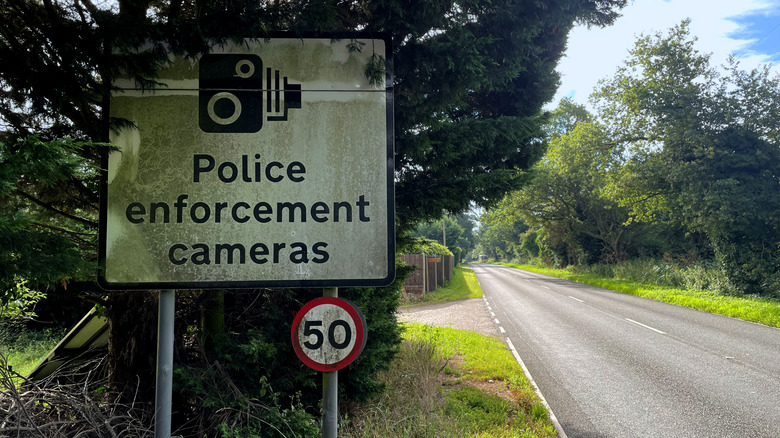
Speed cameras can be wrong. Not often, but the conditions for error are real and legally significant. Speed cameras are vulnerable to radio frequency interference, typically associated with nearby transmitters, high-voltage power lines, reflective surfaces, and even the patrol car's own heater or air conditioner fan. Besides just capturing a different vehicle, these cameras can also be confused by weather conditions — even for lidar systems.
U.S. courts can accept radar calibration readings as evidence. However, the officer's training and testimony in that regard is often essential. Speed cameras are often certified to an accuracy of +1 mph, -2 mph. However, they have to be regularly calibrated to be accurate. In 2024, the ABC7 Chicago investifative team obtained calibration reports showing that city cameras had an accuracy window of up to ±0.62 mph. This means that drivers ticketed for going 26 in a 25 zone may have technically been doing 25.38. Or in other words, you can get ticketed for going 1 mph over the speed limit, even if you are not going 1 mph over the speed limit.
Average-speed cameras have their own quirks. Motorcycles with no front plate historically evaded them. Although you used to be able to change lanes between cameras to confuse them, that trick is dead: modern Automatic Number Plate Recognition (ANPR) systems cover all lanes simultaneously.
The blunt reality: Thousands of tickets can be issued between routine calibration inspections. These systems are accurate the vast majority of the time. Still, they're not perfect, and knowing that is useful if you ever find yourself staring down a ticket you're not sure you deserve.