

Steel Vs. Aluminum Rocker Arms: Does It Make A Difference?
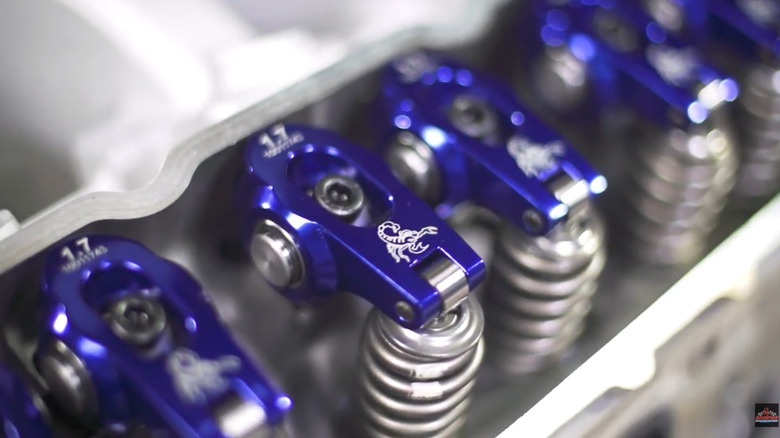
Rocker arms made of different materials — like steel or aluminum — can offer separate drawbacks and advantages based directly on the differences between those materials. We'll get into the details below, but perhaps the most important characteristic to keep in mind is that, generally speaking, steel is stronger and heavier than aluminum. But to see how that really comes into play with rocker arms, we'll have to see exactly what those components do in the first place.
Rocker arms work as levers in the engine. You can imagine them as being similar to see-saws; when one side goes up, the other goes down. They're commonly found in old-school overhead valve/pushrod engines (which are still used in cars like the Chevrolet Corvette, but have been mostly replaced today by overhead-cam motors). Basically, the camshaft has built-in bumps called lobes, and when the shaft turns, components known as lifters ride over the lobes, moving the pushrods upward. The pushrod then pushes on one end of the rocker arm, which then moves on its fulcrum so that the opposite side of the arm is forced downward. The see-sawing up-and-down motion opens and closes the engine's valves, controlling its breathing. (Some overhead-cam engines still do rely on rocker arms, but you won't find them in dual overhead-cam blocks.)
Given how vital engine breathing is to performance, it's no surprise to learn that upgrading your rocker arms really can boost horsepower. And whether those parts are made of steel or aluminum can make a big impact on the results, particularly with how well they'll hold up when the engine is putting them through their paces.
Pros and cons of steel and aluminum rocker arms
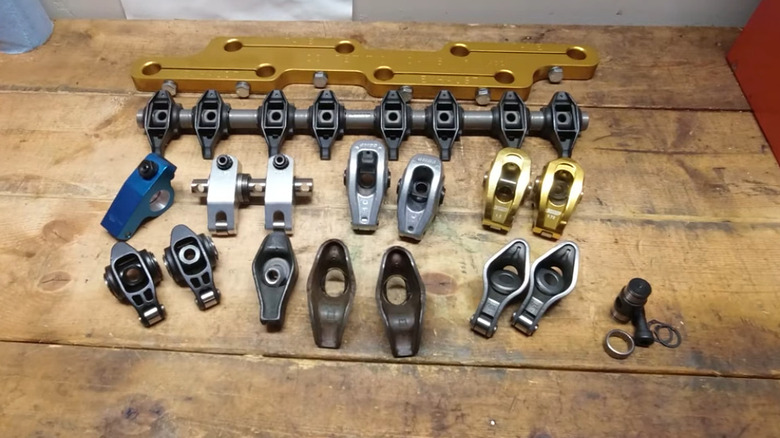
It's good to keep in mind that, according to experts, aluminum rocker arms are able to handle not only most street cars, but many racing machines, too. The key here is that aluminum's lighter weight allows motors to rev higher since there's less inertia for the engine to deal with. Also, although aluminum's relative softness is a drawback in terms of durability, it's a noticeable benefit when it comes to machining parts — which lowers the overall price of aluminum components.
Steel rocker arms, on the other hand, tend to be reserved for situations where engines face more extreme use. This can cover endurance racing, where engines may have to put up with 24 hours worth of competition at a time, or high-boost scenarios from forced induction when the rocker arms have to work against ultra-high cylinder pressures. Steel rocker arms have a place in the trucking industry, too, supporting the longevity and strength needed for long-haul, high-capability applications. In other words, they're one of the reasons why semi trucks last so much longer than cars.
Your material choices also aren't quite as limited as they might seem at first glance. High-strength aluminum alloys, specially treated carbon steel, and unique coatings and heat treatments are among the ways today's rocker-arm manufacturers look to tap into the best of both worlds. The bottom line: While some popular mods will just make your car slower, putting style over substance, swapping rocker arms is a proven method for squeezing more ponies out from under your hood.