

How Dodge Transformed The Viper From Twitchy Beast To Predictable Handler
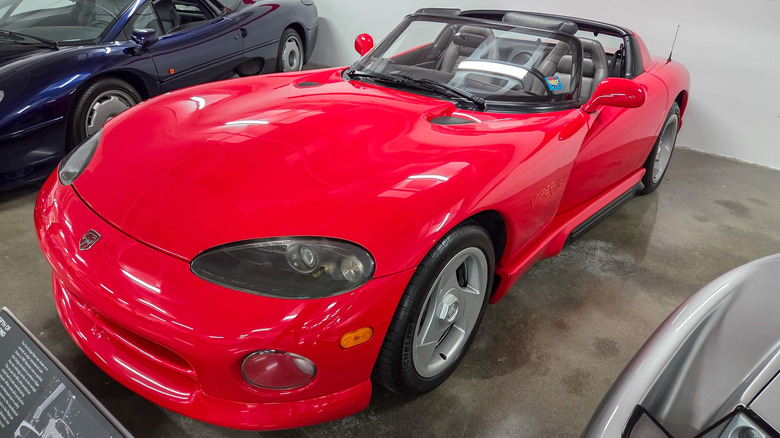
The Dodge Viper (especially the first iteration) is either remembered fondly for its brawny output and unique looks, or less favorably as a machine of death disguised to look like a sports car. The first Viper was essentially the opposite of an Italian exotic like a Ferrari: It was noisy, hot to the touch in certain places because of its side pipe exhaust, lacked basic features like air conditioning, and its engine prioritized sheer brute force over any semblance of refinement. You can still get your hands on this staple of the 1990s, but understand that buying a Dodge Viper will never be a great investment, though some argue you should do it anyway.
One of the chief complaints when the early-'90s first generation launched was its unforgiving handling characteristics, which caused even seasoned reviewers to lose control during testing. The suspension was likely one of the culprits, with its fully independent setup feeling stiff and less predictable when pushing the car's limits.
That SR-I Viper also suffered from tramlining, which is when grooves in the road have a profound effect on the car's control, pulling it in different directions. Oh, and it didn't feature stability or traction control, meaning drivers were on their own in terms of taming the car. These issues, among others, gave some behind the wheel of the first-generation Viper a distinctly uncomfortable feeling that loss of control was ever imminent.
So Dodge made some big adjustments for the SR-II in 1995 that addressed many of the concerns. The Viper's frame was stiffened up, reducing its tendency to twist under force, while aluminum suspension components replaced the previous heavier ones and were relocated, prioritizing control. Finally, the suspension was adjusted to reduce tramlining.
From unpredictable to solid motorsports competitor
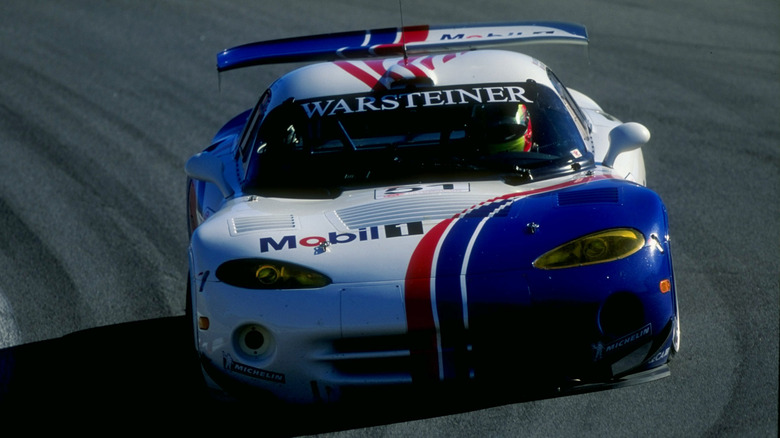
The SR-I Viper may have had a few issues holding it back from greatness, but by the time 1996 rolled around the Viper was ready to compete in motorsports with the GTS-R. This effort leveraged the skills and expertise of Reynard Motorsport, the British company behind several successful race cars, and Oreca, an organization active in racing since the early 1970s. Dodge wasn't a big name in Europe in the '90s, so the car was referred to as the Chrysler Viper GTS-R.
Building a Viper that could take on the likes of Ferrari and Porsche on the track wasn't easy. While impressive at the time, the road Viper's 8.0-liter V10 is a big-block engine that packs less punch than you'd expect, at just 50 horsepower per liter. But Chrysler's collaboration with European partners led to a significant boost in output. Still using the same power plant, the GTS-R reportedly produced nearly 700 horsepower. Right away this reformed beast captured the FIA GT championship in 1997, showing it was a dominant force in the GT2 class.
The GTS-R was the start that led to multiple wins across championships and endurance races until it was retired in 2004 in favor of a Competition Coupe version with an even larger 8.3-liter V10. The Dodge Viper was discontinued in 2017, which effectively ended its professional motorsport career, although there are rumors it could return.