

LaGuardia's Runway Warning System Didn't Activate Before Fatal Crash Because The Firetruck Didn't Have A Transponder
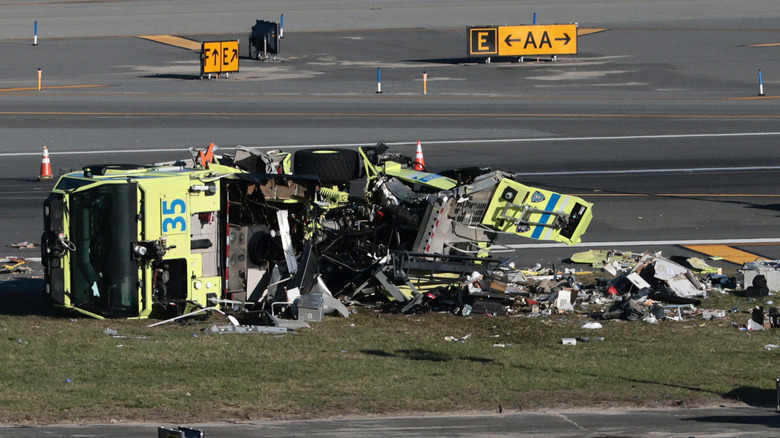
There was no single reason why the collision between an Air Canada Express jet and a fire truck happened at New York's LaGuardia Airport on April 22 that left two pilots dead and nearly 40 people injured. It comes down to multiple failures on multiple levels, including the fact that tracking technologies designed to prevent this exact sort of crash weren't working at the airport at the time of the incident. New information from National Transportation Safety Board Chair Jennifer Homendy — a Biden appointee — says that the airport's ground surveillance system didn't generate an alert warning for the close proximity of vehicles to the runway.
Homendy said in a press briefing that the fire truck that the Air Canada Bombardier CRJ-900 collided with was not equipped with a transponder, and that's why the warning system, known as ASDE-X, didn't work, according to Forbes. She added that, "many, many things went wrong." This piece of equipment would have sent its exact location to air traffic control. The Federal Aviation Administration has previously encouraged airports to equip their fire trucks with transponders since they make their movements far easier to track, Reuters reports. Clearly, LaGuardia decided against those recommendations.
 Heather Diehl/Getty
It wasn't like this truck was a one-off. Homedy noted that there is "no indication" that the other trucks behind the destroyed fire truck had their own transponders, either, according to Forbes.
"Controllers should have all the information, the tools to do their job," Homendy said, according to Reuters. "You have to have information on ground movements, whether that's aircraft or vehicles moving."
ATC staffing concerns
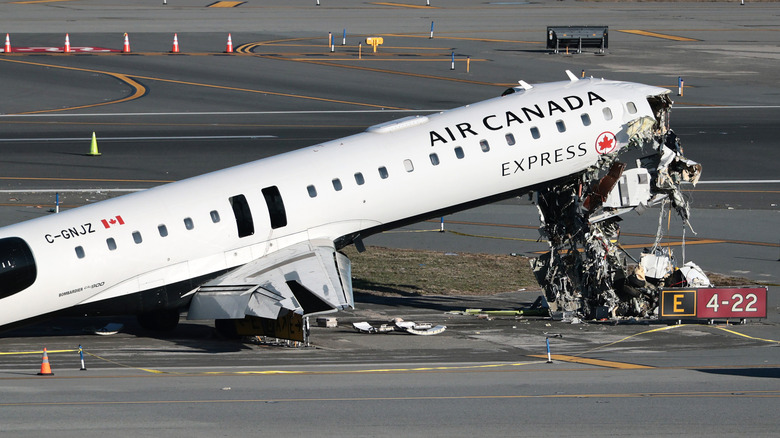
One element that certainly remains unclear right now is why the fire truck made the decision to cross the runway. Yes, the air traffic controller clearly gave them the go-ahead, but, according to Homendy, the runway status lights (which flash red to warn when it is unsafe to cross an operational runway) were indeed operational. It raises a lot of questions about training and the general operational reliability of these systems at LaGuardia, which I don't want to speculate on.
Additionally, Homendy talked about longstanding issues the National Transportation Safety Board took with air traffic controller staffing levels — especially at busy airports at LaGuardia. Sure, the fact that there were two controllers on duty at the time of the accident technically means they met the FAA norms for an overnight shift, but listening to the frantic nature of the ATC radio chatter before, during and after the crash proves that it clearly isn't enough. Also, if there were two ATC personnel up there, what was the other guy doing, because you only ever hear the one person directing traffic on the ground and in the air?
Of course, NTSB can only make recommendations to the FAA; it can't actually enforce them. Here's what she told reporters at LaGuardia, from Reuters:
"In this situation, for the midnight shift, it is standard operating procedure that they only have two on duty and those two perform the duties of other controllers," [Homendy said.] "Certainly, I can tell you that our air traffic control team has stated this is a concern for them for years."