

Here's How To Decipher The Different Grades Of Motor Oil
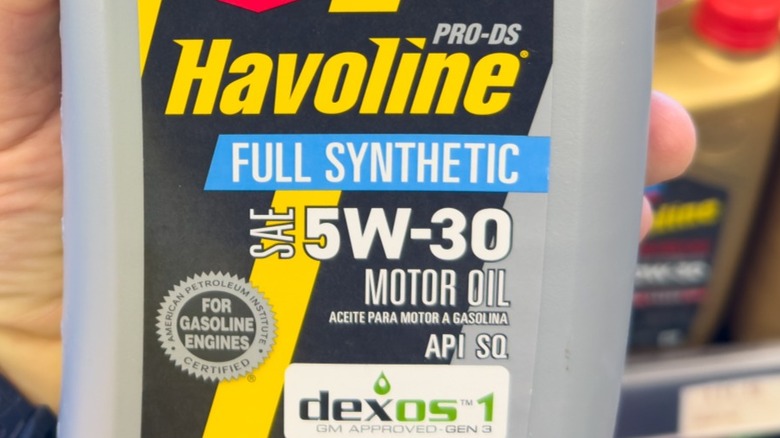
You've always been good, we hope, about making sure the right grade of oil is put in your car, whether you do it yourself, or you have it changed by professionals. So, if your car requires 5W-30 oil, that's what it gets. If you're unsure, you can typically find the recommended grade in the owner's manual, on the sticker on your doorjamb, or on the oil cap. But what do those numbers in the grade mean?
Those numbers have to do with viscosity, or how thick your oil is and how thick it stays under pressure in extreme temperatures. Oil gets thicker in cold temperatures and thins out in extreme heat. That can be a problem, because oil that is too thick can keep an engine from starting or running. If oil is too thin, it won't form a protective film over the engine parts, which means you'll have metal rubbing against metal, a potentially catastrophic problem. Nevertheless, modern technology means thinner motor oils can mostly be used now.)
When you look at the bottle in the store, you'll see a code that usually combines two sets of two digits, separated by a dash. The numbers to the left of the "W" indicate low temperature viscosity. The numbers on this scale are 0W, 5W, 10W, 15W, 20W, and 25W, with 0W oil running thinner at colder temperatures than 5W, and so on. The numbers on the right, after the dash, refer to high temperature viscosity. The numbers on this scale are 8, 12, 16, 20, 30, 40, 50, and 60. Oil that has a grade ending in 60 will run thicker at high temperatures than 50, and so on.
The W doesn't stand for what you think it does

You'd be forgiven if you thought that the "W" in the middle of the numbers in an oil grade stands for "weight" or "weighted". After all, people often imprecisely refer to an oil's grade as its "weight". But "W" actually stands for "winter", because that number on the left refers to how the oil has tested in cold temperatures. However, that number itself is not a specific temperature or measurement of viscosity. Instead, it refers to a range of viscosity and temperatures. The lower the number on the left, the thinner it is in cold weather and the easier it flows. For example, 0W oil has been successfully tested for starting an engine (cranking viscosity) at -35 degrees Celsius and running an engine (pumping viscosity) at -40 degrees Celsius.
As we said, the numbers on the right indicate how well the oil performs in very hot temperatures. The higher the number on the right, the thicker the oil stays and the better it is able to protect engine components. Two types of viscosity are measured for this — kinematic viscosity (how quickly the oil flows) at 100 degrees Celsius, and high shear viscosity (how well the oil remains thick enough to protect engine parts) at 150 degrees Celsius. For example, oil with a grade that ends in 30 falls within a kinematic viscosity range of 9.3 to xtagstartz12.5 cSt (centistokes) and a high shear viscosity of 2.3 cp (centipoise).
What if you put the wrong grade of oil in your car?
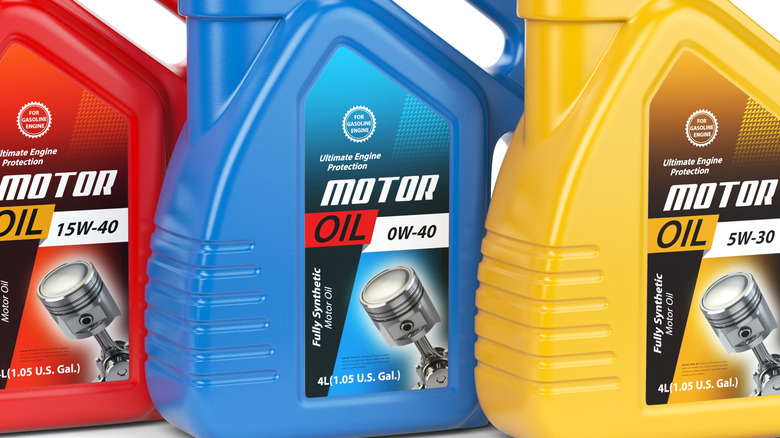
So, you just put a quart of 5W-30 in your car instead of the recommended 0W-20. Oh, no! If only there were a way to change the oil that is in your car. Oh, wait... Seriously, though, that quart of 5W-30 isn't going to kill your engine, especially if it's the same brand as the 0W-20 that is already in your engine. To make sure, you can check the label to see if the oil can be mixed with other brands and viscosities. At the very least, you'll be able to make it to the quick lube place without any serious issues. But what if you just changed your oil and realize you put in five quarts of the wrong weight? It's time to crawl under the car and loosen the drain plug again. The point is, it's an easy mistake to fix when caught early.
What about using different weights of oil as the seasons change? This was common practice before the "W" and cold temperature weights were added to the grades. Only one number was used in the grade, like SAE 30 or SAE 40. Today, oils have additives that are made for a range of temperatures. However, your manual may specify a range of grades for different temperatures, instead of just one weight. There are plenty of common myths about oil, but it's important to follow the manufacturer's recommendations on oil weight.