

Was The Ford Explorer Sport Trac Too Early For Its Own Good?
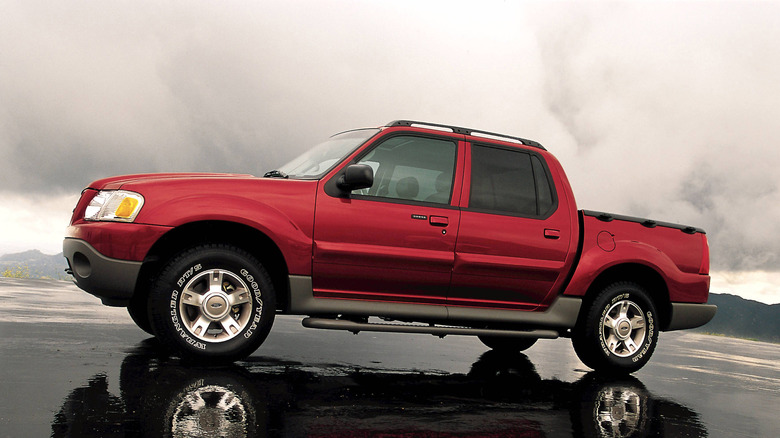
We've reached an era in automotive history where crossover and SUV flexibility reigns supreme. Drivers can enjoy respectable cargo space, towing capacity, and off-road capability, all blended together in the same package — a car that's spacious and easy to see out of, but has better handling capability than its size suggests. Above all, especially with hybrid technology becoming more and more commonplace, fuel economy doesn't get in the way of all things adventure-ready.
There's a myriad of vehicles on the market that fit this bill well, especially with a bed integrated into their basic design. Trucks like the Ford Honda Ridgeline and Hyundai Santa Cruz are excellent examples of flexible unibody-based vehicles with pickup versatility that have done pretty well for themselves in the last few years. They're bedded crossovers that blur product lines and tickle consumers' collective fancy, even if their beds seldom carry more than a bag of mulch.
These very commonplace vehicles didn't just randomly show up one day, though. Remember the early 2000s? That period of time when a small card-looking device contained our tunes with far less capacity than a CD or cassette? Turn the clock back to 2000 when Ford introduced the Explorer Sport Trac. It was based on the body-on-frame setup of the standard Explorer, and it sold well enough to stick around for a number of years, but it might've missed its ideal timeline — the era of stylish pickups riding on unibody platforms and offering better fuel economy to go along with their versatility.
The Nostradamus of peak SUV life
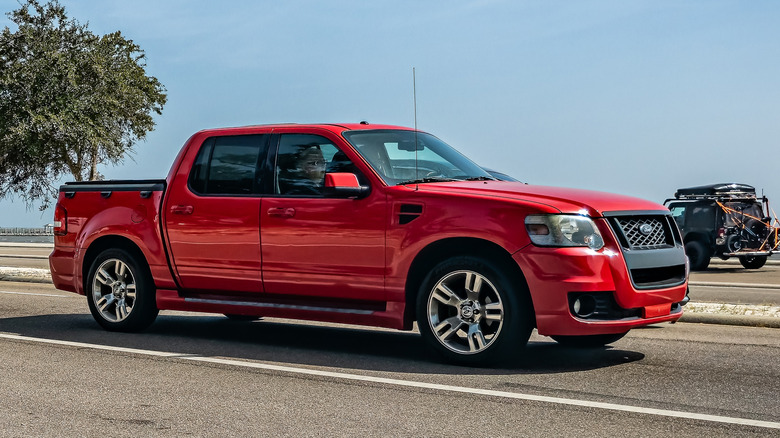
Ford's marketing for the Sport Trac was clear: This thing can haul bicycles, surfboards, or camping supplies. It was geared towards the adventure-minded who wanted the roominess of the standard Explorer. It's a message that's still sent in marketing materials for other successful trucks today. And generally speaking, it did well. Between 20 and 25% of the Explorer's sales were Sport Trac models, though the two were not separated in Ford's sales data.
Classified as a mid-size pickup truck, the Sport Trac was an amalgamation of the three-door (or two-door, depending on whether you consider the hatch a door) Explorer Sport and a traditional pickup. It was situated above the Ranger but below the venerable F-150. The sole debut powerplant was a 4.0-liter V6 making a hair over 200 horsepower. It came in either rear- or all-wheel drive, had either a five-speed manual (hell yeah) or automatic gearbox, and even boasted a 5,260-pound tow capacity. It came in a variety of trims, and as much as 1,500 lbs. of whatever could be stored in its baby four-foot bed.
The Sport Trac's first generation lasted from 2001 to 2005, with the second generation kicking off a few years later, spanning 2007 to 2010. The second generation featured revised styling all-around, an available 4.6-liter V8 that bumped output to 292 hp, increased chassis rigidity, and independent rear suspension, but those changes weren't enough to save the pickup.
The Sport Trac walked so that others could walk a bit faster
It's been 16 years since the Sport Trac was killed off, but what caused its death? Sales were nearly cut in half between the 2008 and 2009 model years across the entire Explorer lineup, and the fact that NHTSA didn't rate the Sport Trac well regarding the occurrence of rollover could've hurt it even more. Unibody crossovers and SUVs were in demand by 2010, so if the Sport Trac had followed the overall trend, it might've done well with improved handling, fuel economy, and safety ratings.
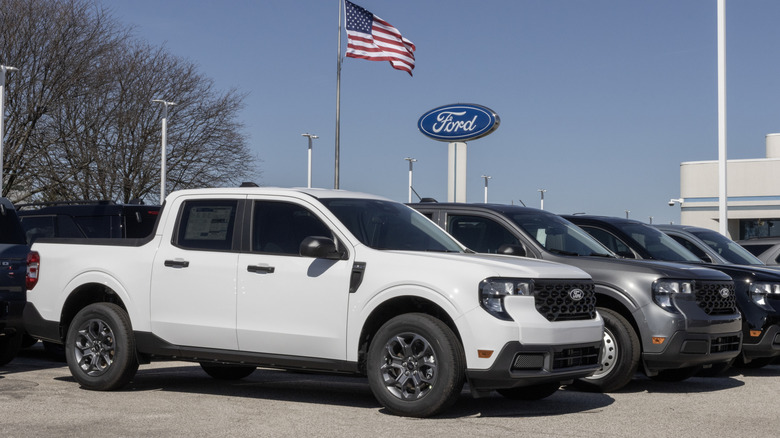
Ford has taken a second shot, though. They debuted the Maverick in 2022, and it's done really well. This lil' fella sports a 4.5-foot bed, several powertrain choices (including a hybrid), and substantially better fuel economy than the Sport Trac — an EPA-rated combined fuel economy range from 25 mpg to 39 mpg combined is astonishing compared to its forefather's 16. Its maximum payload matches the Sport Trac's, but tow capacity only peaks at 4,000 lbs. More than a thousand less, but considering its solid reviews and sturdy sales numbers — which are nearing 500,000 units since its debut — that's seemingly not as big of a deal in our modern era.
Was the Ford Explorer Sport Trac too early for its own good? Pickup trucks continue to be amply popular today, and fuel economy concerns aren't going anywhere, so an evolved version of the Sport Trac could've done seriously well. And maybe that's exactly what the Maverick is.