

You Can Actually JB Weld A Broken Connecting Rod Back Together In A Pinch
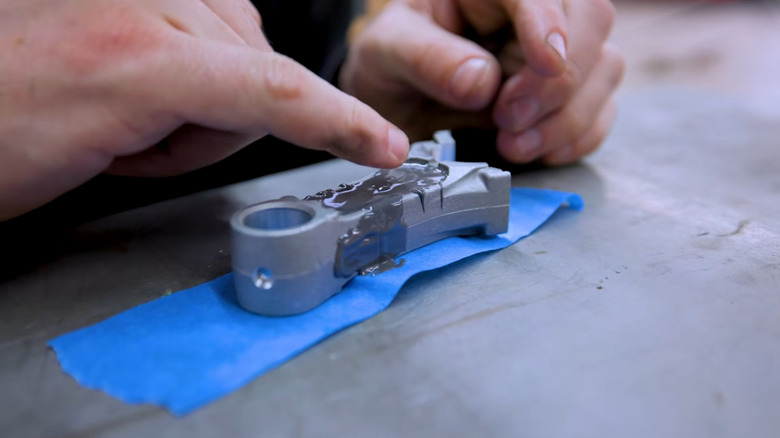
What can't JB Weld do? It's the metal glue that works wonders, and has left dozens of flat surfaces around my workshop with a swirled glop of grey permanently affixed. This is rarely the kind of thing you use for a permanent fix on any project, but sometimes a temporary fix is all you need. And sometimes temporary becomes permanent when it does the job good enough to never need fixing again. A few bucks worth of this two-part bond can fix things that would normally cost a lot more to replace. And apparently, if you're in a pinch, it can even be used to reunite two halves of a snapped connecting rod.
The mad scientists at BigTime are back at it again, putting together a handful of different experiments to determine exactly what JB Weld won't fix. Each of these tests is probably unwise, and some possibly even rise to the matter of dangerous. This is one of those "don't try this at home" kinds of things, unless you're extremely desperate. Maybe you blew up your differential forty-five miles down an abandoned two-track trail and haven't seen anyone in a couple days, and you need to get things back together enough to limp it home. Maybe you punctured a hole in your oil pan and need to glop it up enough to hold the oil in until you can get a new one. Or maybe you cut a brand new minibike connecting rod in half and want to test how long it will stay together if you put a bunch of epoxy on it.
Whatever the situation is, it's entirely possible that JB Weld will be there for you. It just depends how long you need it to be there for you.
It'll run, but not forever
When these fellas threw some JB Weld on an oil pan plug that had been overtorqued, I was immediately confident that the epoxy would hold and they'd never see a drop of oil leak from that oil pan again. That's more or less the intended use for JB Weld, it works so well. There's almost no reason to test this use case, it's such a well-trodden path. Let's move on to something a bit more interesting.
It's a bit premature to determine whether the JB Welded differential will stay together long-term, but I'm inclined to believe it will. Given that the crew used two full packs of JB Weld and really got it in between all of the spider gears of the differential, it's probably going to hold for several dozen burnouts, at least. The weak link in that chain is typically the bond between the tires and the road, so you'll get the tires to spin up before the differential eats itself. Unless you do something stupid, like run it out of gear oil, or do a lot of neutral drops.
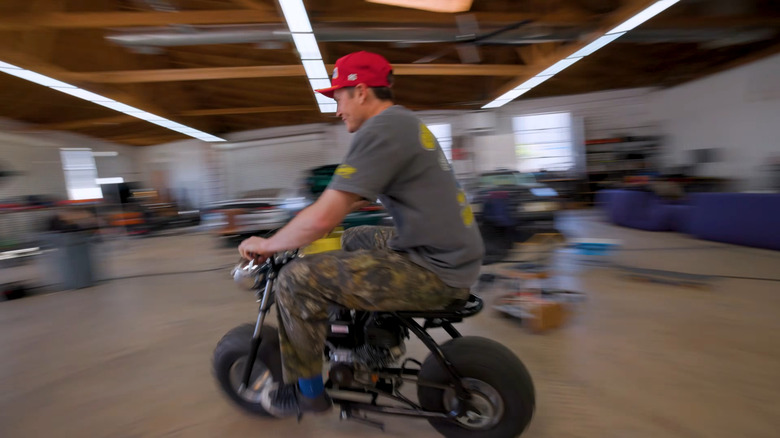
The big surprise for me was seeing the minibike engine's connecting rod cut in half and glued back together with JB Weld. As Zach says in the video before the test is complete, "I think it'll start, I just think first rev it's coming apart." I'm not even sure I was that optimistic. To see the bike not only start and settle into an idle, but rev a little and ride around for a seriously long time, was totally unexpected. Now that I've seen it happen, I'm almost convinced that if the guys had drilled holes above and below the "break" in the connecting rod, the JB Weld would have had more purchase on the metal and might not have broken quite as quickly. Maybe they should give it another try.