

How And Why Honda And Volkswagen Made Shockingly Successful (Yet Still Doomed) V5 Engines
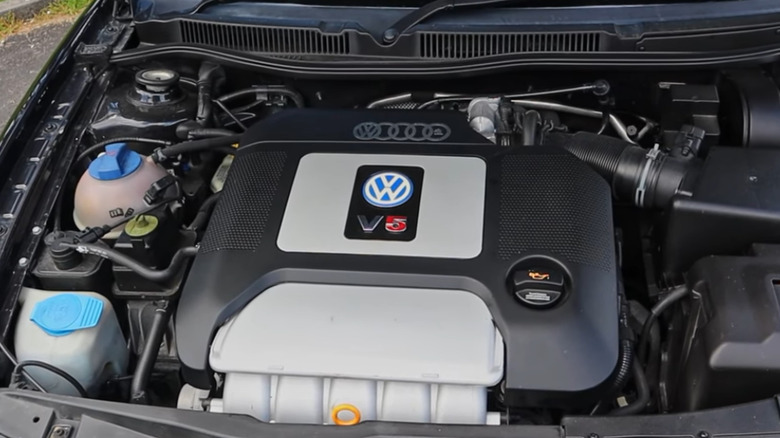
Like all engines, five-cylinder engines have their cons, but they have also had their moments in the sun, especially in Volkswagen Group's products. The company's I5 motors were a relatively common sight under the hoods of various Golfs, Jettas, Beetles, and Passats well into the 21st century. The same is true for Audi entries ranging from the original Audi Quattro of 1980, to more modern high-performance RS models. In fact, VW was so enamored of the five-cylinder engine that it even put a V5 into production vehicles — and it's the only automaker able to make that claim. But that wasn't the only V5 to find some sort of success.
Honda built its own version in 2002, although it was limited to use in the company's MotoGP racing bikes — where it was responsible for Team Honda winning multiple championships in the early 2000s. Now, despite the many differences between VW's and Honda's motors, they did end up having something in common: both were destined for ultimate failure, partly due to the inherent issues with V-type engines running an odd number of cylinders, and partly because of other powertrain improvements that were able to fill the gap between typical four- and six-cylinder motors.
Consider that five-cylinder engines originally took aim at the Goldilocks zone between the other two, targeting more power than a four-cylinder motor but more efficiency than a six-cylinder engine. Well, nowadays, that would be the perfect setting for a smaller turbocharged engine that could deliver those results without the drawbacks or expense of a five-cylinder mill.
VW and the narrow-angle V5
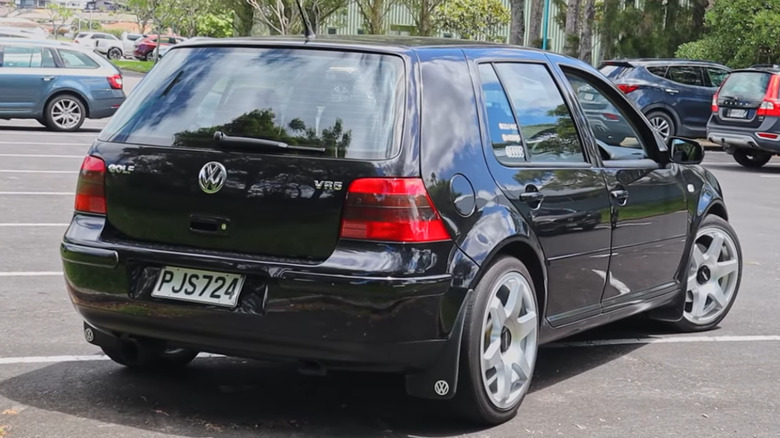
For Volkswagen, the story starts in the 1980s with its VR6 engine, which barely qualifies as a V engine. The angle between the cylinder banks was a mere 15 degrees, meaning it was narrow enough to use one cylinder head for all cylinders — rather than the usual V-engine configuration of having separate cylinder heads for each bank. The next stage came when Volkswagen was looking for a slightly smaller engine package to fit into more of its vehicles, and simply decided to remove one cylinder from the VR6.
Okay, the process was a little more complicated than that because the engine was now out of balance. Volkswagen claimed the narrow V-angle helped mitigate the problem, with some help from a counterweighted crankshaft and a dual-mass flywheel. However, the result was a 2.3-liter engine originally capable of 150 horsepower and 154 pound-feet of torque in the 1997 VW Golf. Upgrades increased output to 170 horses and 168 pound-feet of torque for the 2000 model year, but by then, turbocharging was already proving a better tactic. Indeed, the VR5 engine of the time couldn't top the output of the company's 1.8-liter turbo-four motors. Yet it was heavier, more expensive, and less efficient.
Nor did it ever make it to the United States. While the VR5 was available for Euro-spec versions of the Bora/Jetta, Golf, and Passat, the company's U.S. products featured the traditional I5 instead. Even today, when the VW Golf R is celebrating its 25th anniversary with a new five-cylinder engine, it's one of the Volkswagen Group's I5s — borrowed from the current Audi RS3.
Honda and the wide-angle V5
The Honda we know today got its start building motorcycles in post-World War II Japan, and two-wheel transportation has remained a huge part of the company's business ever since. The history-making Honda Super Cub, first introduced way back in 1958, is considered the best-selling motorcycle in the world, with more than 100 million produced — and counting.
Along the way, Honda followed a familiar script for makers of motorized transportation and turned to racing to boost its presence even further — and one of its most successful machines turned out to be a V5 bike called the RC211V. It was specifically engineered for the 2002 motorsports season, when the MotoGP classification was first introduced. Now, this was also during the era when four-stroke motorcycle engines were becoming popular, and the MotoGP class was developed with four-strokes in mind. The inaugural season, however, saw a fair amount of experimentation: Five manufacturers ran four-stroke motors in 2002, and they used four different engine configurations.
Honda's was a 990-cubic-centimeter V5 with a huge V angle of 75.5 degrees, and it was mounted transversely, with three cylinders facing front and two in the rear. The large angle kept the setup balanced without the need to add a balance shaft, which would also have added a weight penalty into the mix. Led by No. 1 rider Valentino Rossi's 11 victories, Honda's V5 bike found its way to the winner's circle in 14 of the year's 16 races. Yet when MotoGP rules changed again for 2007, the V5 no longer fit into either Honda's plans or the new classification scheme, and that was the final season for Honda's "famous five."