

What's The Difference Between Bias Ply And Radial Tires?
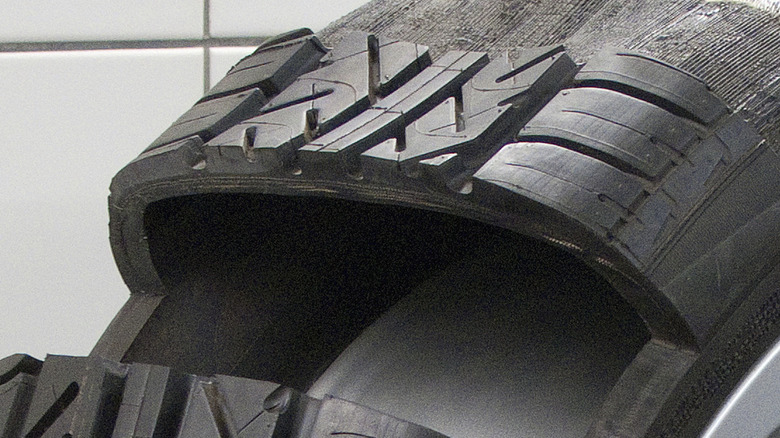
The simplest way to distinguish between radial and bias ply tires is to understand how the layers within the tire, or "plies," lie in relation to its direction of travel. In a radial tire, the polyester, polyamide, or steel cords that form the layers lie perpendicular to the direction the tire will travel — in other words, straight across, from one bead to another. A bias ply tire, on the other hand, has its nylon or Kevlar cords laid at a 30- to 40-degree angle bead-to-bead, with multiple plies layered in opposing diagonals in a crisscross X-like fashion.
But this information is meaningless unless one design presents advantages over the other. Bias-ply tires are better at carrying heavy loads, dealing with rough surfaces, and resisting puncture, but when it comes to road manners, fuel efficiency, ride comfort, and handling high-speed corners, radial-ply tires are simply superior. That's why you almost always see them on crazy-quick motorcycles like the Ninja H2R and high-performance sports cars like the insanely quick Corvette ZR1X.
Radial ply is pretty much the industry standard these days, with bias ply construction relegated to a few niche applications, such as off-roading, drag racing, and period-correct restorations. But bias ply tires are increasingly losing out to radials even in these niche areas. Take drag tires, for example. Fans of straight-line racing had mixed opinions about radials in the past, but things seem different now, as demonstrated in Dragzine's real-world track test comparing radial and bias ply slicks.
Bias ply versus radials in the drag scene
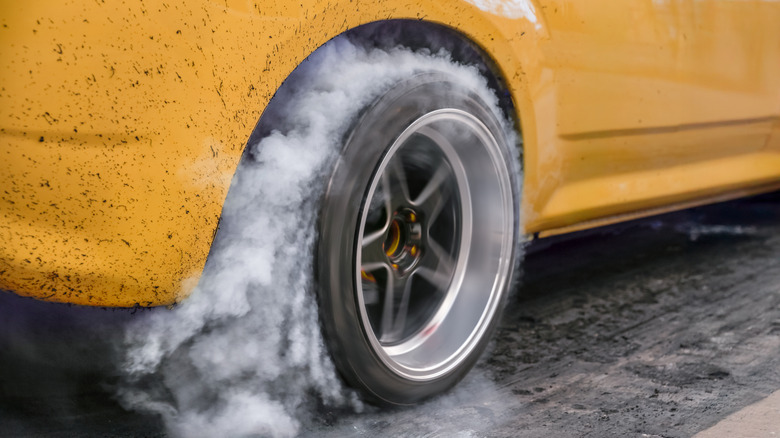
With a pair of fresh bias ply Mickey Thompson ET Drag slicks, the Dragzine Camaro project car ran a 6.36-second elapsed time, which got down to 6.212 after swapping in a set of Mickey Thompson Pro Bracket Radials. The difference is likely due to the Bracket Radials having a stiff sidewall, meaning less tire wrinkle, which also shortened the unload and re-engagement window. The bias-plied Mickey Thompson Drag slicks, in comparison, have softer sidewalls, increased flexibility, and are known to conform better to the track surface. However, as Dragzine puts it, "With that wrinkling sidewall, you are absorbing horsepower that you ideally want to propel you down the track."
Of course, there are nuances to this. Track temperatures, tire pressures, and the car's suspension setup can all affect straight-line performance. And to be fair, a bias ply advantage does exist, as seen in this test in which Hot Rod compared an ET Drag to its radial ply Drag Pro counterpart. While Round 1 saw the radials take a marginal lead, the Drag slicks clawed their way back in Round 2. The bias-ply slicks had an advantage in less-than-perfect conditions while the radials fared better when conditions were closer to ideal. This, however, is still a far better tire dilemma than what drag racers faced in the past.