

Why You Should Still Use Your Blinker Even In Dedicated Turn Lanes
The history of the blinking electric turn signal goes back at least to the 1930s, with either Talbot (1932) or Buick (1939) getting credit for their introduction, depending on whom you believe. Up until that point, drivers often used hand signals to communicate their intentions.
Blinkers became standard nationwide in the United States starting on January 1, 1969, under the Federal Motor Vehicle Safety Standard No. 108, "Lamps, Reflective Devices and Associated Equipment." Sort of like with seatbelts, though, there's a big difference between installing turn signals in an automobile and getting people to use them. And since traffic enforcement is a matter for the states, the result has been a large patchwork collection of different rules regarding exactly how and when to use turn signals. Yet one thing that's stayed the same between most states today — from New York to Texas to Michigan — is that they require the use of turn signals on pretty much all turns, even those from a designated turn lane.
So perhaps the top reason for using your blinker anytime you turn, even from an "official" left-turn lane, is to avoid getting stopped by a police officer and becoming enmeshed in the U.S. legal system — or worse: John Oliver wasn't kidding when he explained how traffic stops are more dangerous than they have to be, with the Police Violence Report adding that the cops killed 112 people last year after pulling them over for a traffic violation. Of course, using your blinkers can be better for your health — and that of others — for different reasons, too. Well, it's mostly one big reason, according to Trooper Steve.
Pay attention when driving
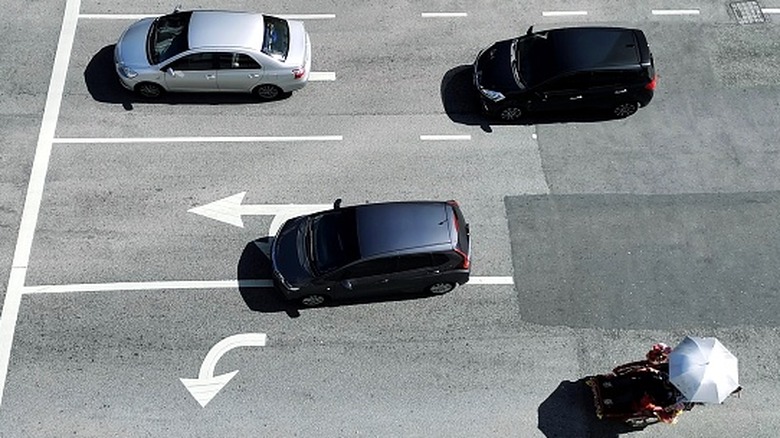
Steve — aka Steven Montiero, a former Florida Highway Patrolman turned traffic safety expert for Orlando's News 6 — starts with a catchy little epigram about how "A turn lane tells other drivers where you're allowed to go. Your signal tells them what you are about to do." The thought here is that a driver may have ended up in a designated turn lane by mistake, and could be about to do, well, who knows what to get back on track. From a safety standpoint, the belief is that having blinkers on gives other drivers — and bicyclists and pedestrians — more evidence of what the pilot of the "turning car" actually means to do.
True, that's not going to be 100% accurate — how many times have you seen folks driving straight for mile after mile with their turn signals on? — but even a little assistance can be a big help on a crowded road. That's why you should use turn signals even in roundabouts. Moreover, one of the most common situations in which people may be tempted to go without turn signals is turning left from a dedicated turn lane into an intersection.
Research by the Southeast Michigan Council of Governments noted that even though left turns aren't the most common accident scenario, they were still responsible for the most traffic fatalities and serious injuries in the study. Meanwhile, an earlier study carried out by the New York City Department of Transportation indicated that twice as many pedestrians and bicyclists were killed or seriously injured by left-turning vehicles than those turning right, and there were three times as many fatalities and serious injuries overall.