

This Statue Of A Trabant With Legs Will Absolutely Haunt Your Dreams
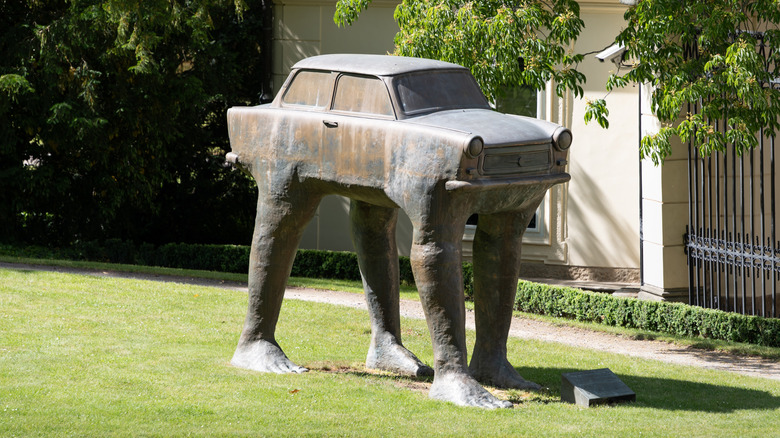
Despite appearances, the David Černý "Quo Vadis" sculpture is not simply the result of a terrifying fever dream. Nor is it just a silly monument to commemorate the environmentally unfriendly two-stroke Trabant that helped to mobilize thousands during the latter half of the 20th century. Instead, it signifies something altogether more important: movement of people.
In the second half of 1989, just before the fall of the Berlin Wall, East Germans living under the Soviet regime would travel to Prague, then in Czechoslovakia (now the Czech Republic) – and specifically the West German embassy — to return to the western half of a then-divided Germany. The former German Ambassador to Prague, Helmut Elfenkamper, described this movement as "the beginning of the end of the communism in Europe". "Quo Vadis", which literally means "where are you going?" in Latin, was erected in 1990 as a tribute to those refugees, who often left their Trabant compact cars behind the Iron Curtain. In this context, the human-legged Trabant connection becomes a little clearer. Yes, a statue of a family walking might've been a more accurate depiction of the times, perhaps even with a Trabant key dangling from the father's pocket, but then this is art.
The original sculpture, made from metal and fibreglass, resides in the city of Leipzig, in the now-reunified Federal Republic of Germany, but the bronze casting made in 2001 is arguably more famous. Standing in the gardens of the German embassy, where so many refugees flocked almost 40 years ago, it's a popular tourist attraction. The sculpture was actually moved almost 20 years ago, so those who visit outside of business hours can still see it through the railings. All that's missing for the full effect is a speaker, constantly blaring the joyfully bouncy two-stroke tone of the humble Trabant, but we suppose you could always pack a JBL.
The Trabant is a cult classic today
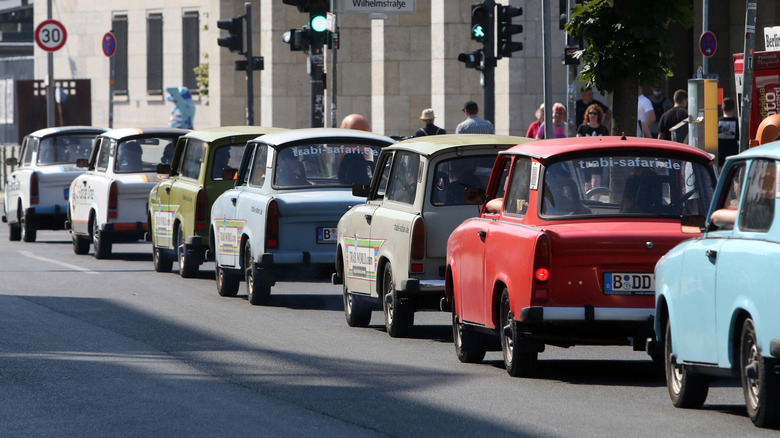
Not only was the mighty Trabant a great mobilizer of the people, but it's also a culturally significant symbol of motoring today. Like so many famous classic cars (the Beetle and 2CV spring to mind here), it was terrible in lots of ways. It was badly made, and a horrendous performer, but all of that hasn't stopped it from going down in history as a cherished icon.
Arguably the most iconic Trabi moment in history came in 1989 at the fall of the Berlin wall, when thousands jumped into their Trabant 601s and crossed the Bösebrücke at Bornholmer Strasse, one of the newly opened border crossing point. The sea of Trabants was a spectacle indeed, and it soon became a symbol of freedom, immortalized now in the form of David Černý's sculpture. And that isn't the only Trabi artwork of note: Birgit Kinder's iconic graffiti artwork on the Berlin Wall showed the Trabi breaking through from East Germany to the west.
With so many made, and such simple construction techniques, the iconic Trabant 601 is still remarkably cheap to acquire. In mainland Europe, usable examples exchange hands for as little as €1,000 (around $1,150). Now that all Trabant 601s are over 25 years old, they are also eligible to import. Fortunately, many other U.S. citizens have had this idea before, so there are some examples already in North America and available for you to pick up, should buying a Trabant in the U.S. appeal to you. This also side-steps the process of importing one yourself.
Generally speaking, only very smart examples get imported — why bother spending thousands to import a rough one? — and so prices are a little higher over here. Still, budget between $5,000 and $10,000 and you should be fine, although finding one for sale may take a short while.