

ZF 8 Speed Vs. Aisin 8 Speed Transmissions: How Do They Compare?
For a long time, most automatic transmissions were written off by enthusiasts thanks to their sluggish, slow shifts. There's a reason why they're commonly referred to as "slushboxes". But since the mid-to-late 2000s, automatic transmission performance has — thankfully — improved greatly, to the point where manuals are getting hard to find. According to the 2024 EPA Automotive Trends Report, manuals now account for less than one in every 100 new car sales in the U.S..
That's largely thanks to two particular 'boxes that have moved the dial and turned autos from pariahs to fully accepted parts of the automotive landscape. Perhaps surprisingly, we're not talking about fancy, quick-shifting, dual-clutch units, like those prominently found in Volkswagens, Porsches, some BMW M cars, and more. Nope, we're talking the conventional, torque converter-equipped ZF and Aisin eight-speed transmissions. But how do these two compare against each other?
Both are proven eight-cog systems that have a long and illustrious service record. But let's dig into what makes each of these transmissions great, where their shortcomings lie, and how they differ mechanically.
The Aisin eight-speed started it all
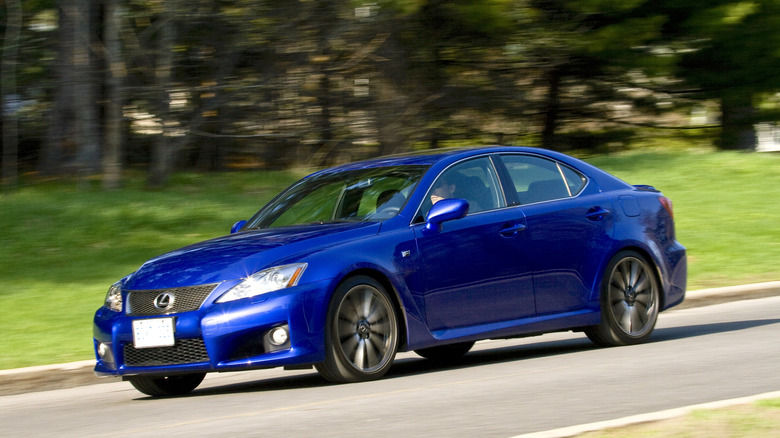
Turn the clock back to the 2008 model year. "Low" by Flo Rida (featuring T-Pain) was clogging up the airwaves, and the venerable Lexus ISF arrived on the U.S. market — the brand's first V8-powered sports sedan built to take on the BMW M3 and Mercedes-Benz AMG C63.
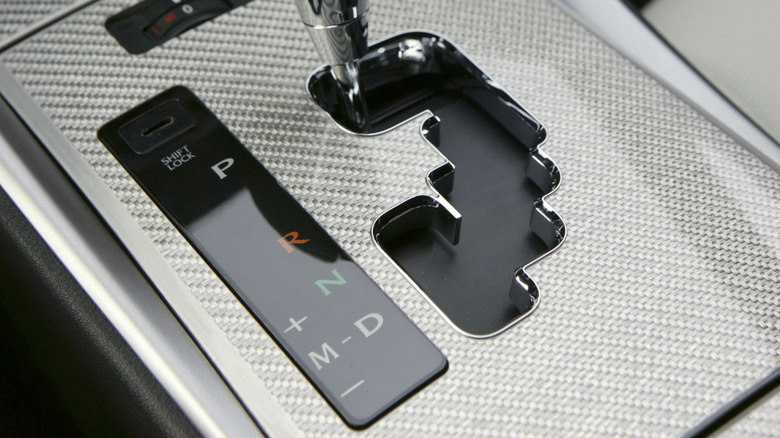
The F's high-card was its 416 naturally aspirated horsepower, but what made its hand so hard to beat was the eight-speed Aisin AA80E automatic transmission, the first of its kind. Finally, a conventional auto that overcame the slushbox trope, yet provided more than one overdrive gear to improve overall fuel efficiency. Just imagine what that 18 mpg combined economy would've been without so many ratios in there?
What also makes this 'box great is that shifts take as little as 100 milliseconds – a match for the Ferrari F430 when it debuted. Then, the torque converter is locked between gears two through eight, which means the car feels more a manual transmission when you roll off the throttle: You feel the compression. It also could withstand a respectable amount of torque for its day: 406 pound-feet.
That being said, the Aisin has some drawbacks. Thanks to its mechanical makeup, there are actually two shifts happening when the driver feels just one. This is because, as Motor Frontier explains, there is a major load transfer between two internal clutches, and the shifting involves two elements to disengage and two elements to engage simultaneously shifting between third and eighth gear. The complexity impedes smoothness. And while the 406 pound-feet torque limit isn't bad for stock power, increasing output via aftermarket tuning can get near or even exceed that figure quite easily.
The ZF 8HP goes a small, quick step further
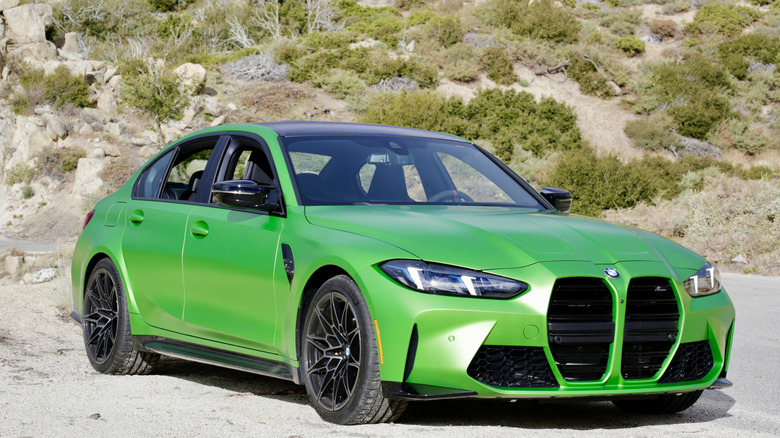
In a sense, the Aisin transmission walked so ZF's 8HP could run. It's in service in the current G8X-generation BMW M3 and M4, and many other past and current Bimmers, as well as other brands' products, with power outputs ranging from mundane to mega.
Having made its debut in 2009, the ZF unit is both lighter and simpler than the Aisin, which lends to faster shifts. The AA80E weighs 209 pounds, whereas the 8HP weighs 176. As pointed out by FCP Euro, only three of five total shift elements are used in any gear, which cuts down on drag and bolsters smoothness. By comparison, the Aisin's computer has to actuate four. While ZF 8HP shift times are programmed by some automakers to be around 200 milliseconds, performance models' vary between 50 and 150 milliseconds. The Aisin's 100-millisecond minimum shift time puts it right in the middle of that range. Fast, but not as fast as the ZF can be.
In terms of selecting which is better, it really comes down to personal preference. Not only in regards to one's desired shift times, but also how they feel. This author has experienced both in a myriad of vehicles, and while the Aisin is a hair slower, it's not enough to completely write off. Both transmissions are regarded as reliable as long as they see regular service and don't deal with more power than they're designed for. Perhaps most importantly, they both definitely put the old slushbox connotation to bed.