

How An Engine From 1816 Paved The Way For The Refrigeration Revolution
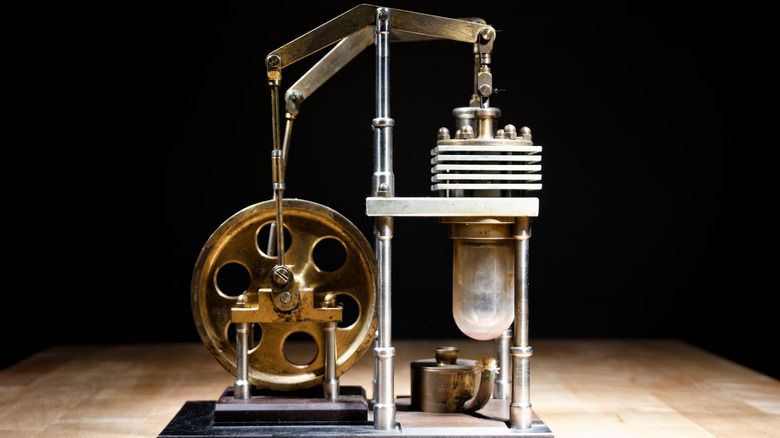
Refrigeration is commonplace in the modern era. We use it to keep our food from spoiling, to cool our homes and workplaces, and to keep our car cabins from becoming saunas. There are even specific in-car refrigerators, although many of them aren't very good. While modern refrigeration is a relatively novel technology, only really becoming widespread in the early 20th century, humans have been toying with the idea since the ancient times. However, one of the earliest mechanical systems of cooling wasn't evaporative cooling, like we use today. It was a different method that actually came from an engine that was invented over 200 years ago.
In 1816, Scottish inventor Robert Stirling patented the Stirling engine, which was originally designed to pump water into a quarry. It was an external combustion engine that was also intended to replace steam engines of the time, since it was safer and more efficient. Unfortunately for Stirling, his engine never caught widespread demand and was eventually made obsolete by internal combustion engines and electric motors. But it did create an unexpected alternative idea: cooling. And its unique system of moving cold air around paved the way for modern air conditioning as we know it.
How did the Stirling engine create colder temperatures?
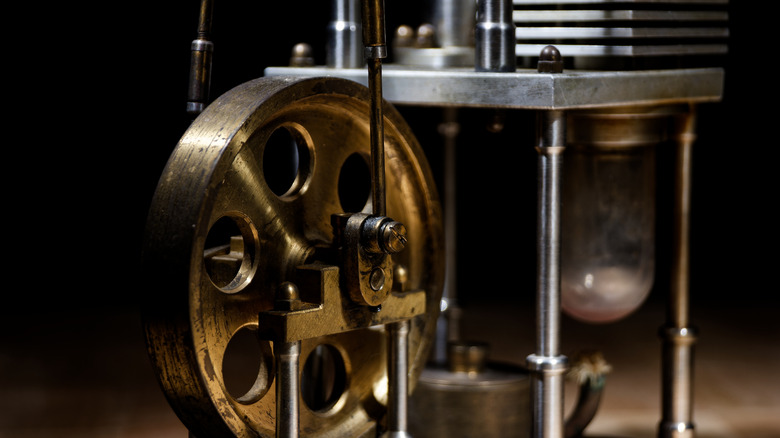
A Stirling engine in its most basic form is essentially a single cylinder with a piston-style "displacer" inside of it. The displacer isn't airtight, so there's a small air gap between it and the cylinder walls. Above and below the cylinder are metal plates. The bottom plate is warmed by an external heat source underneath it, and on the top plate is a piston attached to a wheel that's connected to the displacer. As the bottom plate warms, it heats the air at the bottom of the cylinder, which expands the air and pushes the piston up, turning the wheel and pushing the displacer back down.
As the displacer goes down, the hot air inside the cylinder rises to the top and the heat escapes through the top metal plate into the room's ambient air. That cooling effect sucks the piston back down, which then turns the wheel, and brings the displacer back up. As the displacer rises, it forces the air back down to the bottom of the cylinder, where it's reheated and the process repeats. That process will turn the wheel for as long as there's a temperature differential between the top and bottom plates. And it works in reverse, too, if the top plate is hot and bottom plate is cold.
How does that create cold air, though? Well, if you manually or mechanically turn the wheel instead of using a temperature differential, the moving air inside the cylinder will make one plate hot and one plate cold. If you scale that up by using a big Stirling engine with an electric motor to drive the wheel quickly, you can theoretically harness the cold air created from one of the plates.
Modern refrigeration uses evaporative cooling, but the Stirling engine is still used
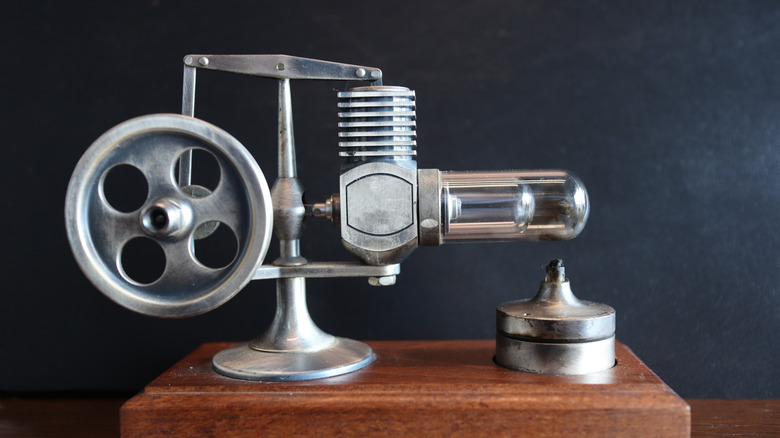
Once evaporative cooling using liquid refrigerant was figured out in 1834 by American inventor Jacob Perkins, the Stirling engine's cooling usage was mostly killed off. Evaporative cooling still works by transferring heat from one place to another – it just does so with liquid chemicals (some of which are safer than others) that evaporate at low temperatures and pressure.
Evaporative cooling is actually far older than the Stirling engine. It's as old as 2,000 BCE, in fact, with ancient civilizations storing liquid in clay pots which were soaked in water. That water would evaporate, drawing heat away from the the pot and cooling the liquid inside. However, the Stirling engine's transfer of hot and cold air from one area was the precursor to using evaporative cooling to send that colder air somewhere else.
There are still some uses for Stirling-style engines, but most of them have to do with generating efficient mechanical power without the use of internal combustion. Some submarines use Stirling engines to generate power underwater, as diesel engines in those submarines need air. There are a few applications where Stirling engines are used for cooling, too. Stirling Cryogenerators can generate temperatures as low as -258 degrees Celsius, though they're far more advanced and complex than Robert Stirling's original design. Some companies are even looking into highly efficient Stirling-style engines to create air refrigeration without using chemicals that pollute the earth – but the purposes of those engines are far from commercial.